


Choose the right bilge pump without guessing. This guide helps you match pump size, pump type, layout, and backup features to your boat, plus how you’ll actually use it from day to day. That matters. Marine bilge pumps aren’t one-size-fits-all, and a small skiff, a center console, a sailboat, and a commercial fishing boat can all need very different setups.
This tutorial covers selection, not full installation or maintenance. By the end, you’ll know how to measure your needs, compare pump ratings, avoid common buying mistakes, and put together a better pumping plan. You’ll also see how published pump numbers can mislead buyers in real use. If you’re shopping through First Choice Marine or trying to decide what to buy before replacing an old unit, this step-by-step guide will help you make a safer choice.
Before You Start
Before comparing marine bilge pumps, gather a few basic details about your boat and setup.
- Your boat’s length, beam, and basic hull type
- A rough count of how many bilge areas or compartments your boat has
- Access to your current pump label, if one is already installed
- A tape measure to check hose run length and discharge height
- Your battery voltage, often 12V or 24V
- A notepad or phone to record hose size, fuse size, and wiring path
- Your owner’s manual, if you have it
Tip: If the boat is used offshore, at night, in rough weather, or for work, it needs more pump capacity and more backup than the minimum.
Step 1: Identify what kind of water problem you are planning for
Start by getting clear on the job. A bilge pump won’t fix a major hull breach, but it will remove the normal water that collects from spray, rain, shaft seals, plumbing drips, washdown runoff, and minor leaks fast enough to keep the bilge under control.
Think about these questions:
- Do you boat on calm inland water or offshore?
- Do you leave the boat in the water between trips?
- Do you have one bilge area or several compartments?
- Do you run long distances where help may be far away?
- Is this a recreational boat or a regulated commercial vessel?
For commercial users, regulations give useful capacity benchmarks. Under 46 CFR §169.667, some minimums include 10 gpm for boats from 26 ft to under 40 ft, 25 gpm for 40 ft to under 65 ft, and 50 gpm combined for certain vessels 65 ft to under 120 ft with two fixed power bilge pumps.
| Vessel Size | Minimum Pump Capacity | Pump Arrangement |
|---|---|---|
| 26 ft to under 40 ft | 10 gpm | Fixed hand or power bilge pump |
| 40 ft to under 65 ft | 25 gpm | Fixed power bilge pump |
| 65 ft to under 120 ft | 50 gpm combined | Two fixed power bilge pumps |
Even on a recreational boat, those numbers can still help when planning. For a wider safety view, read Marine Bilge Pumps and Boat Safety after this guide.
Common mistake: Buyers choose a pump based only on boat length. That’s not enough. Actual risk also depends on how the boat is used, how the compartments are laid out, and how much exposure the boat faces.
Step 2: Measure your bilge layout before you choose a pump size
Check the real space. Look at the low spots where water collects. Many owners think they have one bilge, but the boat actually has two separate areas, or sometimes more. That changes the choice fast because one big pump in the wrong place can still leave water sitting somewhere else.
Measure these items:
- Bilge depth at the lowest point where a pump can sit.
- Horizontal hose run from the pump to the discharge fitting.
- Vertical lift from the pump to the hull outlet.
- Number of bends and fittings in the hose route.
- Current hose inside diameter.
BoatUS technical guidance warns that installation losses can cut actual output a lot. Long hose runs, extra lift, sharp bends, small hose, and rough hose walls all reduce flow once the system is installed. A pump rated for a certain gallons-per-hour number on the box may move much less water after it’s set up on your boat.
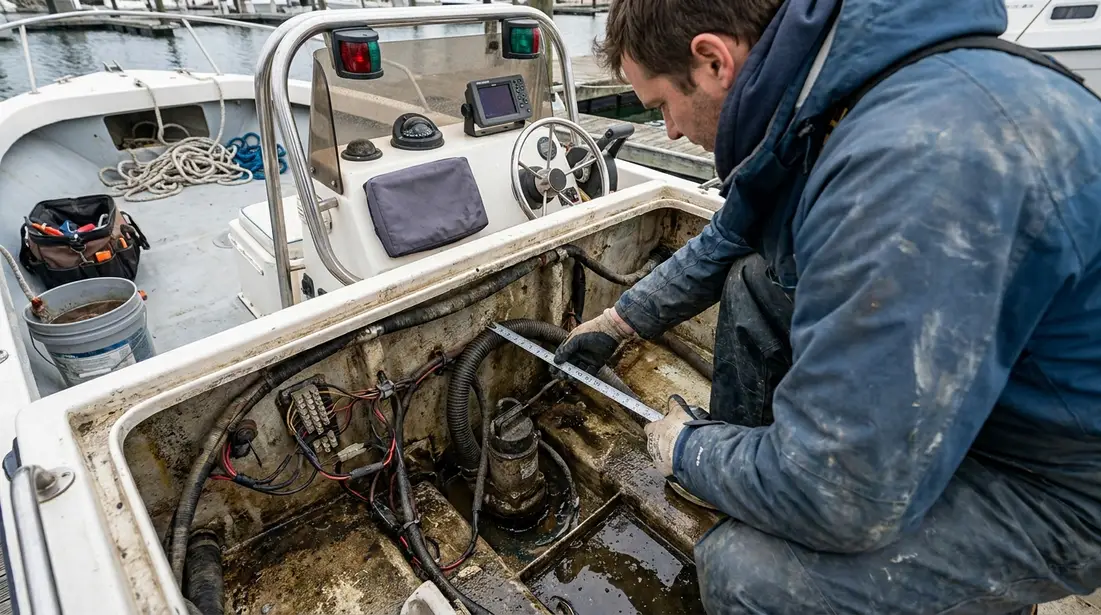
Tip: Choose the largest practical hose diameter your pump supports. Keep the run short. Use smooth-bore hose where you can.
Common mistake: Some owners upgrade the pump but keep an undersized discharge hose. That can cancel out the upgrade.
Step 3: Choose the right pump type for how you use your boat
Pick the pump style that fits how you really use your boat. For most owners, that means choosing a standard centrifugal electric pump, an automatic pump with built-in sensing, or a pump that uses a separate float switch. On some larger or commercial boats, a diaphragm or self-priming pump is needed in certain parts of the system. Most small recreational boats do not need that. They use centrifugal pumps.
Use this quick rule:
- Small trailer boats and jon boats: may use one small automatic electric pump
- Center consoles and bay boats: generally do best with an automatic main pump and a backup plan
- Cabin boats and cruisers: may need more than one pump in more than one location
- Commercial or fishing boats: should be matched to applicable regulations and service conditions
One regulation says it plainly:
Each vessel must be equipped with a bilge pump and bilge piping capable of draining any watertight compartment... under all service conditions.
The same idea applies to every owner. Your pump should still work at the dock and while the boat is moving, loaded, or heeled.
If automatic setups still feel unclear, Automatic Bilge Pumps vs Manual: Real Failure Scenarios & Redundant Design is a helpful follow-up read.
Common mistake: Choosing manual-only pumping for a boat that stays in the water. Rain or a small leak can start when nobody is around. That can be a risky setup.
Step 4: Size the pump for real-world flow, not just the box rating
Many people compare pumps by GPH alone, but that number is often measured under ideal conditions. In real use, output drops once water has to move uphill and pass through hose and fittings.
A practical beginner approach is:
- Pick the largest pump that fits your bilge space and wiring system.
- Use the discharge hose size the pump maker specifies.
- Keep the hose run as short and straight as possible.
- Add capacity if you boat offshore or carry heavy loads.
- Use more than one pump if your boat is larger or has separate compartments.
For fishing vessels, things get more specific. Vessels under 79 ft must have a pump and piping system that can drain any watertight compartment under all service conditions. For vessels 79 ft or more, the requirement is a fixed, self-priming, powered bilge pump connected to a bilge manifold. Also, each bilge suction line strainer needs an open area of at least three times the open area of the suction line.
That figure matters for everyday boaters too. A clogged or undersized strainer can cut performance fast, and then the pump may seem weaker than it really is.
Tip: Treat the pump rating on the package as a best-case starting point, not a promise.
Troubleshooting note: If your current pump seems weak, the issue may be hose lift, battery voltage drop, or debris rather than the pump alone.
Step 5: Plan for redundancy, alarms, and battery power
A good bilge setup needs to work as a full system, not just as a single pump. Automatic operation helps a lot, but it should never be your only layer of protection. BoatUS guidance recommends wiring automatic bilge pumps directly to the battery instead of having them run only through the distribution panel. The reason is simple: the pump can still run when the main panel is off.
You should consider adding:
- A second pump mounted slightly higher as a backup
- A high-water alarm for early warning
- A separate float switch or electronic sensor if your pump doesn’t include one
- A fuse sized to the pump maker’s spec near the power source
- A manual override switch at the helm
On multihull or compartmented vessels, redundancy matters even more. Regulations require each hull of a multihull vessel to have at least two ways to pump the bilges in each hull. Another regulation says that if engines and boilers are in two or more watertight compartments, pumps must be spread across those spaces.
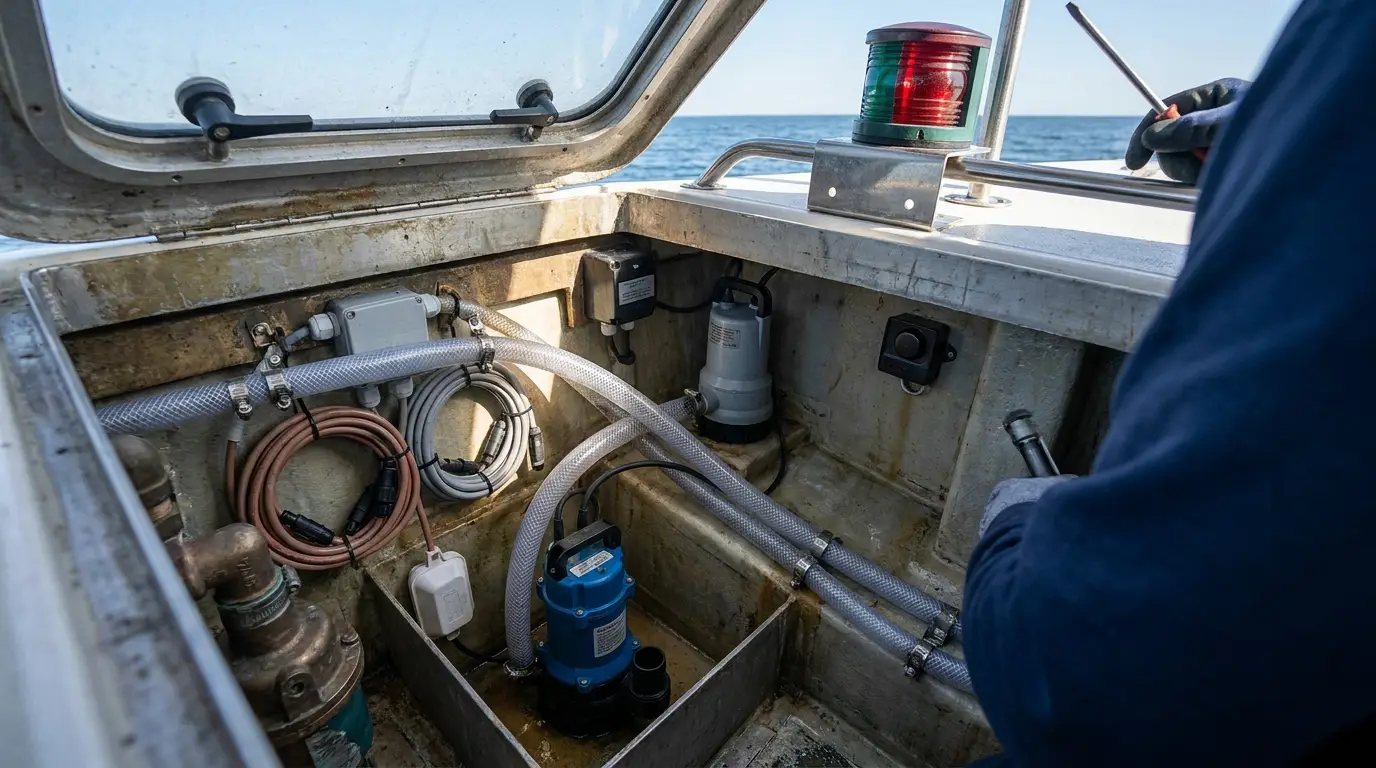
Common mistake: Owners install one large pump low in the boat and assume it will handle every compartment.
Step 6: Check the discharge setup and backflow protection
Your pump choice only works if the discharge path is set up properly. In normal use, the outlet should stay above the waterline, and ideally above the heeled waterline too, not just when the boat is sitting level. Practical Sailor’s summary of ABYC H-22 guidance says pump placement and discharge routing still need to remove water when the boat heels. If the outlet can’t stay above the heeled waterline, the system may need a vented loop.
Backflow matters as well. Some regulations require a non-return valve or swing check valve between the sea connection and the bilge main so seawater does not run back into the bilge. Check valves can reduce flow, so use them with care and only where they match the system design.
Tip: If you add a check valve, keep in mind that it may reduce effective pump output. Keep the rest of the hose route efficient.
If there is weak discharge, cycling, or water running back into the bilge, review Marine Bilge Pumps: Troubleshooting Common Problems.
Step 7: Compare features that actually matter when buying
When comparing marine bilge pumps, focus on the features that affect day-to-day use:
- Voltage: match it to your boat’s system
- Rated capacity: use it as a guide, not the full story
- Hose outlet size: bigger can be better if space allows
- Automatic sensing: built-in or external switch
- Current draw: key for battery reserve
- Pump footprint: it needs to fit the bilge properly
- Service access: leave room to inspect it and clear debris
- Strainer design: easy cleaning matters
A trusted marine parts retailer can help here too. On this online marine parts store, buyers can compare pumps and related system parts in one place. That makes it easier to match the hose, switch, wiring and accessories instead of buying each part separately. It’s much simpler.
Common mistake: Buyers pick the cheapest pump, then forget the switch, fuse, hose and outlet fitting that help it work properly.
Frequently Asked Questions
What size bilge pump do I need for my boat?
Start with your boat’s size, but do not stop there. You also need to factor in hose length, lift height, compartment layout, and how you use the boat. In many cases, the largest practical pump that fits your space and wiring is the better choice.
Are automatic bilge pumps better than manual pumps?
For most modern boats, yes. Automatic pumps offer protection when you are not watching the bilge, especially if the boat stays in the water. But they work best when paired with a high-water alarm and a manual override switch.
Why does my bilge pump move less water than its rating says?
Because the box rating is usually measured in ideal conditions. Real boats add hose lift, bends, fittings, voltage drop, and sometimes check valves, all of which reduce actual flow. That is why installation details matter so much.
Should I install one big pump or two smaller pumps?
Two pumps are often smarter than one, especially on larger boats or boats with more than one low area. A lower pump can handle routine water, while a higher backup pump comes on if water rises. This also gives you redundancy if one pump fails.
Where can I compare marine bilge pumps and related parts?
A marine-focused retailer like First Choice Marine can make comparison easier because you can look at pumps, float switches, hose, wiring items, and related accessories together. That helps you build a complete system instead of replacing only one part.
Do I need a smart bilge monitor or high-water alarm?
A high-water alarm is a smart upgrade for many boats, especially cruisers, offshore boats, and commercial rigs. Smart monitoring is also becoming more common, with newer products offering alerts and diagnostics rather than simple on-off pumping alone. First Choice Marine is a useful place to watch for bilge system options as boat owners move toward more connected safety gear.
Make Sure Your Choice Works Before You Trust It
After you choose your pump, check the full setup. Make sure it fits the bilge, the hose size is correct, the discharge route is short and clear, the wiring is right, and the outlet sits above the waterline like it should. Then test everything with clean water before your next trip.
A good result is easy to see. The pump should switch on when needed, push water out with real force, shut off the right way, and leave only a small amount behind that it can’t pick up. If your boat has a backup pump or an alarm, test those at the same time.
The next steps are simple. Write down your current setup, replace weak parts as a full system, and upgrade for your real boating conditions, not just the minimum. That way, your marine bilge pumps do their job when the water gets rough.
