


Table of Contents
- Why Upgrade Marine Electronics on Older Center Consoles
- Quick Comparison: Top Marine Electronics for Older Center Consoles
- Best Fishfinder for a Center Console: In-Hull and Transducer Options
- Chartplotter for Small Center Console: GPS and Navigation Systems
- VHF Radios and Communication Equipment
- NMEA 2000 Network for Older Boats: Integration Without Full Rewiring
- Marine Electronics Installation: Mounting, Wiring, and Retrofit Planning
- Audio, Lighting, and Accessory Electronics
- Frequently Asked Questions
Last Updated: October 10, 2026
Why Upgrade Marine Electronics on Older Center Consoles
Older center consoles often lack integrated navigation and fish-finding capabilities, relying instead on fragmented systems: separate GPS units, standalone fish finders, and awkwardly mounted VHF radios. These setups create clutter, consume valuable helm space, and leave safety gaps when equipment fails independently.
The good news: upgrading marine electronics for older center consoles doesn't require a complete rewire or a visit to a marine contractor. Modern systems are designed with retrofit installations in mind. According to Strategic Market Research's 2026 analysis of marine console systems, integrated electronics reduce installation complexity by 16.4% compared to legacy piecemeal setups, and many of today's solutions work alongside your existing equipment rather than replacing it entirely.
The marine electronics market reached USD 7.71 billion in 2026, driven largely by owners of older vessels seeking modern capabilities without full refit expense.
Quick Comparison: Top Marine Electronics for Older Center Consoles
| Category | Best Pick | Price | Key Advantage | Best For |
|---|---|---|---|---|
| VHF Radio | Icom M430 | $666.24 | Compact flush-mount, NMEA 2000 ready | Tight helm spaces |
| VHF + AIS + GPS | Furuno FM4800 | $731.84 | All-in-one, loudhailer, dual-station capable | Full-featured comms |
| In-Hull Transducer | Raymarine P79s | $518.69 | No hull drilling, NMEA 2000 output | Trailered boats |
| Display Mount | NavPod PowerPod | $456.70 | Waterproof seal, swivel base, UV resistant | Electronics protection |
| Electronics Mount | Rod Boss Double | $169.84 | Dual-display capability, ball-socket adjustment | Limited console space |
| Marine Stereo | Rockford Fosgate PMX-3 | $696.67 | IPX6 waterproof, Bluetooth, 2.7" display | Audio + connectivity |
| VHF Antenna | Shakespeare 5241-R | $120.06 | 3 dB gain, compact 36" profile | Center console fit |
| Storage Box | Taylor Made #83558 | $677.68 | 27"x26" fiberglass, lockable, weatherproof | Electronics + gear storage |
Best Fishfinder for a Center Console: In-Hull and Transducer Options
The best upgrade for fishing-focused older center consoles is an in-hull transducer paired with a modern chartplotter, eliminating the need to drill through the hull.

The Raymarine P79s In-Hull Depth Smart XD ($518.69) mounts inside the hull with a plastic base filled with non-toxic antifreeze, transmitting sonar signal through solid fiberglass without external protrusions. The 235 kHz frequency prevents interference, and the 7-degree beamwidth provides accurate depth readings to 150 meters on NMEA 2000 networks. For trailered boats, this approach protects the transducer from damage.

Installation takes a few hours: locate a spot on the inside of the hull aligned with the centerline, secure the mounting base, fill it with antifreeze, and insert the transducer. The hand-adjustable base lets you dial in the proper deadrise offset. This works best on solid fiberglass hulls up to 25 feet; cored hulls require an external transducer.
Before ordering any transducer, confirm your hull construction. Tap the inside of the hull near your proposed mounting spot. Solid fiberglass sounds dull and dense; cored hulls sound hollow. If you're unsure, an in-hull unit is still safer than drilling a through-hull fitting on an older boat where you can't inspect the interior for hidden damage.
Connect the P79s to a compatible chartplotter via NMEA 2000 or NMEA 0183 to display depth, temperature, and sonar data on a single screen, eliminating the need for a standalone fish finder.
Chartplotter for Small Center Console: GPS and Navigation Systems
Modern chartplotters are dramatically smaller and more powerful than units from five years ago. For older center consoles, a compact 7-inch or 8-inch display paired with a slim VHF radio is ideal.
The Icom M430 Fixed Mount VHF Radio With Built-In GPS ($666.24) integrates with legacy equipment without complete rewiring. The built-in GPS and NMEA 2000 connectivity feed position data to a separate MFD or serve as your primary navigation source. The compact 202 x 82 x 52.6 mm body fits tight side-pod installations, and the color TFT LCD with three display modes remains readable in direct sunlight or darkness.
For a dedicated chartplotter, pair a small 7-inch MFD with a simple VHF radio.
VHF Radios and Communication Equipment
A reliable VHF radio is essential safety equipment. Older center consoles often have aging units with limited features, poor audio, or corroded connectors. Upgrading to a modern VHF radio with Class D DSC and integrated GPS adds safety and functionality.
The Furuno FM4800 VHF AIS GPS Loudhailer NMEA 2000 ($731.84) combines a 25-watt VHF transceiver, built-in GPS, AIS receiver, and 30-watt loudhailer in one unit. The AIS receiver displays other vessels on your chartplotter, a critical safety feature in crowded anchorages. The loudhailer with intercom is useful for helm-to-bow communication.
The FM4800's NMEA 2000 connectivity integrates seamlessly with compatible chartplotters and fish finders. With a Furuno NavNet TZtouch2 MFD, you can initiate DSC calls by tapping an AIS target.
The FM4800 mounts on a lightweight bracket, desktop, overhead, or flush-mounted. For NMEA 0183 equipment, the FM4800 outputs position and AIS data to legacy chartplotters and fish finders without forcing replacement of working electronics.
The Shakespeare 3' VHF Antenna (#5241-R, $120.06) offers a compact 36-inch profile with 3 dB gain, adequate for most recreational fishing boats. It includes a 15-foot RG-58 cable and PL-259 connector. For corroded antenna connectors, the Shakespeare G/P PL-259 Connector (#PL-259-CP-G, $19.44) provides a solderless, gold-plated replacement resisting salt-spray degradation.
NMEA 2000 Network for Older Boats: Integration Without Full Rewiring
NMEA 2000 networks solve the rewiring concern by connecting modern equipment with a single backbone cable, eliminating individual wires from each device to a central switch panel.
NMEA 2000 is a plug-and-play marine networking standard where each device (VHF radio, chartplotter, fish finder, autopilot, engine monitor) connects to a central backbone using standardized connectors. Data flows automatically between devices without custom wiring.
Icom M430 Fixed Mount VHF Radio With Built-In GPS Black #M430 11 USA →
For older center consoles, you can add a modern chartplotter, upgrade your VHF radio, and install a new fish finder without rewiring your entire helm. The Icom M430 and Furuno FM4800 both feature NMEA 2000 certification and NMEA 0183 compatibility.
If your boat has an older electrical panel, you won't replace it. Instead, run a NMEA 2000 backbone (a single twisted-pair cable with terminator blocks) along the console, connect new electronics to it, and keep existing power distribution untouched.
Marine Electronics Installation: Mounting, Wiring, and Retrofit Planning
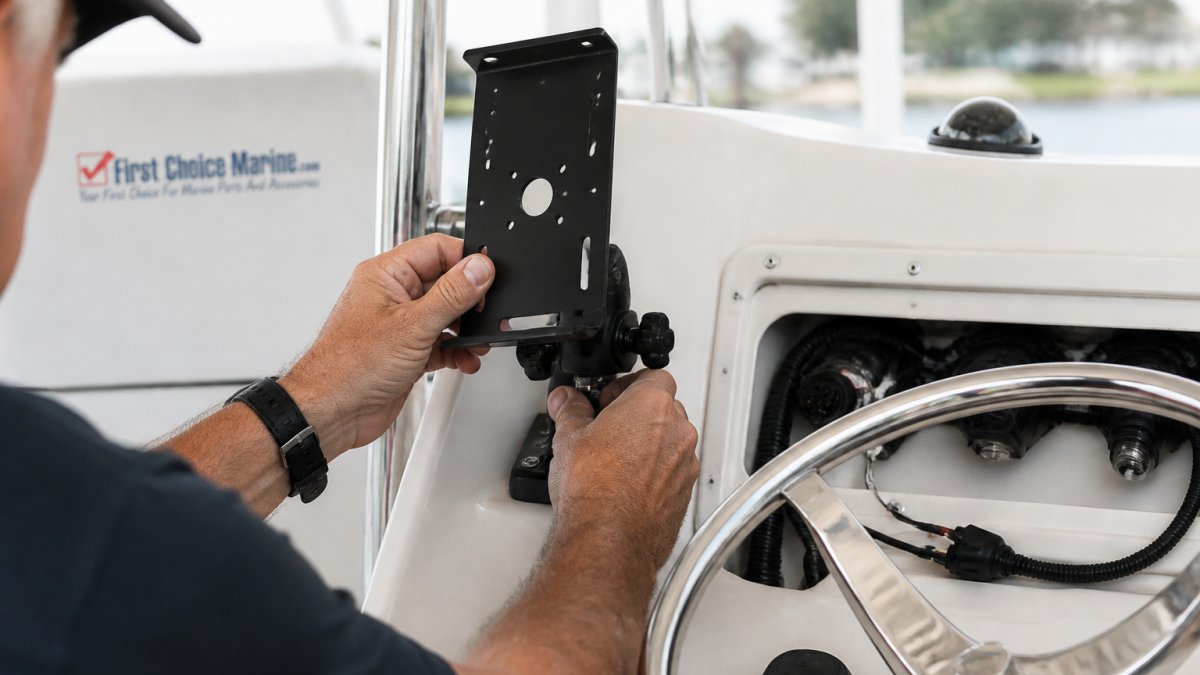
Installing electronics on an older center console requires planning to avoid water ingress and protect connectors from saltwater spray while working within limited space and potentially corroded wiring.
The Rod Boss 2.5 Ball Socket Horizontal Double Electronics Mount (#6025EM-DS-H, $169.84) is ideal for adding two displays without consuming additional console space. The 2.5-inch ball socket system allows infinite angle adjustment, and the marine-grade construction withstands saltwater exposure and UV radiation.
NavPod PowerPod Pre-Cut mounts are custom-molded to fit specific displays and offer a waterproof seal protecting electronics from spray. The double gasket system creates a watertight barrier, and the acrylic-capped ABS material resists UV degradation.

Before adding new electronics, inspect your power distribution. Confirm your battery bank can supply the current your new VHF radio (5+ amps on transmit) and fish finder (3-5 amps) will draw.
Run new electronics cables through conduit or cable trays, away from engine heat and raw-water plumbing. Secure connectors with stainless steel hardware and apply dielectric grease. Avoid daisy-chaining power; run individual wires back to the battery to prevent intermittent failures from corrosion.
If your older center console has a hard top, mounting a VHF antenna and GPS receiver at the highest point improves signal reception dramatically. The Shakespeare 3' VHF Antenna (#5241-R, $120.06) mounts easily on a ratchet bracket.
Audio, Lighting, and Accessory Electronics
Once you've handled navigation and safety, audio and lighting round out your electronics upgrade. The Rockford Fosgate Punch Marine AM/FM/WB Digital Media Receiver (#PMX-3, $696.67) is a compact, waterproof head unit designed for the marine environment. The 2.7-inch full-color TFT display is optically wet-bonded to prevent dust and moisture penetration, and the unit is IPX6-rated and salt-fog tested to ASTM standards.
The PMX-3 features Bluetooth audio streaming, SiriusXM readiness, and Pandora control via smartphone. The internal 4x45-watt amplifier is adequate for a small center console cabin or tower speakers. A waterproof rotary encoder knob with white LED illumination makes operation intuitive in bright sunlight or complete darkness. For older boats with corroded stereo installations, this unit is a plug-and-play replacement that brings your audio system into the 2026 era without custom fabrication.
Lighting upgrades are often overlooked but improve both safety and usability.
For electronics storage, the Taylor Made Electronics Box (#83558, $677.68) is a practical solution for center consoles. The 27"x26"x10" fiberglass box with an RTM-molded design provides weatherproof storage for spare parts, cables, and accessories. The lockable front door with weather-protecting seals keeps saltwater spray and UV exposure away from sensitive equipment.
Upgrading marine electronics on an older center console is achievable without a complete refit. Start with navigation and safety, a modern VHF radio with GPS and an in-hull transducer solve most functional gaps. Layer in audio and storage as budget allows. First Choice Marine stocks the mounting hardware, connectors, and protective enclosures that make retrofits practical.
Frequently Asked Questions
What marine electronics should an older center console boat have?
Older center consoles benefit from VHF radio with GPS for safety and navigation, a fishfinder or sonar system for fishing, and a chartplotter for route planning. If your boat has solid fiberglass and space constraints, in-hull transducers like the Raymarine P79S work without external hull modifications. Prioritize equipment that integrates via NMEA 0183 or NMEA 2000 to avoid complete rewiring. Start with navigation and communication, then add fishfinding capability based on your use case.
Can you install a modern chartplotter on an older boat with legacy wiring?
Yes, modern chartplotters can work on older boats if you check compatibility with your existing electrical system and network standards. Many newer units support both NMEA 2000 and NMEA 0183, allowing them to connect to older equipment without replacing all wiring. Use a NavPod display mount like the PowerPod series to protect the back of the chartplotter from saltwater spray and UV exposure. Verify your boat's 12V or 24V power supply can handle the new unit's current draw before installation.
What is the best fishfinder for an older center console?
The Raymarine P79S in-hull transducer is ideal for older center consoles because it requires no hull drilling or external protrusions, making it perfect for trailered boats. It delivers depth data to multiple displays via NMEA 0183 or NMEA 2000, integrating with existing chartplotters without rewiring. For boats up to 25 feet with solid fiberglass hulls, in-hull installation avoids corrosion issues common with through-hull transducers on older vessels. Choose a 235 kHz frequency to prevent interference with other onboard sonar systems.
How do you upgrade marine electronics without replacing the whole system?
Upgrade one component at a time, starting with the device that improves safety or fishing most for your use. Use NMEA 2000 or NMEA 0183 connections to integrate new equipment with existing systems instead of rewiring everything. The Icom M430 VHF radio and Furuno FM4800 both support NMEA 2000, allowing them to share data with older chartplotters and fishfinders. Install display mounts like NavPod PowerPods to protect new electronics from spray while keeping your console layout clean. This modular approach spreads costs and minimizes installation downtime.
What should you check before installing electronics on an older boat?
Verify your boat's electrical system voltage (12V or 24V) and available amperage to ensure new equipment won't overload the battery or alternator. Inspect existing wiring for corrosion, especially around connectors and through-hull fittings. Check console space and mounting surfaces for compatibility with new displays or radios; older center consoles often have tight clearances. Confirm that legacy NMEA 0183 or NMEA 2000 connections exist, or plan for a new network backbone. Test that your hull material is solid fiberglass if using in-hull transducers. Document existing antenna locations to avoid signal interference from new VHF or radar installations.
