


Table of Contents
- What You'll Need Before Buying Marine Parts Online
- Step 1: Verify Sellers on Reputable Marine Parts Websites
- Step 2: Run a Marine Parts Compatibility Lookup Before You Order
- Step 3: Decide Between OEM vs Aftermarket Boat Parts
- Step 4: Check Secure Payment and Shipping Terms at Checkout
- Step 5: Read the Boat Parts Return Policy Before You Pay
- Common Mistakes to Avoid When Buying Marine Parts Online
- Frequently Asked Questions
Last Updated: October 8, 2026
What You'll Need Before Buying Marine Parts Online
Buying marine parts online safely starts with two numbers that live on your boat, not in your inbox. According to Stratview Research's Recreational Boat Parts and Accessories Market Report, the recreational boat parts and accessories market reached $17.7 billion in 2025 and is expected to hit $18.9 billion in 2026. That scale means thousands of sellers, and a meaningful share of them are not legitimate. At First Choice Marine, we've spent over 100 years in marine hardware.
The good news: a five-minute prep step prevents most of them. Before you open a single product page, collect your documentation.
Gather Your Engine and Hull Identification Numbers
Your Hull Identification Number (HIN) is a 12-character code stamped into the transom, usually on the upper right side. Your engine's serial number sits on a plate on the cowling or mounting bracket. Write both down before you shop.
Why it matters: marine parts are rarely universal. A water pump kit for a 40 hp Mercury four-stroke won't fit a 60 hp, even though the listings look nearly identical. Without your exact numbers, you're guessing.

- HIN from the transom
- Engine serial number and horsepower
- Engine year and model
- Photos of the failed part from two angles
Step 1: Verify Sellers on Reputable Marine Parts Websites
Reputable marine parts websites share a handful of traits: a physical business address, a working phone number, manufacturer-authorized product lines, and clear warranty language. If a storefront is missing two or more of those, walk away.
The stakes are real. A Trawler Forum thread on a scam boat parts website describes a site that pulled buyers in with unusually low prices and then raised concerns during checkout. That's an individual report, not a formal investigation, but the pattern shows up often enough to treat as a warning sign.
Red Flags That Signal a Scam Storefront
- Prices far below every other seller for the same part number
- No physical address or only a PO box
- Payment accepted only by wire transfer, gift card, or cryptocurrency
- No returns page, or a returns page with vague, contradictory terms
- Product photos lifted from manufacturer catalogs with watermarks cropped out
- A domain registered within the last few months
One more: check whether the site lists an actual manufacturer part number. Legitimate sellers publish SKUs and UPC codes. Our Mercury Marine Water Pump Complete Kit #46-812966A12, for example, carries both a normalized SKU and a UPC, which lets you verify the part against Mercury's own catalog before you buy.
Step 2: Run a Marine Parts Compatibility Lookup Before You Order
A marine parts compatibility lookup is the process of matching a part number to your specific engine or hull using manufacturer fitment data. It takes about two minutes and prevents the most expensive mistake in online parts buying: ordering something that arrives, looks right, and doesn't fit. Verifying these technical specifications serves as a foundational practice that complements general online shopping tips for navigating the complexities of the digital marketplace.
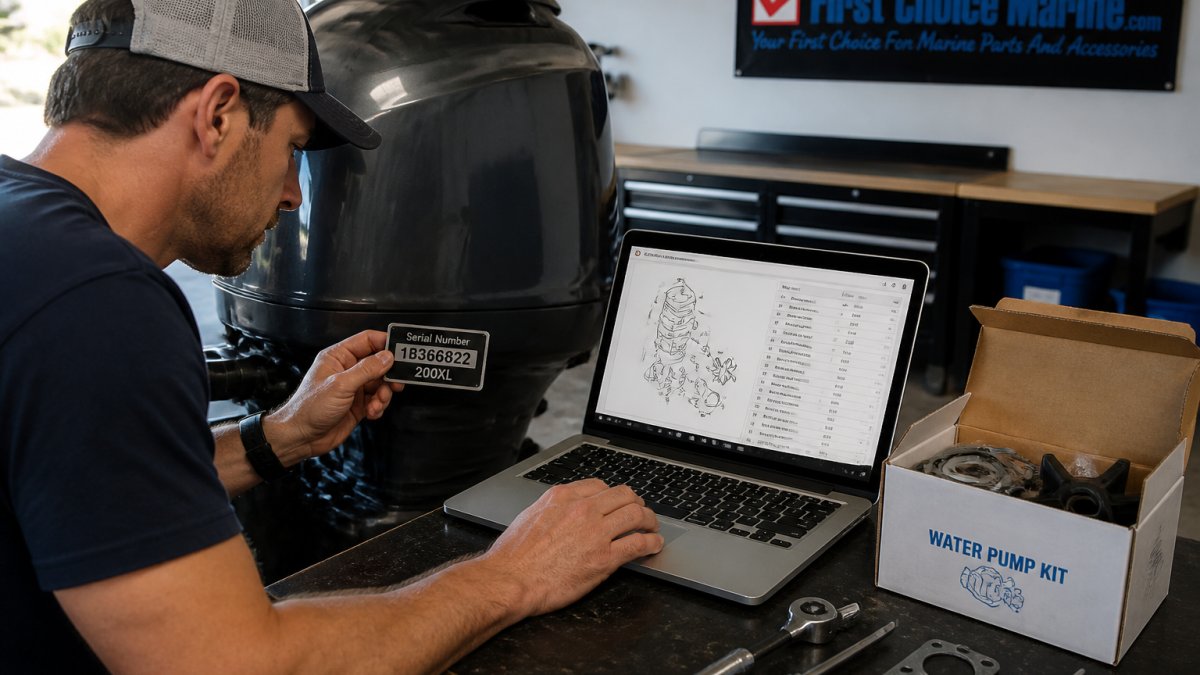
Here's how we'd run it:
- Enter your engine serial number into the manufacturer's parts diagram
- Note the exact part number the diagram returns
- Search that part number, not a generic description like "water pump kit"
- Confirm the listing's stated horsepower and year range covers your engine
- Check the UPC against the manufacturer's catalog
That last step catches counterfeit and mislabeled listings. A Reddit r/boating discussion on sourcing quality boat parts includes owners describing cheaply made components, including bilge pumps that failed quickly. Part numbers and UPCs are how you avoid that category entirely.
Step 3: Decide Between OEM vs Aftermarket Boat Parts
OEM vs aftermarket boat parts comes down to three trade-offs: fit, price, and warranty coverage. OEM parts are built to the manufacturer's original specifications. Aftermarket parts are made by third parties, and quality varies enormously across that group.
| Factor | OEM Parts | Aftermarket Parts |
|---|---|---|
| Fitment | Exact, by serial number | Varies by brand |
| Price | Higher | Often lower |
| Warranty | Manufacturer-backed | Seller-dependent |
| Availability | Can be backordered | Usually in stock |
| Best for | Critical engine systems | Cosmetic and non-critical items |
Our rule of thumb: OEM for anything inside the engine, aftermarket for trim, hardware, and accessories where a failure won't end your day.
Quicksilver parts illustrate why OEM matters in critical systems. They're produced by Mercury Marine to original equipment specifications, and the brand has supplied Mercury replacement parts for over 65 years. For a water pump, that difference shows up as impeller tolerances you can trust.
Mercury Marine Water Pump Complete Kit #46-812966A12 →

Step 4: Check Secure Payment and Shipping Terms at Checkout
Secure payment means two things: an encrypted connection and a payment method with dispute rights. Look for HTTPS in the address bar, and pay by credit card or a processor like PayPal. Both give you a path to a chargeback if the part never arrives or arrives wrong.
Wire transfers, gift cards, and crypto offer no such protection. A seller who insists on them is telling you something.
Shipping terms deserve the same scrutiny. Heavy items like bilge pumps and steering hardware can carry real freight costs, and a low sticker price often hides them. Check the total at checkout before you commit, and note the carrier and estimated delivery window.
Step 5: Read the Boat Parts Return Policy Before You Pay
A boat parts return policy determines what happens when fitment goes wrong, and it's the single most overlooked page on any marine retailer's site. Read it before checkout, not after the box arrives.
What a workable policy includes:
- A return window of at least 14 days, ideally 30
- Clear restocking fee disclosure
- Defined condition requirements for electrical parts
- A stated process for defective or incorrect items
- Who pays return shipping
Electrical components are the sticking point. Many sellers won't accept returns on installed electronics, which is fair, but the policy should say so plainly. If you can't find the return terms in under a minute, that's a signal about how the rest of the transaction will go.
Common Mistakes to Avoid When Buying Marine Parts Online
The mistakes that cost boat owners the most are rarely dramatic. They're small shortcuts taken under time pressure.
- Ordering by photo instead of part number. Two impellers can look identical and fit different engines.
- Skipping the serial number. Horsepower alone isn't enough; year and model matter.
- Chasing the lowest price. Prices far below market usually mean counterfeit, used, or nonexistent inventory.
- Ignoring shipping weight. A $14 fuel filter and a $156 water pump kit have very different freight profiles.
- Assuming returns are free. Read the policy first.
- Buying electrical parts without checking voltage and connector type. Marine electrical systems vary more than most owners expect.
Our Mercury Marine Fuel Filter #35-802893Q01 at $13.99 and Mercury Marine Oil Filter #35-858004Q at $19.99 are good examples of parts where the part number, not the photo, tells you whether it fits.

Frequently Asked Questions
How can I tell if an online marine parts seller is reputable?
Look for a real business address, a working phone number, and clear terms of sale rather than a contact form alone. Check whether the site lists manufacturer part numbers and UPC codes, which legitimate sellers publish. A boating-forum report describes a fraudulent site that attracted buyers with very low prices and raised concern during checkout, so treat prices far below market as a warning sign. Pay by credit card or another method with dispute protection, and keep the order confirmation.
How do I make sure a marine part will fit my boat or engine?
Run a marine parts compatibility lookup using your engine serial number, not just the horsepower rating. Mercury and Mariner 4-stroke outboards from 30 hp through 60 hp, for example, take different water pump kits than 40 hp through 50 hp models, and the listings state which engines each kit fits. Cross-check the part number against your owner's or service manual, and confirm the seller publishes the same number before you add it to the cart.
Is it safe to buy OEM boat parts online?
Yes, when the seller publishes the manufacturer part number and UPC. Mercury Marine fuel filter 35-802893Q01, for instance, lists its UPC and the engines it fits, so you can verify it matches what came off your boat. OEM parts are built to the manufacturer's original equipment specifications, which matters for engine components where tolerances are tight. Buying OEM online is safe as long as you confirm the seller is an authorized source and the return policy covers fitment errors.
What should I check before paying for boat parts online?
Confirm four things: the part number matches your engine, the seller's return window and restocking terms, the shipping cost and delivery estimate for heavy items like bilge pumps, and whether checkout uses a secure payment page. The boat parts return policy matters most on electrical components, which many sellers exclude from returns once installed. If a site hides shipping costs until the final step or pressures you with a countdown timer, close the tab and buy elsewhere.
The gap between a smooth repair and a wasted weekend usually comes down to verification: the right serial number, the right part number, and a seller who stands behind the sale. First Choice Marine stocks OEM Mercury and Quicksilver parts with free shipping and secure checkout, backed by over 100 years of marine hardware experience. Sign in to your account and order the part that actually fits your boat.
