


Table of Contents
- Propeller Repair vs Replacement: The 50% Rule
- Damaged Boat Propeller Symptoms: What to Look For
- Boat Propeller Inspection: Step-by-Step Guide
- Boat Propeller Repair Cost vs Replacement Cost
- When to Replace a Boat Propeller
- Material Differences: Aluminum vs Stainless Steel
- Environmental and Insurance Considerations
- Frequently Asked Questions
Last Updated: October 7, 2026
Propeller Repair vs Replacement: The 50% Rule
When your propeller takes a hit, the real question becomes propeller repair vs replacement, whether you should fix it or buy new.
The global marine propeller market reached $5.26 billion in 2026, according to First Choice Marine's industry analysis, reflecting how critical propeller performance is to boat owners.
This isn't arbitrary. According to Yamaha Outboards maintenance guidance, repair costs exceeding 50% of replacement value mark the threshold where replacement becomes the cost-effective choice.
Damage type, propeller material, and hub involvement all determine which path makes sense. Here's how to assess your propeller and decide.
Damaged Boat Propeller Symptoms: What to Look For
Your propeller sends signals long before it fails completely. Catching them early helps you make the right repair-versus-replacement call.
Hub Failure and Spun Hubs
A spun hub is one of the most common propeller failures.
When the hub fails, RPMs climb but the boat goes nowhere, the rubber has deteriorated or spun inside the hub bore, breaking the engine-to-propeller connection.
The Solas ME-RB-2 Rubber Hub for Mercury, Mariner, and MerCruiser Amita series propellers costs $76.57 and qualifies for free shipping through First Choice Marine.

Hub failure often signals deeper wear.
Blade Damage: Nicks, Bends, and Cavitation
Blade damage ranges from cosmetic to catastrophic. Small nicks affect hydrodynamic efficiency but rarely justify replacement alone. Cavitation, erosion from pressure bubbles collapsing on the blade surface, roughens the blade and degrades performance.
One bent blade throws the propeller out of balance, sending vibration through the shaft into the gearcase that can damage bearings and seals.
Material matters here. Stainless steel propellers tolerate repair better than aluminum.
Boat Propeller Inspection: Step-by-Step Guide
A systematic inspection reveals what you're actually dealing with.
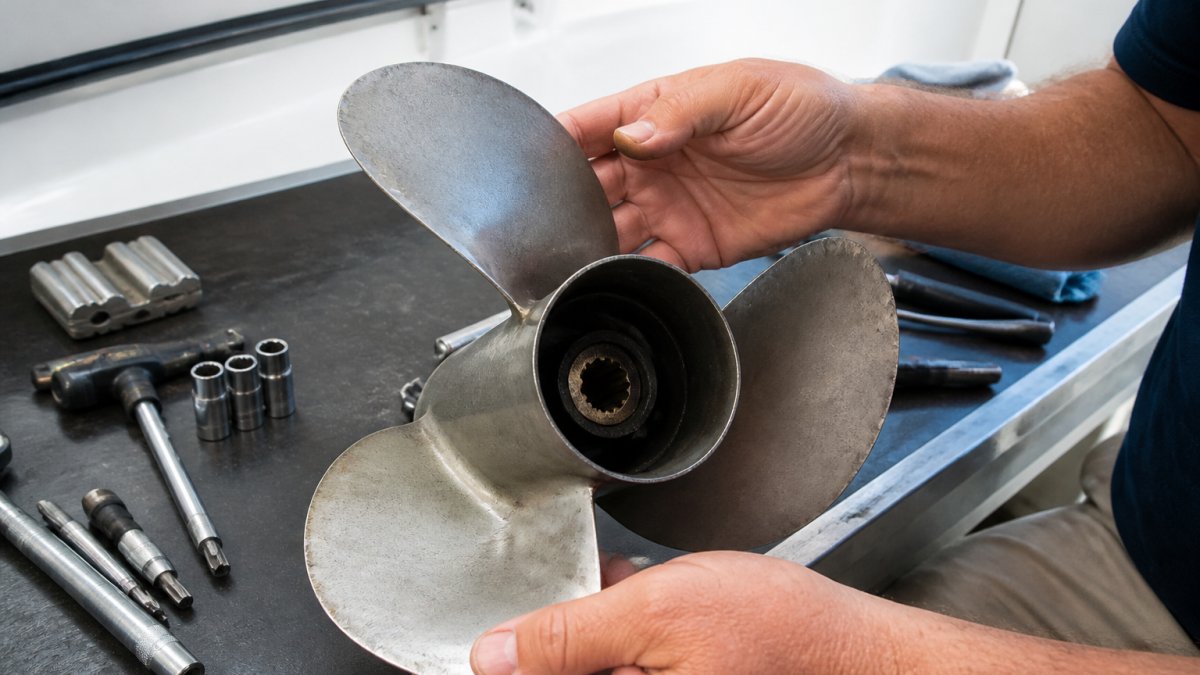
You don't need professional equipment to start. Here's what to look for:
Step 1: Remove the propeller. Use a propeller puller to extract it safely from the shaft without damage. Don't force it.
Step 3: Examine each blade. Look for nicks, cracks, and bends.
Step 4: Check for subsurface cracks. Look for stress patterns or discoloration.
Step 5: Measure blade geometry. Compare blade angles visually, uneven angles reduce efficiency and create vibration.
Step 6: Assess the propeller shaft. Look for corrosion, scoring, or wear in the bore.
Boat Propeller Repair Cost vs Replacement Cost
Professional repair typically runs $300 or more, according to community feedback from experienced boaters on Reddit's r/boating community. This covers welding, balancing, and verification that the repaired propeller meets original specifications.
Replacement costs vary by material and size. A new stainless steel propeller averages around $900.
Here's where the 50% rule applies: a $300 repair on a $900 replacement stays below the threshold. A $500 repair on a $900 replacement is 56%, time to replace.
The Full Cost Stack: What the Quote Doesn't Show
The repair quote is only one line item. Add these to the repair side of the ledger:
- Hub kit or hub replacement, required if the hub is spun or the bore is scored, regardless of blade condition. Budget $75-$125.
- Propeller puller and hardware, $30-$80 if you remove the prop yourself; typically bundled into labor if the shop does it.
- Re-balancing after repair, a repaired blade changes mass distribution. Dynamic balancing prevents the vibration that eats gearcase bearings.
- Re-inspection interval, a repaired prop should be re-checked after the first 10-20 hours of use.
On the replacement side:

- Hub kit for the new prop, many ship without a hub, so add $75-$125.
- Prop nut, washer, and cotter hardware, usually $15-$40.
- Installation, DIY is free; a shop typically charges a half-hour of labor.
Decision Matrix: Repair vs. Replace by Scenario
Use this matrix to slot your situation into a recommendation. The 50% rule is the backbone, but damage type and material override it in several rows.
| Scenario | Typical Repair Cost | Typical Replacement Cost | Repair % of Replacement | Recommendation |
|---|---|---|---|---|
| Aluminum, single small nick | $150-$250 | $200-$400 | 60-100% | Replace, repair rarely pencils out |
| Aluminum, bent blade | $200-$350 | $200-$400 | 75-100%+ | Replace |
| Stainless, single bent blade | $300-$450 | $800-$1,200 | 30-50% | Repair |
| Stainless, two or more damaged blades | $500-$800 | $800-$1,200 | 55-80% | Replace |
| Any material, spun hub with clean bore | $75-$150 (hub only) | $200-$1,200 | 10-40% | Repair (hub only) |
| Any material, spun hub with scored bore | $400-$700 | $200-$1,200 | 50%+ | Replace |
| Any material, subsurface crack at blade root | Not recommended | $200-$1,200 | N/A | Replace |
| Any material, cavitation burns with efficiency loss | $250-$500 | $200-$1,200 | Varies | Repair if stainless, replace if aluminum |
Aluminum vs Stainless Steel Economics
Aluminum and stainless steel follow opposite repair economics. Aluminum propellers are designed for cost, not longevity, the part costs so little that replacement is the standard recommendation.
Stainless steel propellers justify professional repair. Higher replacement costs keep repair economical longer, an $800-$1,200 replacement makes a $400 repair worthwhile, below the 50% threshold.
| Material | Typical Replacement Cost | Typical Repair Cost | Repair Makes Sense? |
|---|---|---|---|
| Aluminum | $200-$400 | $200-$350 | Rarely (repair ≈ replacement) |
| Stainless Steel | $800-$1,200 | $300-$500 | Usually (repair < 50% replacement) |
The Long-Term Cost Nobody Prices In
A repaired stainless propeller can perform close to new, but over time, a prop slightly out of pitch or with a rougher blade surface may burn more fuel per hour than factory-new.
Boaters tracking fuel burn report that a repaired prop never re-pitched to spec may cost more at cruise.
Repair wins on day-one cost; replacement wins on long-run efficiency and resale. If you keep the boat and run it hard, weight the fuel penalty.
Solas ME-RB-2 Rubber Hub Mercury/Mercruiser #170150 →
When to Replace a Boat Propeller
Replace your propeller when damage exceeds what repair can reasonably address, or when repair costs approach replacement cost:
Hub damage with bore wear. If the hub has spun and the bore shows scoring, replacement prevents recurrence, a new propeller includes a fresh hub assembly.
Multiple blade damage. Two or more damaged blades shift the economics. Repair becomes complex and expensive. Replacement is simpler and often cheaper.
Subsurface cracks. Cracks that penetrate below the surface weaken blade structural integrity. Welding may hold temporarily, but the propeller remains compromised. Replace it.
Cavitation with efficiency loss. Severe cavitation roughens the blade surface, reducing hydrodynamic efficiency significantly.
Shaft damage. A bent or corroded shaft means the propeller won't perform correctly even if repaired, often a sign it's time for complete replacement.
The Insurance Question Most Guides Skip
Before writing a check for either path, check whether the damage is covered.
Standard marine policies vary widely. Some treat propeller damage as a wear-and-tear exclusion, so a gradual bend or cavitation burn isn't covered.
The adjuster will ask for documentation of the cause.
What to document before you call:
- Photos of the damage from multiple angles, including the hub and bore.
- Photos of the lower unit and skeg, impact damage often shows there and supports the striking narrative.
- The date, time, and location of the incident, plus water conditions.
- Your repair and replacement quotes in writing, so the adjuster can compare.
- Your policy's propeller and striking clauses, highlighted.
If the claim is approved, the payout may cover full replacement, making replacement obvious even if repair was cheaper out of pocket.
Long-Term Performance: What a Repaired Prop Looks Like in Year Five
Three mechanisms drive long-term degradation in repaired propellers:
1. Pitch and cup drift. Welding and grinding changes blade geometry. A shop verifying against original specs can bring pitch and cup back within tolerance, but tolerance is a range, not a point. A prop a fraction of an inch off in pitch runs at a different RPM for the same throttle.
2. Surface finish. A repaired blade is rarely as smooth as factory-finished. Micro-roughness increases drag and accelerates cavitation in high-slip conditions, and tends to grow, not shrink, over years.
3. Fatigue at the repair site. Welding creates a heat-affected zone that's typically the first place a new crack appears after another strike.
In practice: if you run low hours in fresh water and rarely strike bottom, a quality repair can serve for many seasons.
Hub Replacement as a Cost-Effective Alternative
Before committing to full propeller replacement, consider hub-only replacement. The Mercury Flo-Torq SSR Propeller Hub Kit 4-Stroke with 1" Prop Shaft costs $122.13 and qualifies for free shipping through First Choice Marine.

Hub kits are routine replacement items that wear from normal use and should be replaced any time a propeller is removed for service or after a strike.
If inspection reveals hub failure but intact blades, hub replacement alone keeps you under the 50% threshold and restores your propeller to service, one of the smartest cost-effective repairs available.
Material Differences: Aluminum vs Stainless Steel
Material choice determines repair economics, long-term performance, and maintenance burden.
Aluminum propellers are lighter and cheaper, ideal for smaller engines and recreational boats where cost matters more than durability.
Stainless steel propellers cost more upfront but resist corrosion and impact better, maintaining hydrodynamic efficiency longer because the blade surface resists cavitation erosion.
Material shapes your long-term maintenance strategy: aluminum demands frequent inspection and lower repair thresholds; stainless steel justifies professional repair and longer service intervals.
Environmental and Insurance Considerations
Propeller damage doesn't always demand replacement. The 50% rule gives you a clear boundary: if professional repair costs less than half your replacement cost, repair makes sense. If repair approaches or exceeds that threshold, replacement is smarter.
First Choice Marine stocks replacement hub kits and complete propeller options to keep your boat performing at peak efficiency. Whether you choose repair or replacement, having quality components on hand, like the Mercury Prop Hub Kit HD for $289.28 or the Solas Prop Bliz Series E stainless steel propeller at $572.14, ensures you're making the decision with confidence and backing it with parts engineered for the demanding marine environment.
Frequently Asked Questions
How much does it cost to repair a boat propeller?
Professional propeller repair typically costs $300 or more, depending on damage severity and material. For aluminum propellers, repair is often not cost-effective since the part itself costs less than professional welding and balancing services. Stainless steel propellers, which cost $900 or more to replace, are more economical to repair. Hub replacement alone, a simpler alternative, ranges from $23 to $289 depending on the hub type.
Is it cheaper to repair or replace a boat propeller?
The 50% rule applies: if repair costs exceed 50% of replacement value, replacement is the better choice. For a $900 stainless steel propeller, this threshold is $450. Aluminum props almost always favor replacement because professional repair costs outpace their low purchase price. However, replacing just the hub, the rubber component between the propeller and shaft, can restore function at a fraction of full propeller replacement cost.
What are the common problems with boat propellers?
Common issues include spun hubs (rubber insert deterioration causing loss of thrust), blade deformation from cavitation or impact, nicks and dings from debris strikes, and bore wear at the hub connection. Cupping (blade edge separation) reduces hydrodynamic efficiency and fuel economy. Hub failure shows as engine RPM climbing without corresponding boat speed increase. Subsurface cracks develop from metal fatigue and repeated stress.
When should a boat prop be replaced?
Replace the propeller when repair costs exceed 50% of replacement value, when blade damage affects more than two radii points, or when the hub is spun and cannot be repaired. If the propeller has lost more than 10-15% of its original blade geometry, replacement restores fuel efficiency and performance better than repair. For aluminum propellers, replacement is almost always the choice due to low material cost. Stainless steel propellers warrant repair consideration.
Can a bent boat propeller be repaired?
Yes, bent propellers can be repaired through welding and re-pitching, which restores blade geometry and angle to factory specifications. High-quality repairs check six or more radii points to ensure hydrodynamic efficiency. Aluminum propellers are rarely worth repairing due to cost, but stainless steel bends justify professional repair.
