


Table of Contents
- Why Propeller Choice Determines Your Fuel Bill
- Quick Comparison: Top Fuel-Efficient Propellers
- 1. Sharrow MX Series: The Loop Propeller That Cuts Fuel Burn
- 2. Solas Suzuki Dual Prop: Efficiency for Heavy Boats
- 3. Solas Rubex S3 and L3: High-Speed Efficiency
- 4. Solas Rubex Hydro: Versatile Fuel Savers
- Stainless Steel vs Aluminum Propeller Fuel Efficiency
- How to Calculate Propeller Pitch for Your Boat
- Frequently Asked Questions
Last Updated: October 2, 2026
Why Propeller Choice Determines Your Fuel Bill
Independent testing shows the best marine propeller for fuel efficiency can improve fuel efficiency by as much as 46% at cruising speed. The best marine propeller for fuel efficiency is one matched to your hull, engine, and typical load, not simply the most expensive option on the shelf. Below: the top picks, the stainless versus aluminum debate, and how to calculate the right pitch.
The Real Cost of a Mismatched Prop
A propeller that's wrong for your boat burns fuel on every trip. According to BoatTEST's independent propeller testing, a Sharrow loop propeller delivered a 46% fuel efficiency improvement at 18 knots compared to a conventional design. Even smaller gains compound fast: National Fisherman's comparison of proprietary designs documented 10-30% fuel savings at 2,500 to 4,000 RPMs. Over a full season, that's hundreds of dollars in fuel and a noticeably shorter range.
Quick Comparison: Top Fuel-Efficient Propellers
The table below summarizes the four picks covered in this guide, ranked by efficiency potential and price.
| Propeller | Price | Blades | Best For |
|---|---|---|---|
| Sharrow MX Series | $5,443.28 | Loop design | Maximum efficiency and range |
| Solas Suzuki Dual Prop | $570.94 (front) | 3-blade front | Heavy boats, dual-prop setups |
| Solas Rubex S3 | $529.84 | 3-blade | High-speed performance |
| Solas Rubex Hydro | $484.41 | 3-blade | Versatile all-around use |
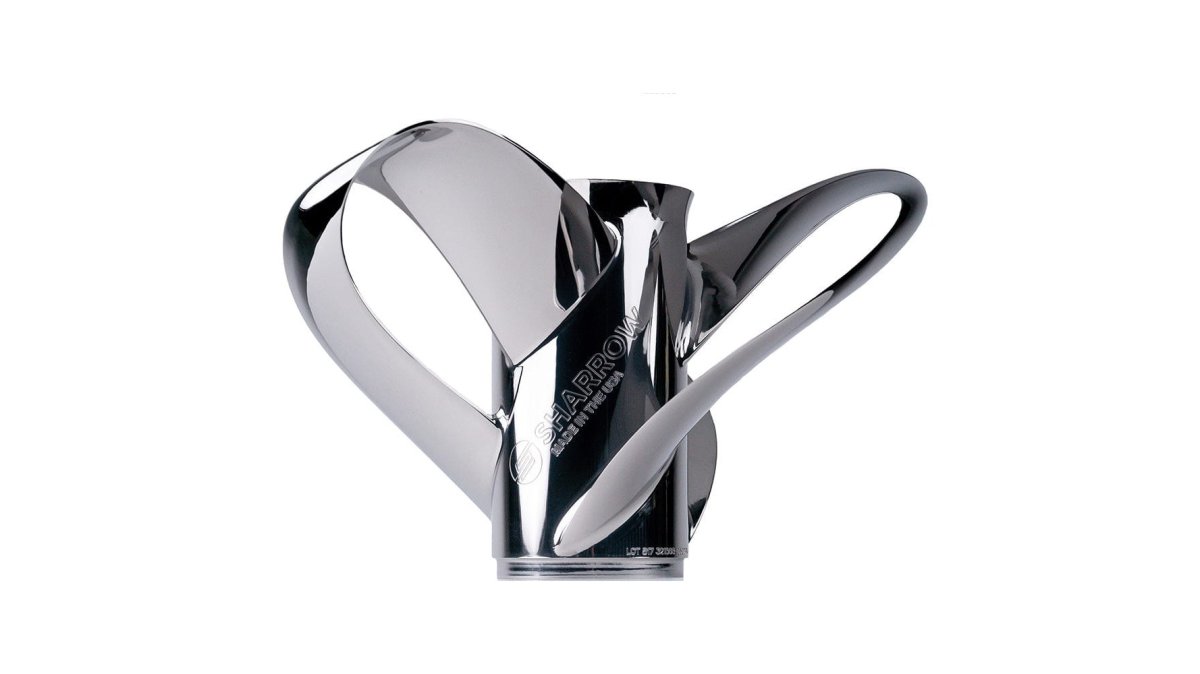
1. Sharrow MX Series: The Loop Propeller That Cuts Fuel Burn
The Sharrow MX Series is an efficient propeller we carry, and the numbers back it up.

The MX Series adds up to 30% greater range, planing at 500-1,000 RPM less than traditional propellers, and up to 50% more reverse thrust.
The catch is price. At $5,443.28, it costs several times more than a standard stainless prop.
2. Solas Suzuki Dual Prop: Efficiency for Heavy Boats
Heavy boats need grip, and the Solas Suzuki Dual Prop delivers it. This matched front-and-rear set pairs a 3-blade 15.5-inch stainless front unit with a 4-blade 14.125-inch stainless rear unit, maximizing efficiency, maneuverability, and reverse thrust with grip and acceleration suited to heavier hulls.

The front propeller runs $570.94 and the rear $603.86, both stainless with a 25-tooth spline. The dual-prop arrangement is what makes it efficient on heavy boats: two smaller blades create less hydrodynamic drag than one large blade while maintaining thrust. For a heavy cruiser or loaded fishing boat, this is the setup to consider.
3. Solas Rubex S3 and L3: High-Speed Efficiency
If top-end speed matters as much as fuel burn, the Rubex S3 and L3 are the picks. Both are 3-blade stainless propellers from Solas' E Series, built with hydrodynamic blade geometry that reduces cavitation and ventilation for solid hookup across the RPM range.

The Rubex S3 comes in 21-inch and 22-inch pitch configurations at $529.84, tuned for high-speed performance on performance boats, offshore fishing vessels, and cruisers. The Rubex L3 offers 16-inch and 18-inch pitch options at $472.29, with left-hand rotation and a balance of acceleration, mid-range performance, and fuel efficiency.
Stainless steel construction resists blade flex and holds precise pitch under load, which is exactly what you want at higher speeds. Both require an interchangeable hub kit, sold separately.
4. Solas Rubex Hydro: Versatile Fuel Savers
The Rubex Hydro is a 3-blade stainless propeller for outboard and sterndrive engines, available in 15, 17, and 19-inch pitch configurations, all at $484.41.
What sets the Hydro apart is Solas' interchangeable RBX hub system: adapt the same propeller to different engine brands and models by swapping the hub kit, which matters if you repower or run more than one boat.
The hub kit is sold separately, so factor that into your total. And like any stainless prop, it costs more up front than aluminum.
Stainless Steel vs Aluminum Propeller Fuel Efficiency
Stainless steel generally offers better fuel efficiency. Aluminum alloy flexes under load at higher speeds, and that flex can reduce efficiency as the blade shape changes with RPMs.
That rigidity shows up in real numbers. A JLM Marine case study of a 57-foot motoryacht documented an 8-10% fuel efficiency gain after the owner switched to custom CNC-machined stainless props.
So why does anyone run aluminum? Cost and forgiveness: aluminum props are cheaper and easier to replace after hitting a submerged obstacle. For general cruising on smaller boats, a 3-blade aluminum propeller remains a reasonable, cost-effective standard.
The Comparison Table Most Guides Skip
| Factor | Aluminum | Stainless Steel |
|---|---|---|
| Blade flex under load | High, pitch changes at speed | Minimal, holds designed pitch |
| Typical fuel efficiency vs. aluminum | Baseline | 5-10% better in matched setups |
| Weight | Lighter | Heavier (can matter on small hulls) |
| Impact behavior | Deforms or breaks; cheap to replace | Can damage lower unit if struck hard |
| Repair cost after impact | Low (often replace) | High (weld/repitch or replace) |
| Best use case | Occasional use, shallow water, budget | High-hours use, offshore, efficiency goals |
The Cost-Per-Gallon Math
Purchase price is only half the equation. Run the same back-of-envelope calculation from the pitch section:
Annual savings = annual hours × cruise GPH × fuel price × efficiency gain
At 100 hours per season, 10 GPH cruise burn, $4.00/gal fuel, and a 7% efficiency gain, stainless saves roughly $280 per year. Over five seasons that's $1,400. Below 50 hours per season, the math may favor aluminum.
Sharrow MX Series Stainless Steel Propeller #TBD1 →
The Factor That Erases Every Gain: Propeller Condition
A perfectly matched stainless prop with a dinged blade, bent tip, or a season of barnacles on the hub will burn more fuel than a clean aluminum prop of the same pitch. Efficiency gains from material and design are real, but conditional on condition.
What to check before you spend a dollar on a new prop:
- Nicks and dings on the leading edge, even small ones disrupt laminar flow and increase slip. A 1/8-inch nick can cost measurable top-end RPM.
- Bent or cupped blades, a blade that's out of spec by a few thousandths of an inch loses thrust.
- Marine growth, barnacles, algae, and oxidation on the blades and hub add drag and imbalance. On a moored boat, growth can accumulate in weeks.
- Hub and spline wear, a worn hub lets the prop slip under load, which reads as lost RPM and higher fuel burn.
- Anode condition, a depleted anode accelerates corrosion on the prop and lower unit, degrading blade surfaces over time.
How to Calculate Propeller Pitch for Your Boat
Propeller pitch is the theoretical distance, in inches, a propeller would move forward in one full rotation. Choosing the right pitch is a significant factor in matching your propeller to your engine and fuel goals. Below is a process for calculating pitch, plus a worked example.
Step 1: Confirm Your Engine's WOT Range
Find your engine's rated wide-open-throttle (WOT) RPM range in the owner's manual or on the engine plate. Typical ranges:
- Most 4-stroke outboards: 5,000-6,000 RPM
- Many sterndrives: 4,400-4,800 RPM
- Older 2-strokes: 5,000-5,500 RPM
Your goal is the middle-to-upper end of that range with a normal load and clean hull. Below the range means you're over-propped; above it, under-propped.
Step 2: Measure Actual Speed at WOT
Use GPS, not a paddlewheel or pitot speedometer. Note the RPM and speed at full throttle on flat water with your typical load.
Step 3: Calculate Theoretical Speed
The standard formula:
Theoretical speed (mph) = (RPM ÷ gear ratio) × pitch ÷ 1056
Where:
- RPM = engine RPM at WOT
- Gear ratio = lower unit gear ratio (e.g., 2.07:1)
- Pitch = propeller pitch in inches
- 1056 = conversion constant for mph
Step 4: Calculate Slip Percentage
Slip % = ((theoretical speed − actual speed) ÷ theoretical speed) × 100
A slip percentage of 10-15% is normal for most planing hulls. Here's what the number tells you:
| Slip % | What It Means | Likely Fix |
|---|---|---|
| Under 10% | Over-propped or unusually efficient hull | Try 1-2 inches less pitch |
| 10-15% | Healthy setup | None, this is the target |
| 15-20% | Slipping; losing efficiency | Check for damage, fouling, or wrong blade geometry |
| Over 20% | Significant slip | Ventilation, wrong diameter, or damaged prop |
Worked Example
A 21-foot center console with a 150 HP outboard, 2.07:1 gear ratio, running a 19-inch pitch stainless prop. At WOT with a normal load, the engine turns 5,400 RPM and GPS shows 41 mph.
- Theoretical speed = (5,400 ÷ 2.07) × 19 ÷ 1056 = 46.9 mph
- Slip % = ((46.9 − 41) ÷ 46.9) × 100 = 12.6%
That's a healthy setup. If the same boat only hit 37 mph, slip would be 21%, a sign of fouling, a damaged blade, or the wrong prop for the hull.
The Pitch Adjustment Rule
Each inch of pitch change typically shifts engine RPM by 150-200. So if you're 300 RPM below the bottom of your WOT range, dropping 2 inches of pitch should bring you back in. Change one variable at a time and re-test.
A Quick Way to Estimate Your Fuel Savings
You don't need a dyno to estimate whether a prop change pays off. Use this back-of-envelope method:
- Record your current gallons-per-hour (GPH) at typical cruise RPM from your fuel flow gauge or by topping off and logging hours.
- Estimate the efficiency gain (a well-matched stainless prop over a flexing aluminum one commonly yields 5-10%; a loop-design prop can yield more at mid-range RPMs).
- Multiply: annual hours × cruise GPH × fuel price × estimated gain = annual savings.
Example: 120 hours per season × 8 GPH × $4.00/gal × 8% gain = $307 per year. That number is what you compare against the price difference between props, not the sticker price alone.
Frequently Asked Questions
Is a 17 or 19 pitch prop better for fuel efficiency?
A 17-pitch prop is better for fuel efficiency on heavier boats or when you need quicker planing, as it lets the engine reach its optimal RPM range without lugging. A 19-pitch prop suits lighter boats or high-speed cruising. The right choice depends on your boat's weight and engine's recommended wide-open-throttle RPM. Testing both pitches with a fuel flow meter is the only way to know which delivers better marine propeller efficiency for your specific setup.
Are stainless steel propellers more efficient than aluminum?
Yes, stainless steel propellers generally deliver better fuel efficiency than aluminum because they resist blade flex under load. Aluminum flexes at higher speeds, which reduces pitch accuracy and can reduce efficiency. Stainless steel maintains its shape, keeping thrust consistent. However, the higher upfront cost means you need to boat enough hours to offset the price difference.
Does a 4-blade propeller improve fuel economy over a 3-blade?
A 4-blade propeller can improve fuel economy in specific situations, particularly on heavy boats that need more stern lift and better mid-range grip. Four-blade props hold plane at lower speeds, which reduces fuel burn during acceleration. However, they typically sacrifice some top-end speed compared to 3-blade designs. For most recreational boaters running at cruise, a well-matched 3-blade stainless prop often delivers comparable or better overall marine propeller efficiency.
How does propeller slip affect fuel consumption?
Propeller slip is the difference between theoretical and actual forward movement. A slip percentage above 20% means your prop is spinning without converting that energy into forward motion, wasting fuel. Common causes include excessive pitch, a damaged blade, or a fouled hull. Reducing slip by selecting the correct pitch and keeping the hull clean can improve fuel burn rate noticeably. A slip calculator using GPS speed and RPM data gives you a baseline to work from.
What are the signs of a mismatched boat propeller?
Key signs include the engine not reaching its recommended wide-open-throttle RPM range, sluggish hole shot, excessive vibration, and higher-than-normal fuel burn at cruise. If your engine over-revs, the pitch is too low; if it lugs below the target RPM, the pitch is too high. Cavitation and ventilation during turns also point to a mismatch. Checking these signs before buying a new prop saves you from repeating the same mistake.
