


Table of Contents
- Gather Your Engine and Boat Specifications
- How to Read Boat Propeller Numbers and Specifications
- Solas Stainless vs Aluminum Propellers: Which Material Fits Your Needs
- Use the Solas Prop Finder Tool for Accurate Matching
- Test Your Current Propeller Performance and Adjust Pitch
- Boat Propeller Performance Tuning: Optimize for Your Hull and Usage
- Common Mistakes to Avoid When Selecting a Solas Propeller
- Frequently Asked Questions
Last Updated: October 2, 2026
Gather Your Engine and Boat Specifications
Learning how to select the correct Solas prop for your boat starts with identifying your engine and boat details. This information forms the foundation of every propeller decision you'll make.

Check your engine's nameplate on the engine block or transom and write down the exact model number, don't estimate, as it's specific to your engine's generation and configuration.
Note the horsepower and year of manufacture, as propeller recommendations change based on engine power and design year.
Write down these details:
- Engine manufacturer (Mercury, Yamaha, Suzuki, Volvo Penta, Evinrude, etc.)
- Exact model number
- Horsepower rating
- Year of manufacture
- Type of drive (outboard, sterndrive, or jet drive)
How to Read Boat Propeller Numbers and Specifications
Every propeller carries a designation that tells you its size and performance characteristics.
The standard format is: Diameter x Pitch x Rotation x Spline.
Understanding diameter and pitch
Diameter (measured in inches) is the width of the propeller circle when blades are fully extended. Pitch is the theoretical forward distance the propeller moves with one complete rotation. A "14 x 25" propeller has a 14-inch diameter and 25-inch pitch. Larger diameter propellers generate more thrust by moving more water. Higher pitch makes the engine work harder for more speed; lower pitch enables easier acceleration but lower top speed.
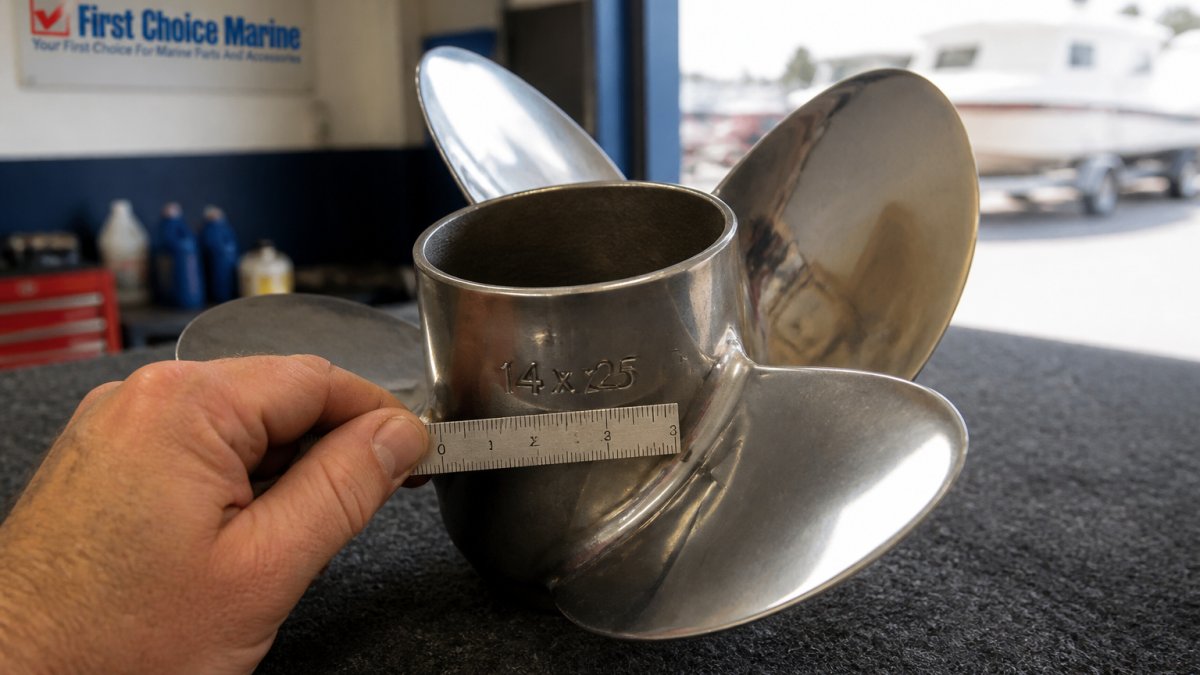
Decoding rotation direction and spline configuration
Rotation direction matters for dual-propeller setups: right-hand propellers spin clockwise (viewed from behind), left-hand counter-clockwise. Spline configuration refers to the connection between propeller and shaft, common counts are 13, 15, 17, and 19. Your engine shaft must match exactly. Check your existing propeller's hub for these numbers, or contact the previous owner or engine documentation.
Solas Stainless vs Aluminum Propellers: Which Material Fits Your Needs
Stainless steel propellers hold their shape better under load, resist corrosion, and maintain blade geometry during hard acceleration. Aluminum propellers cost less and are lighter but flex under heavy load and reduce efficiency slightly. Aluminum is easier to repair if damaged; stainless steel blades are harder to repair.
Choose stainless steel if you run at wide open throttle regularly, tow frequently, or want maximum performance and durability. Choose aluminum if you cruise at moderate speeds, want lower upfront cost, or value easy repairability.
Stainless steel propellers from Solas, like the Solas Prop SS Volvo Dual/Prop Rear 13.9 x 17 RH, maintain consistent performance season after season. The stainless construction resists blade flex and maintains precise pitch under load.
Use the Solas Prop Finder Tool for Accurate Matching
The most reliable way to find your correct Solas prop for your boat is using the Solas Prop Finder tool, which matches your specific engine to compatible propeller part numbers.
Visit the Solas Prop Finder tool and enter your engine specifications. The tool asks for:
- Engine manufacturer and model
- Horsepower rating
- Drive type (outboard, sterndrive, jet)
- Current propeller size (if known)
The tool returns a list of compatible Solas propeller models with part numbers. This eliminates guesswork. You get exact matches for your engine configuration.
The finder ensures you order the right part the first time, eliminating returns and delays.
Test Your Current Propeller Performance and Adjust Pitch
Test your current propeller's performance before replacing it. Real performance data beats theoretical calculations.
Measuring wide open throttle RPM and interpreting results
Run your boat at wide open throttle on calm water with a typical load and note the RPM reading (WOT RPM). Most outboard engines operate optimally between 4,500 and 6,100 RPM at WOT, check your engine's documentation for the exact target range.
If WOT RPM is above the manufacturer's range, pitch is too low. If below the range, pitch is too high.
A general rule of thumb: a two-inch increase in propeller pitch typically reduces WOT RPM by 300-400 RPM. This relationship helps you calculate what pitch adjustment you need.
Here's how to interpret your results and adjust:
Solas Prop SS Volvo Dual/Prop Rear 13.9 x 17 RH #8551-139-17 →
| WOT RPM Reading | Meaning | Pitch Adjustment | Expected Result |
|---|---|---|---|
| Above manufacturer max (e.g., 6,500+ on a 6,100 max engine) | Pitch too low | Increase pitch 1-2 inches | RPM drops into optimal range |
| Within manufacturer range | Optimal | No change needed | Keep current propeller |
| Below manufacturer minimum (e.g., 4,000 on a 4,500 min engine) | Pitch too high | Decrease pitch 1-2 inches | RPM rises into optimal range |
Accounting for load and altitude when testing
Always test with your typical load aboard. Altitude significantly affects engine performance: engines produce less horsepower at higher elevations because air density decreases. If you regularly operate at altitude, consider a slightly lower pitch (1-2 inches) than your sea-level optimal to maintain RPM in the target range.
Water temperature and salinity effects
Making your adjustment decision
If your current performance is already within the optimal RPM range, keep the same size. Only change pitch if WOT RPM is consistently outside the manufacturer's range under your typical operating conditions. Verify the propeller part number using the Solas Prop Finder tool to ensure you order the correct diameter, pitch, rotation, and spline configuration.
Boat Propeller Performance Tuning: Optimize for Your Hull and Usage
Once you have the right base propeller, fine-tuning depends on your hull design, typical load, and how you use the boat.
Matching blade count and geometry to your vessel type
Three-blade propellers balance acceleration and top speed. Four-blade propellers generate more thrust and reduce vibration. Planing hulls work well with three-blade props optimized for speed; displacement hulls benefit from four-blade designs that maximize thrust.
For speed fishing or skiing, use three-blade with lower pitch. For cruising, use three-blade with mid-range pitch. For towing or heavy loads, use four-blade for maximum thrust and stability.
Load-specific pitch tuning: Light vs. heavy operation
Select pitch based on your primary use case. If you primarily run light, use slightly higher pitch (1-2 inches above heavy-load optimal) for better top speed. If you primarily run heavy or tow, use slightly lower pitch (1-2 inches below light-load optimal) to maintain RPM under load. Choose based on which scenario happens most often.
Altitude and elevation adjustments
Altitude is one of the most overlooked variables in propeller selection. Engines produce significantly less horsepower at elevation because air density decreases. The effect is substantial:
- At 2,500 feet elevation, engines typically produce 5-8% less horsepower
- At 5,000 feet elevation, the loss increases to 10-15%
- At 7,500 feet elevation, horsepower loss reaches 15-20%
When an engine loses horsepower, it struggles to turn a propeller pitched for sea-level performance. Your WOT RPM will drop below the optimal range, reducing efficiency and top speed.
If you fish or boat primarily at elevation, select a propeller pitched 1-2 inches lower than you would at sea level.
Water temperature and salinity effects
Bringing it together: Your tuning decision
- If you run primarily light: Use the baseline pitch or increase by 1 inch for better top speed
- If you run primarily heavy or tow: Decrease pitch by 1 inch to maintain RPM under load
- If you operate at elevation: Decrease pitch by 1-2 inches to compensate for reduced air density
- If you switch between freshwater and saltwater: Optimize for your primary environment; accept minor RPM shifts in the secondary environment
Common Mistakes to Avoid When Selecting a Solas Propeller
Most propeller selection errors come from skipping the verification steps. Here are the mistakes that cost boaters time and money.
Frequently Asked Questions
How do I know what size propeller I need for my boat?
Start by identifying your engine make, model, year, and horsepower. Then check your current propeller's diameter and pitch, usually stamped on the hub. The Solas Prop Finder tool lets you input your motor specifications to find the correct equivalent Solas propeller part number. If you're unsure, test your current propeller at wide-open throttle (WOT) to see if your RPM falls within the manufacturer's recommended range. A two-inch pitch increase typically reduces WOT RPM by 300-400, so you can adjust from there.
What is the difference between pitch and diameter in boat propellers?
Diameter is the width of the propeller circle when viewed from above, measured in inches. Pitch is how far forward the propeller would travel in one complete rotation if there were no slip, also measured in inches. A larger diameter increases thrust and acceleration; a larger pitch increases top speed but reduces RPM at WOT. For example, a 14-inch diameter with 25-inch pitch propeller suits different performance goals than a 13.9-inch diameter with 17-inch pitch.
What happens if I choose the wrong propeller pitch?
Choosing the wrong pitch affects your engine's RPM at wide-open throttle. Too high a pitch keeps RPM too low, reducing acceleration and fuel efficiency. Too low a pitch over-revs the engine, risking damage and poor fuel economy. The sweet spot is running within your engine's optimal RPM range at WOT. If your current propeller leaves you outside that range, moving to a higher or lower pitch Solas propeller brings you back into spec and improves both performance and reliability.
Does a Solas propeller improve boat performance?
A correctly matched Solas propeller improves performance by optimizing your engine's RPM range and thrust delivery. Stainless steel Solas propellers maintain blade geometry under load better than aluminum, delivering consistent performance. The real gain comes from precise matching to your engine and hull, not from the brand alone.
