


Table of Contents
- Essential Marine Hardware for DIY Boaters
- Top Marine Maintenance Supplies for 2026
- Marine Electrical Maintenance Tips
- Your Essential Boat Maintenance Schedule
- DIY vs. Professional Maintenance: Cost-Benefit Analysis
- Eco-Friendly Marine Maintenance Standards
- Conclusion
- Frequently Asked Questions
Last Updated: September 30, 2026
Essential Marine Hardware for DIY Boaters
The recreational boat parts and accessories market is projected to reach $18.9 billion in 2026, up from $17.7 billion a year earlier, according to Stratview Research's recreational boat parts market report. That growth reflects a simple reality: more boat owners are choosing to repair rather than replace. At First Choice Marine, we've spent over a century helping DIY boaters find the right marine hardware for the job.
Quick Picks:
- Best Bilge Pump: Johnson Pump Aqua Void Ultima Combo 500 GPH
- Best Corrosion Protection: Mercury Marine Anode Kit
- Best Value Water Pump Kit: EMP Water Pump Kit
- Best Surface Protection: Boat Bling Pontoon Sauce
Top Marine Maintenance Supplies for 2026
The boat repairing market hit $8.79 billion in 2026 and is growing at 9.6% annually through 2030, per Research and Markets' boat repairing market report. That spending reflects harder-working boats and longer seasons.

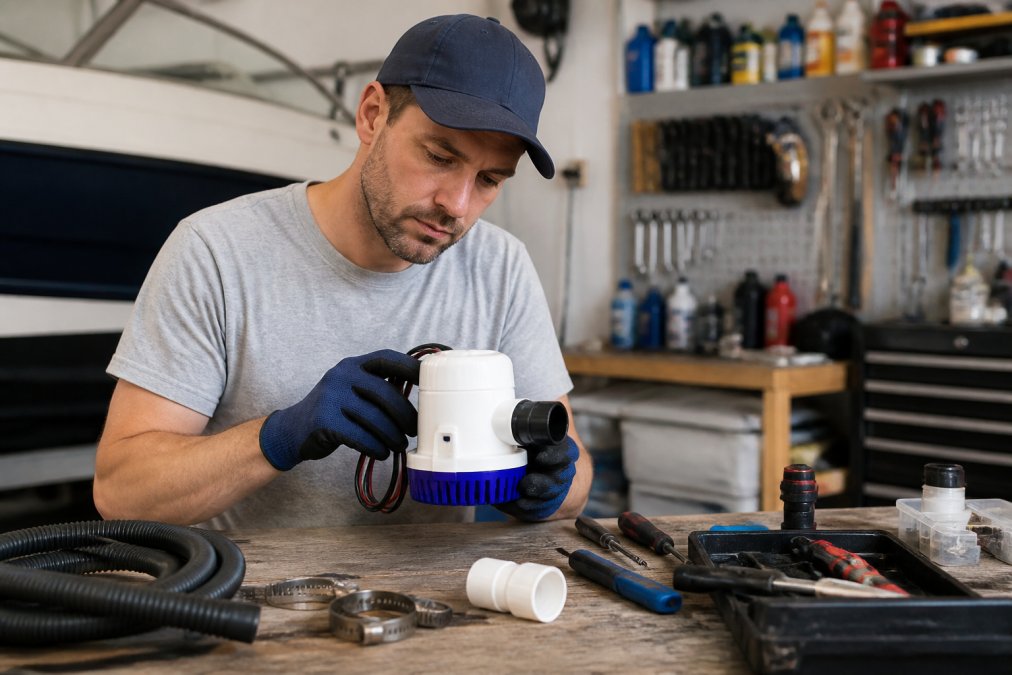
Bilge Pumps: Johnson Pump Aqua Void Ultima Combo
The Johnson Pump Aqua Void Ultima Combo 500 GPH ($91.05, free shipping) is our top bilge pump pick for its quick-change motor connection: swap the cartridge motor or upgrade capacity without cutting and splicing wires. The reinforced click-in basket simplifies single-handed cleaning in a tight bilge space, and the included Ultima Switch uses Mirus field effect detector cells to activate and deactivate the pump automatically based on water level.
Anodes: Mercury Marine Anode Kit
The Mercury Marine Anode Kit #97-888760Q03 ($107.49, free shipping) protects MerCruiser Bravo II and III drives from galvanic corrosion with a four-piece magnesium kit: flat trim tab anode, drive shaft plate anode, lift ram anodes, and attaching hardware.
Water Pump Kits: Mercury Marine and EMP
Two options cover most outboards. The Mercury Marine Water Pump Complete Kit #46-812966A12 ($155.99, free shipping) fits Mercury and Mariner 4-stroke outboards from 30 to 60 hp, with impeller, housings, face plate, gaskets, drive key, face seal, seal carrier, and water tube coupling. For a broader fit at a lower price, the EMP Water Pump Kit #46-46501 ($74.81, free shipping) works on Mercury and Mariner 3-cylinder (30-105 hp), 4-cylinder (75-120 hp), and V6 (200-250 hp) outboards, plus MerCruiser Alpha Gen II pumps, and includes a rubber-coated wear plate, stainless steel housing, and a 2-year limited warranty.

Oils and Lubricants: BRP XPS Marine
Two BRP oils cover most needs. The BRP XPS Marine XD30 Oil Gallon ($61.62, free shipping) suits water-cooled 2-cycle outboards specifying TC-W3 oils, reduces carbon and deposit buildup, and works for pre-mix and oil injection.
Surface Protection: 3M Body Filler and Boat Bling Pontoon Sauce
The 3M Marine Lightweight Body Filler Gallon ($74.54, free shipping) repairs dents and dings on fiberglass, aluminum, and steel. The vacuum-processed formula minimizes pinholes and cures tack-free in 20 minutes.
| Supply | Price | Best For | Key Feature |
|---|---|---|---|
| Johnson Pump Aqua Void | $91.05 | Boats under 25 ft | Quick-change motor |
| Mercury Anode Kit | $107.49 | Bravo II/III, fresh water | Four-piece magnesium kit |
| Mercury Water Pump Kit | $155.99 | Mercury 30-60 hp 4-stroke | 9-piece complete kit |
| EMP Water Pump Kit | $74.81 | Mercury/Mariner 30-250 hp | 2-year warranty |
| BRP XD30 Oil | $61.62 | 2-cycle outboards | TC-W3 certified |
| BRP 5W40 Oil | $20.93 | 4-stroke engines | Anti-corrosion additives |
| 3M Body Filler | $74.54 | Fiberglass and aluminum | Cures in 20 minutes |
| Boat Bling Pontoon Sauce | $37.15 | Aluminum pontoons | Removes oxidation |
Marine Electrical Maintenance Tips
Marine electrical maintenance prevents the failures that strand boats. Corroded terminals, loose grounds, and degraded wire insulation cause most electrical problems on the water; the difference between fixing it and throwing parts at it is a diagnostic sequence.
Start With the Battery, Not the Symptom
Clean terminals with a wire brush, then apply dielectric grease to block moisture. Check voltage monthly; below 12.4V at rest signals a charge problem, not necessarily a bad battery.
The Voltage-Drop Test: The Skill Most DIY Boaters Skip
A component that won't run isn't always bad, it's often a bad connection upstream. The voltage-drop test finds it in minutes.
- Set your multimeter to DC volts.
- Put one probe on the battery positive post and the other on the positive terminal of the device.
- Have someone activate the device (or use a jumper).
- Read the voltage. More than 0.5V drop on a 12V circuit means resistance in the path, a corroded terminal, a loose ground, or a failing switch.
- Repeat on the ground side, from the device's ground terminal back to the battery negative post.
Corrosion, Wire, and Connectors
Inspect all connections for green corrosion, which indicates water intrusion, and replace any wire with cracked or brittle insulation. Use marine-grade tinned copper wire only; standard wire wicks moisture and corrodes from the inside. Heat-shrink connectors with adhesive lining seal the connection against the environment that caused the last failure.
Test Your Bilge Pump Float Switch Manually
Pour water into the bilge and confirm the pump activates. Do this monthly. A float switch that sticks in the "off" position is a flooded-bilge waiting to happen, and one that sticks "on" will kill your battery at the dock. The BoatUS guide to new marine products highlights how modern monitoring systems like water-in-fuel detection now catch problems before they become breakdowns.
When to Stop and Call a Pro
Electrical is where DIY enthusiasm gets expensive. Use this rule:
- DIY: battery service, terminal cleaning, fuse and bulb replacement, adding a fused accessory circuit, replacing a failed bilge pump with a like-for-like unit.
- Call a pro: anything involving shore power AC, bonding and galvanic isolator systems, engine computer or CAN-bus faults, intermittent problems you can't reproduce, or any repair where you've already replaced two parts and the symptom remains.
Buy a $40-$100 digital multimeter before you buy any replacement part. The voltage-drop test will tell you whether you need a part at all, and it's the single highest-return tool in a DIY boater's kit.
Your Essential Boat Maintenance Schedule
An essential boat maintenance schedule separates boats that last from boats that don't. A 22-foot trailered center console has little in common with a 38-foot twin-diesel cruiser in a saltwater slip, so the schedule below is broken out by season and vessel type.
The 2026 Seasonal Checklist
Spring commissioning (before first launch)
| Task | Outboard / Gas | Inboard / Diesel | Time |
|---|---|---|---|
| Inspect and replace anodes | Yes | Yes | 15 min |
| Battery load test and terminal clean | Yes | Yes | 20 min |
| Replace water pump impeller | Every 2-3 seasons | Annually | 1-2 hrs |
| Change engine oil and filter | Every 100 hrs or annually | Every 100-200 hrs | 45 min |
| Fuel filter / water separator | Yes | Yes (primary + secondary) | 30 min |
| Lower unit gear lube | Yes | N/A | 30 min |
| Belts, hoses, clamps inspection | Yes | Yes | 30 min |
| Test bilge pump and float switch | Yes | Yes | 10 min |
| Wash, compound, and wax hull | Yes | Yes | 3-6 hrs |
Summer in-season (monthly)

- Inspect anodes, 10 minutes. Replace at 50% consumption.
- Check battery voltage at rest, 5 minutes. Below 12.4V means a charging problem, not a bad battery.
- Test bilge pump manually with a bucket of water, 10 minutes.
- Check engine oil level and look for milky or fuel-diluted oil.
- Inspect sacrificial anodes on trim tabs and outboard bracket.
- Look for new corrosion at every ground and terminal you can reach.
Fall layup (before storage)
- Fog the engine or run a fuel stabilizer through the system.
- Drain and refill lower unit; check for water intrusion (milky lube = failed seal).
- Remove, inspect, and store batteries on a maintainer, never leave them in a freezing hull.
- Flush raw-water systems with fresh water; for inboards, winterize with marine-grade antifreeze.
- Remove electronics you can, and bag what you can't.
- Full electrical diagnostic, 1 hour. This is the single best time to find a problem before it strands you in spring.
Winter storage checks (monthly)
- Verify the cover isn't pooling water or chafing gelcoat.
- Check the battery maintainer is still connected and reading correctly.
- Look for rodent intrusion, chewed wiring is the most common spring surprise.
Vessel-Specific Adjustments
Trailered boats under 25 ft: The trailer is half the maintenance. Grease wheel bearings annually (or every 3,000 miles), inspect bunk carpet for exposed bolts, and check the winch strap and bow eye for corrosion. A failed highway bearing costs more than every part in this guide combined.
Tools That Make the Schedule Stick
The single most common mistake is skipping the impeller. A failed impeller overheats the engine in minutes, and the debris it sheds travels into the cooling passages where it causes problems for years.
DIY vs. Professional Maintenance: Cost-Benefit Analysis
DIY maintenance saves labor but costs time and carries risk; the break-even point depends on the job.
Eco-Friendly Marine Maintenance Standards
Eco-friendly maintenance protects waterways and keeps boaters compliant with clean water rules. Use biodegradable cleaners and avoid products containing chlorine or phosphates; Boat Bling Pontoon Sauce uses a spray-on, rinse-off process. Dispose of used oil, antifreeze, and old anodes at certified collection sites, and never pump bilge water containing oil or fuel overboard.
Conclusion
Keeping a boat in peak condition comes down to buying the right parts and staying ahead of maintenance. The supplies above cover the essentials: bilge pumps, anodes, water pump kits, oils, and surface protection.
Frequently Asked Questions
What are the essential maintenance supplies every boat owner should have?
Every boat owner should carry spare anodes, a bilge pump, water pump kits, and marine-grade oils. For example, the Johnson Pump Aqua Void Ultima Combo 500 GPH is a reliable bilge pump with automatic operation. Mercury Marine anode kits protect against galvanic corrosion, and BRP XPS oils keep engines lubricated. These supplies cover the most common failure points and help you avoid costly repairs.
How often should I perform routine marine maintenance?
Follow a seasonal schedule: inspect anodes annually, replace water pump impellers every 100 hours or annually, and check bilge pumps before each trip. For electrical systems, test batteries and connections monthly. Adhering to this schedule extends component lifespan and ensures safety on the water.
What are the best marine-grade cleaners for fiberglass hulls?
For fiberglass hulls, use a pH-neutral marine cleaner to avoid damaging the gelcoat. For aluminum surfaces like pontoons, Boat Bling Pontoon Sauce effectively removes oxidation and waterline stains. Always rinse thoroughly and follow with a protective wax. Avoid abrasive cleaners that can scratch the surface. Regular cleaning prevents grime buildup and maintains hull integrity.
How do I choose the right marine hardware for DIY repairs?
Match hardware to your vessel's material and environment. For fresh water, magnesium anodes like the Mercury Marine Anode Kit work well; for saltwater, choose aluminum or zinc anodes. Ensure components meet marine-grade standards, such as Mil-Spec A-21412(SH). Consult your owner's manual for specific part numbers. When in doubt, contact a specialist for guidance.
What are the most common marine electrical maintenance issues?
Corroded terminals, loose connections, and battery drain are frequent problems. Inspect wiring for chafing and apply dielectric grease to prevent corrosion. Use smart charging solutions to maintain battery health. Address issues early to avoid failures on the water and ensure reliable engine performance.
