


Quick Summary
Battery terminal protectors are insulating covers that fit over marine battery posts and cable connections. They block accidental shorts from loose tools or cables and seal the metal from moisture and salt air. Choose one by matching the terminal style and cable gauge.
- Exposed terminals create corrosion buildup and a short-circuit hazard from dropped tools or loose cables.
- Confirm whether your battery uses wing nut terminals before buying a cover.
- Match the cover to your cable gauge, since a smaller cover will not seal properly.
- Disconnect the negative cable first and reconnect it last when installing covers.
- Replace covers that are cracked or swollen, since damaged covers stop insulating.
Table of Contents
- Why Marine Battery Terminals Need Protection
- How Battery Terminal Protectors Are Selected
- Marine Battery Terminal Covers: Seachoice Options
- Sea-Dog Battery Terminal Covers for Wing Nut Terminals
- Battery Terminal Protector Spray Versus Physical Covers
- Battery Terminal Protector Gel as a Corrosion Layer
- Choosing and Installing Your Terminal Protectors
- Frequently Asked Questions
Marine battery terminals are exposed metal, and that exposure causes two recurring problems on the water: corrosion that builds up on the posts and clamps, and accidental shorts when a wrench, a loose cable or a metal tool bridges the positive and negative terminals. A terminal protector addresses both by insulating the connection and sealing it from moisture and salt air. This guide covers the protectors available from First Choice Marine, how to choose the right one for your terminals and cables, and how to install it.
Last Updated: November 14, 2026
Why Marine Battery Terminals Need Protection
Boat batteries sit in damp, salt-laden compartments where condensation and spray settle onto the posts. Over time that moisture reacts with the metal and leaves a crusty buildup that increases resistance, weakens starting power and can make a battery harder to charge. Exposed terminals also create a shock and short-circuit hazard, because a dropped tool or a loose cable end can bridge the two posts.
Terminal protectors reduce both risks. A rubber or PVC cover fits over the terminal and cable connection, insulating the metal and keeping water out.
How Battery Terminal Protectors Are Selected
Choosing a protector comes down to three fit questions. Start by identifying the terminal style. Wing nut terminals, common on marine batteries, need a cover designed to fit over the wing nut. Standard terminals without a wing nut need a different cover shape. Check which style your battery uses before you buy.
Next, match the cable gauge. Protectors are sized for specific cable ranges, such as 6 and 4 AWG or 2/0 AWG, and a cover sized for a smaller cable will not seal properly. Finally, decide how many cables you need to cover and whether you want pairs or bulk packs. Bulk packs suit boats with several batteries or frequent replacements.
Marine Battery Terminal Covers: Seachoice Options
Seachoice offers several terminal cover sets, and the right one depends on your terminal style and cable size. The Seachoice Battery Terminal Cover Marine 2-2/0 AWG #13681 is priced at $7.87 and includes one red and one black boot. Its listing states that it accommodates battery terminals with a wing nut as well as standard terminals without one.
For smaller cables, the Seachoice Battery Terminal Covers Marine 6-4 AWG #13701 sells for $10.08 and is designed for 4 and 6 gauge cables with wing nut terminals. The Seachoice Battery Terminal Covers 6-4 AWG #13691 is the non-wing-nut version of the same gauge at the same price, so confirm your terminal shape before ordering. The Seachoice Battery Terminal Covers 2/0 AWG 2-pk #13641 is a two-pack priced at $7.51 for standard terminals without a wing nut.
Best for: boat owners who want a simple, matched red and black set for a single battery. Skip if: your cables are heavier than the stated gauge range, because the cover will not seal over the connection.
The Seachoice covers differ mainly by cable gauge and terminal style, as the listings below show.
| Product | Price | Key detail |
|---|---|---|
| Seachoice #13681 (2-2/0 AWG) | $7.87 | Red and black boots; fits wing nut and standard terminals |
| Seachoice #13701 (6-4 AWG) | $10.08 | Sized for 4 and 6 gauge cables with wing nut terminals |
| Seachoice #13691 (6-4 AWG) | $10.08 | Non-wing-nut version of the same gauge |
| Seachoice #13641 (2/0 AWG, 2-pk) | $7.51 | Two-pack for standard terminals without a wing nut |
Price
Sea-Dog Battery Terminal Covers for Wing Nut Terminals
Sea-Dog covers are molded from PVC and are built to insulate integral marine wing nut terminals. The listings state that they satisfy USCG and ABYC requirements for preventing accidental grounding of battery terminals, and that they are color coded to avoid polarity mix-ups. They are described as fitting most marine batteries as well as automotive batteries that use add-on marine terminals.
The Sea-Dog 1/2" Battery Terminal Covers Pair #415110-1 is priced at $8.82 and is sized for 1/2-inch terminals. The Sea-Dog 5/8" Battery Terminal Covers Pair #415115-1 is priced at $8.48 for 5/8-inch terminals. The listing for the 1/2-inch pair carries a California Proposition 65 warning about chemicals known to the state to cause cancer or reproductive harm, so review that notice before purchase.
For boats with several batteries, the bulk options cost less per cover. The Sea-Dog 1/2" Red Battery Terminal Cover Bulk #415111 is $2.41, and the 1/2" Black #415112 is $3.47. The 5/8" Red #415116 and 5/8" Black #415117 are both $3.47 and list cable gauges of 1/2 and 2/0. With the right covers matched to each cable size, boat engine care tools can help keep routine maintenance on track.
Best for: wing nut terminals on marine batteries, where you need USCG and ABYC-referenced covers. Skip if: your terminals do not have wing nuts, since these covers are designed for integral wing nut terminals.
Battery Terminal Protector Spray Versus Physical Covers
Physical covers and corrosion-inhibiting sprays are not substitutes. They act on different failure modes, and the right answer for most boats is a layered approach: a cover for contact and water intrusion, a spray or gel for the chemistry happening on the metal itself.
A physical cover is a mechanical barrier. It slides over the terminal and cable connection, insulates the exposed metal, and blocks a dropped wrench or loose cable end from bridging positive and negative. What a cover does not do is stop corrosion that has already started under the boot, because moisture can wick in along the cable and sit against the post.
Use this decision framework:
- Short-circuit and contact risk is your main concern (metal tools stored near the battery, tight compartments, kids or guests poking around): start with covers. They address the shock and short hazard directly and stay put.
- Corrosion is your main concern (visible green or white crust, repeated cleaning, batteries that lose charge): start with a spray or gel on clean terminals, then add covers over the top.
- Both risks apply (most wet-bilge and saltwater boats): clean the terminals, apply the corrosion treatment, let it set per the label, then fit the covers. The cover protects the film and the film protects the metal.
Watch out: spraying a corrosion inhibitor over an already-corroded terminal seals the crust in place and hides the problem. Clean the posts and clamps to bare metal with a wire brush, neutralize and rinse, dry thoroughly, then treat. The same rule applies to gel: it goes on clean, tight connections, never over buildup.
Battery Terminal Protector Gel as a Corrosion Layer
How gel differs from spray:
- Thickness and dwell time. Gel stays where you put it and keeps working through a season; sprays are thinner and typically need reapplication more often.
- Coverage. Gel is easier to apply precisely to the post-and-clamp joint without overspray onto nearby wiring or paint.
- Inspection. Gel is translucent or colored enough in most formulations that you can still see the metal underneath, which helps you catch corrosion early. A heavy spray film can hide early buildup.
Gel does not replace an insulating boot. It is a corrosion layer, not a contact barrier, so a dropped tool can still bridge the posts through the gel. The strongest setup on a wet or saltwater boat is clean terminals, a gel or spray layer, and a cover over the top. The cover keeps water and debris off the gel and keeps the gel from being rubbed away by cables.
Application sequence that works:
- Disconnect the negative cable first, then the positive.
- Clean the posts and clamps to bare metal and dry them completely.
- Reconnect and tighten the clamps.
- Apply the gel to the post, the clamp, and the exposed strands where the cable enters the lug.
- Fit the cover over the treated connection.
Watch out: applying gel to a loose or dirty connection traps moisture and corrosion under the coating and makes the problem harder to see. Tighten first, then coat.
On replacement timing, gel is not a one-and-done product. Inspect it each season; if the coating has dried, cracked, or washed away, clean the terminal and reapply. If you see corrosion creeping back under the gel, that is a sign the connection was not clean when it was applied or that water is getting in, and the cover fit is worth checking at the same time.
Choosing and Installing Your Terminal Protectors
Start by confirming the terminal style, the cable gauge and the number of connections you need to cover. Then follow this sequence:
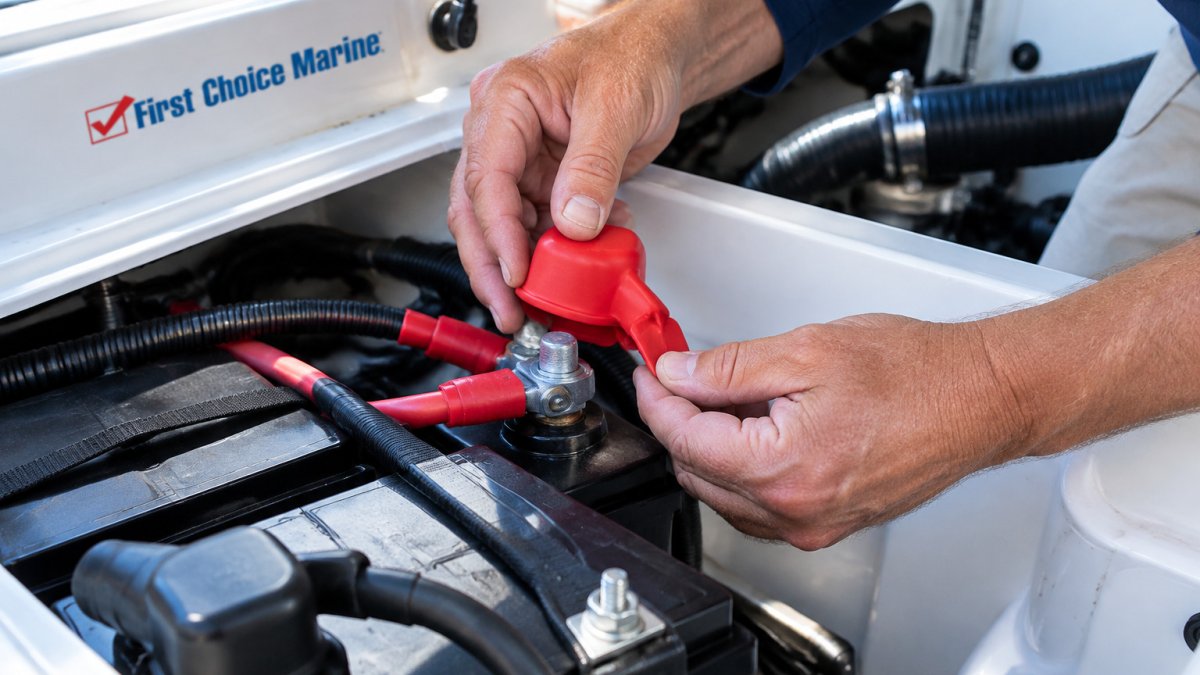
- Disconnect the negative cable first, then the positive, so the wrench cannot short the battery.
- Clean the posts and cable clamps with a wire brush, and rinse off any loose residue.
- Reconnect the positive cable first, then the negative, and tighten both clamps firmly.
- Slide the red cover over the positive connection and the black cover over the negative, making sure each fits snugly over the wing nut or terminal.
- Check that the cover sits flush and that no metal is exposed.
Inspect the covers each season. Cracked or swollen boots should be replaced, since a damaged cover stops insulating and lets moisture reach the metal. For steps to prevent corrosion before it starts, see our guide to preventing battery terminal corrosion. A cover that fits loosely after a few seasons is also worth replacing.
For help matching a cover to your battery, check the terminal style and cable gauge listed on each product page before ordering.
Frequently Asked Questions
What is the best way to protect marine battery terminals?
Fit a insulating cover over each terminal, clean the posts and clamps first, and use a corrosion-inhibiting protector on exposed metal. Covers made of injection-molded PVC, such as the Sea-Dog 415111 and 415112 bulk covers priced at $2.41 and $3.47 respectively, insulate wing nut terminals and help prevent accidental grounding. Inspect the covers periodically, because a cracked or missing cover leaves the terminal exposed.
Do battery terminal covers prevent corrosion?
Covers reduce corrosion by keeping moisture, salt spray and debris away from the post and clamp, but they do not seal the connection completely. Sea-Dog covers are designed to protect integral marine wing nut terminals from both corrosion and shorting. Remove a cover periodically to check for buildup, and clean any residue before refitting it.
Are battery terminal boots universal?
No. Boots are sized for specific terminal types and cable gauges. Seachoice offers separate versions for wing nut terminals, such as the 13681 marine cover priced at $7.87, and for standard terminals without a wing nut, such as the 13691 cover priced at $10.08. Check the terminal style and cable size before ordering.
How do you install marine battery terminal covers?
Disconnect the negative cable first, then the positive, so you avoid a short circuit with a wrench. Clean the posts and clamps, slide the red and black covers over their matching terminals, and make sure the cover seats fully. Reconnect the positive cable first, then the negative, and confirm that the covers stay in place.

