


Quick Summary
Alternatives to standard marine battery terminals include threaded studs with ring lugs, side terminals, stud adapters on posts, and military-style compression clamps. Each suits different needs, such as heavy current, tight compartments or vibration, and each needs matching post size, cable gauge and corrosion-resistant materials.
- Threaded stud connections bolt flat metal to flat metal, so the joint stays tighter than a clamp.
- Positive and negative posts are often different sizes, such as 3/8 inch and 5/16 inch, so confirm both before ordering.
- Clean and dry corroded metal before applying grease or a boot, since coating corrosion traps it underneath.
- Check terminal torque after the first few trips and again each season to prevent loosening.
- Avoid aluminum lugs on copper cable in wet areas because that joint corrodes aggressively.
Table of Contents
- Why Standard Marine Battery Terminals Aren't Always the Right Fit
- 12V Battery Terminal Types Compared Side by Side
- Battery Terminal Connectors: Stud, Ring Lug and Clamp Options
- Battery Terminals Positive and Negative: Sizing and Polarity
- What Are Battery Posts Made Of and How Materials Affect Corrosion
- When an Alternative Terminal Is the Wrong Choice
- Choosing the Right Terminal Setup for Your Boat
- Frequently Asked Questions
7 Alternatives to Standard Marine Battery Terminals
Last Updated: November 12, 2026
Why Standard Marine Battery Terminals Aren't Always the Right Fit
Marine battery terminals take a beating. Saltwater spray, engine vibration and tight engine compartments all work against a simple connection. For many boat owners, the standard terminal that came with the battery is the first part to fail. First Choice Marine has built its range around that reality, so this guide walks through the alternatives worth considering and where each one fits.
The standard setup is a threaded stud or a top post with a clamp. The trouble starts when the connection sees salt, heat or repeated removal. Corrosion builds at the contact surface, resistance rises, and starting power drops. A common mistake is replacing a corroded clamp with an identical one and expecting a different result.
12V Battery Terminal Types Compared Side by Side
Most 12-volt marine batteries use one of three terminal styles: top-post clamps, side terminals and threaded studs. Each has trade-offs in serviceability, contact area and resistance to vibration. The table below adds the selection criteria most guides skip: how each style behaves under load, what cable gauges it accepts, and where it fits.
| Terminal Type | Connection Method | Typical Cable Fit | Best For | Main Drawback |
|---|---|---|---|---|
| Top-post clamp | Wing nut or bolt clamp | 4 AWG to 2/0 AWG depending on lug | Quick removal, standard batteries | Loosens with vibration; contact area shrinks as lead corrodes |
| Threaded stud | Nut and lock washer over ring lug | 6 AWG to 4/0 AWG depending on stud | Heavy current, secure fit | Needs correct stud size; ring lug must match stud diameter |
| Side terminal | Bolt into side face | 6 AWG to 2 AWG typical | Tight compartments | Less common; limited fit options and fewer adapter choices |
| Stud adapter on post | Clamp base with stud top | 6 AWG to 2/0 AWG | Converting a post battery to stud connections | Adds a second connection point that can loosen |
| Military-style compression | Clamp with bolt-through compression | 4 AWG to 2/0 AWG | Vibration-heavy mounts | Bulkier; published marine test data is limited |
How to read the trade-offs. A clamp terminal depends on a wing nut or bolt squeezing lead against lead. That joint has real contact area when new, but lead creeps under vibration and the joint loosens; resistance rises and the terminal heats under starting load. A threaded stud with a ring lug bolts flat metal to flat metal, so the joint stays tight as long as the nut and lock washer hold torque. A side terminal puts the bolt into the battery case, which saves space but limits you to the bolt and adapter the battery maker intended.
Current capacity and voltage drop. Terminal current capacity is limited by the weakest point in the path: the stud diameter, the lug barrel, the cable gauge and the contact area. Match the stud and lug to the cable gauge rather than buying the largest terminal that fits.
Compatibility checks before you buy. Confirm the post diameter (positive and negative often differ), the stud thread and diameter, the cable gauge the lug barrel accepts, and whether the terminal clears the battery box lid. A stud adapter that fits the post but not the cable wastes the purchase.
Product examples in this category. The Seachoice Battery Terminals Marine 2-pk #13671 uses a lead alloy clamp with brass-plated wing nuts and fits all standard battery posts, with a 3/8-inch positive stud and a 5/16-inch negative stud. For owners who want a stud-style connection without replacing the battery, the Seachoice Battery Terminal Marine Bulk 10-pk #13730 converts standard battery post terminals to a marine stud connector and lets you remove the connector easily.
Watch out: a clamp that is only snug will work loose over time, and a stud adapter stacked on a corroded post hides the corrosion under the adapter. Clean both mating surfaces before assembly and recheck torque after the first few trips and again each season.
Battery Terminal Connectors: Stud, Ring Lug and Clamp Options
Connector style decides how the cable stays attached under load. Ring lugs bolt flat to a stud and resist loosening. Clamps grip the post and are faster to remove but depend on tight wing nuts.
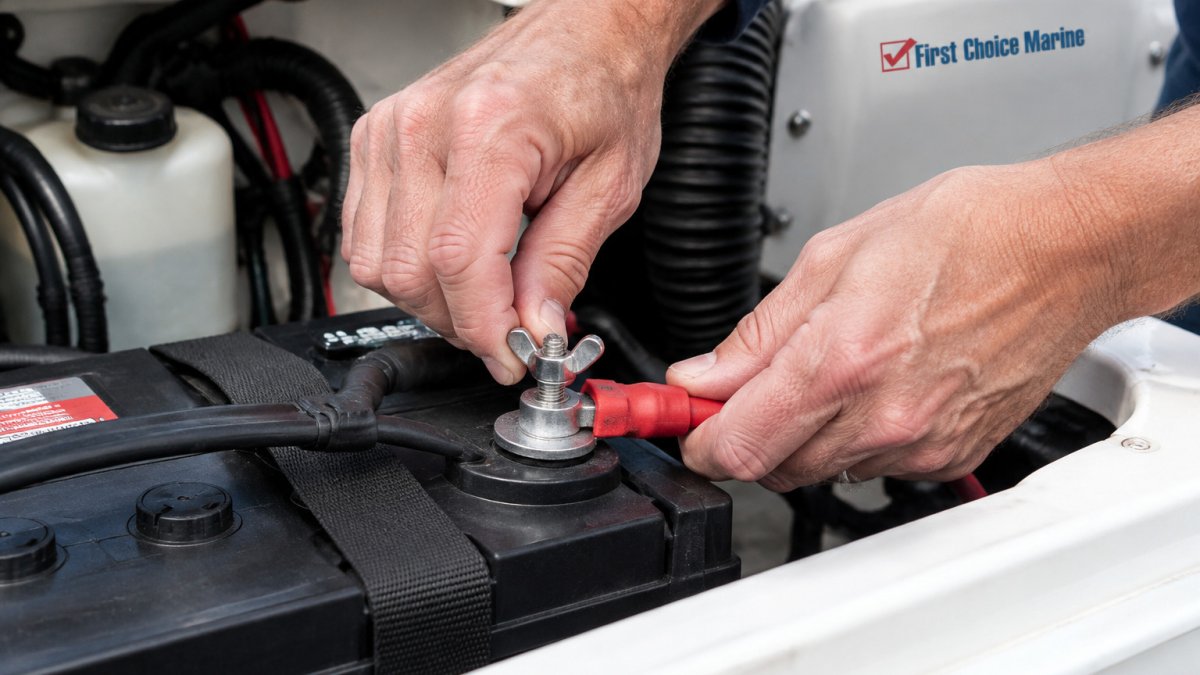
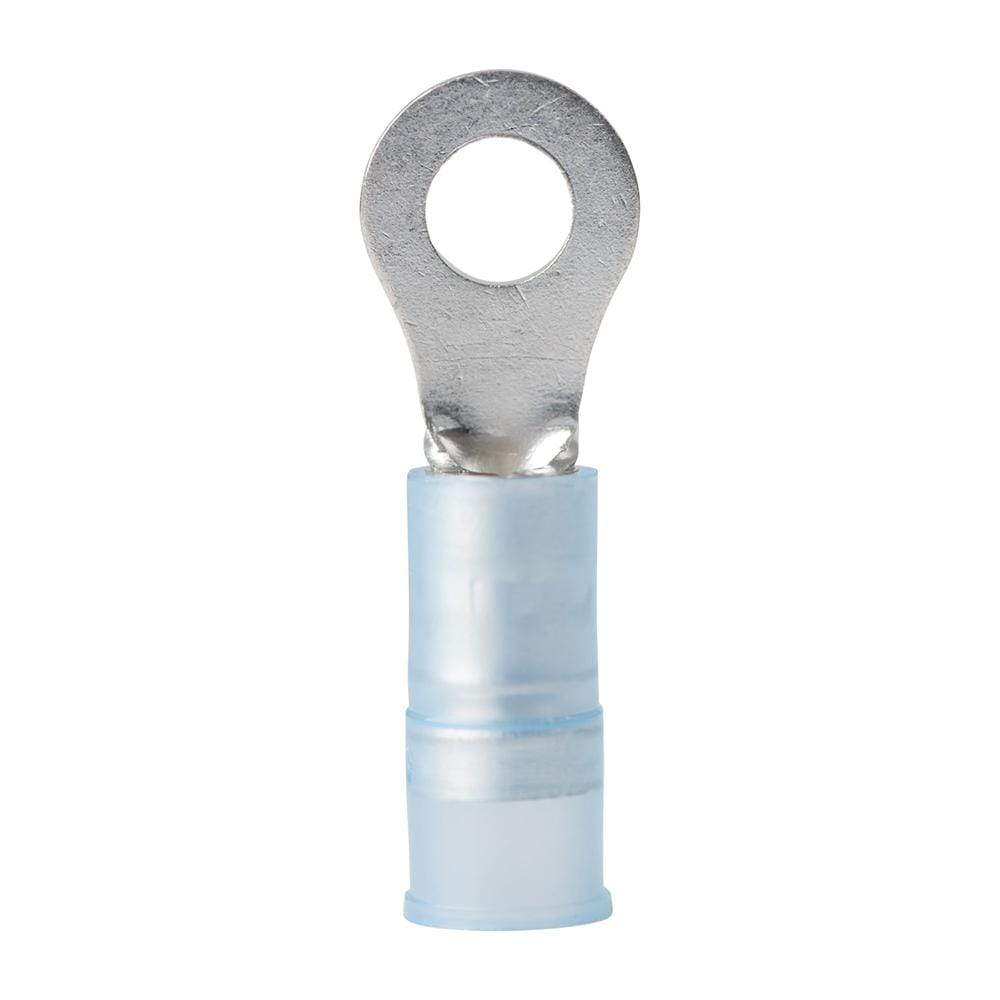
For owners who want a stud-style connection with a fast-release option, the Seachoice 13730 is the most direct fit. For a clamp setup with protective covers, the Seachoice 13661 red/black set adds an epoxy coating that aids polarity identification and corrosion resistance. Where the cable needs a ring terminal and the job calls for a shielded fuse, the EGIS RT Battery Terminal Mount Fuse Block (Model 8023) mounts directly on the terminal and accepts ATO fuses from 1 through 40 amps, with stainless steel self-locking hardware. For ring terminals in the gauge range covered here, see the ring terminal listing.
Watch out: a clamp that is only snug will work loose over time. Check torque after the first few trips and again each season.
Battery Terminals Positive and Negative: Sizing and Polarity
Positive and negative posts are not always the same size. On many marine batteries the positive stud is 3/8 inch and the negative is 5/16 inch, which is why mismatched hardware is a frequent source of wrong-fit complaints. Always confirm both posts before ordering.
Polarity matters for safety. Reversing the cables can damage electronics and, in the worst case, cause a fire. Color-coded covers, such as the Seachoice 13681 red and black boot set, help identify polarity at a glance and protect the terminal from accidental contact.
What Are Battery Posts Made Of and How Materials Affect Corrosion
Lead alloy posts and clamps are common because lead is soft, conforms to the post and forms a good seal. Brass plating on wing nuts resists some corrosion and keeps threads from galling. Stainless steel hardware holds up better in saltwater than plain steel, and tinned copper lugs resist the green corrosion that attacks bare copper in a damp engine compartment. To learn how battery management protections can reduce stress on terminals, read about BMS options for marine batteries.
Why dissimilar metals matter. When two different metals touch in the presence of an electrolyte such as saltwater spray, a galvanic couple can form, and the more active metal may corrode faster. The practical rule: keep the number of different metals in one stack as small as possible, and seal the joint so electrolyte cannot sit between them.
Material pairings to consider.
| Pairing | Behavior in Saltwater | Notes |
|---|---|---|
| Tinned copper lug + stainless stud and nut | Good | Tinning shields the copper; use a lock washer and sealant |
| Bare copper lug + stainless stud | Fair | Copper tarnishes and can corrode at the joint; inspect often |
| Brass clamp + lead post | Fair | Brass plating wears at threads; keep coated |
| Zinc-plated steel fastener + lead post | Poor in salt | Zinc is sacrificial and disappears; fits dry, sheltered installations only |
| Aluminum lug + copper cable | Poor | Aluminum-to-copper joints corrode aggressively; avoid in wet areas |
| Lead clamp + lead post | Good | Same-metal joint resists galvanic attack but still creeps and loosens |
Coatings and protection. The Seachoice 13661 red/black set uses an epoxy coating that aids polarity identification and corrosion resistance, and the Seachoice 13681 red and black boot set accommodates terminals with wing nuts.
Maintenance in saltwater. Inspect terminals each season and after any hard grounding or heavy spray. Look for white or green powdery buildup, which signals active corrosion, and for warmth at the terminal after a crank, which signals resistance. Clean with a baking-soda solution, rinse, dry fully, then reassemble with grease and correct torque.
Watch out: coating a corroded joint traps the corrosion under the coating, so clean and dry the metal before you apply grease or a boot.
When an Alternative Terminal Is the Wrong Choice
Alternatives are not automatically better. A threaded stud connector needs the right stud diameter, so swapping in a stud on a clamp-only battery can waste money. Fuse blocks and mounted accessories add weight and require space the compartment may not have.
Always confirm the terminal matches the battery post, the cable gauge and the load.
Choosing the Right Terminal Setup for Your Boat
Start with the battery post. Measure both posts, then match the terminal style to the connection that will stay tight in your installation. For frequent removal, a clamp with covers is practical. For high current and vibration, a stud connector with stainless hardware is the stronger option.
Next, consider exposure. Boats kept in saltwater need corrosion-resistant materials and protective covers. Boats kept dry can use lower-cost options. Finally, plan for maintenance: clean terminals, check torque and inspect for green or white buildup each season. To pair a charger with your battery and connections for longevity, see the marine battery charger guide.
Pick the setup that matches your posts and your conditions, and check the fit against your battery specification before you buy.
Frequently Asked Questions
What are the best replacement battery terminals for a boat?
For most boats, a marine stud terminal with plated wing nuts is the simplest replacement. Seachoice's 13730 10-pack converts standard battery posts to a marine stud connector and costs $57.86, and its 13671 2-pack, which uses a lead alloy clamp with brass-plated wing nuts, costs $19.08. Match the stud size to your cables: the 13671 set uses a 3/8-inch positive stud and a 5/16-inch negative stud. Choose the option that matches your existing cable ends rather than replacing the whole cable run.
Are marine battery terminals different from standard automotive terminals?
Yes. Standard automotive terminals clamp onto a tapered top post, while marine batteries commonly use threaded studs that accept ring-terminal cables and wing nuts. Marine setups also face saltwater, humidity and vibration, which makes corrosion resistance more important. The Seachoice 13661 2-pack uses an epoxy coating that aids polarity identification and corrosion resistance, costs $14.96, and fits standard battery posts.
Can you use a threaded-stud battery with ring-terminal cables?
Yes, if the stud diameter and thread match the ring terminal's hole. Confirm the stud size before buying cables, since mismatched studs are a common cause of loose connections. Seachoice's marine terminals use a 3/8-inch positive stud and a 5/16-inch negative stud, so check both ends before ordering. The Seachoice 2-2/0 AWG terminal cover set (#13681, $7.87) accommodates battery terminals with wing nuts.
How do you choose battery terminals for a boat?
Start with the battery post type, then the stud size, then the protection you need. Confirm whether your battery has top posts or side terminals, and whether your cables use ring lugs. Next, check the terminal material and whether it is designed for corrosion-prone environments. Finally, add a terminal cover or epoxy-coated set for exposed connections. Compare the Seachoice 13661 epoxy-coated set against the 13671 lead alloy set based on how exposed your battery compartment is.

