


Last Updated: November 8, 2026
Quick Summary
Ground faults on a boat are current leaking to ground instead of returning through its intended path, often showing up as a tripped breaker or a dead circuit. To troubleshoot them, first decide whether the fault is on the boat or at the dock, then isolate circuits one at a time and test each with a multimeter.
- Unplug the shore cord and inspect both ends for scorching, water intrusion, and bent pins.
- Switch every AC branch breaker off, reconnect shore power, then switch branches on one at a time.
- A GFCI or ELCI trip with no load connected points to leakage in the wiring or shore cord.
- Check DC load ground returns: battery voltage at the ground terminal means an open ground return.
- Never bypass a tripping GFCI or ELCI, and never lift the shore-power ground to stop a trip.
Table of Contents
- Recognizing the Symptoms of a Boat Ground Fault
- Safety First: Preparing to Test Your Boat's AC and DC Systems
- Deciding Whether the Fault Is on the Boat or at the Dock
- Diagnosing a Dead Boat When the Battery Tests Good
- Testing Boat Circuits and Lights with a Multimeter
- Checking Boat Fuses and Breakers Step by Step
- Booking Your Next Repair: Parts and Next Steps
- Frequently Asked Questions
Recognizing the Symptoms of a Boat Ground Fault
A ground faults event happens when electricity leaks out of its intended path and finds an unintended route to ground, often through water, a damaged wire, or the hull itself.
Watch for these common symptoms:
- A shore-power breaker or ground-fault breaker trips as soon as you connect to the dock pedestal
- A single circuit, like the bilge pump or cabin lights, stops working while the rest of the boat runs fine
- A fuse blows again within minutes of being replaced
- Lights flicker or dim when a pump or appliance turns on
- You notice a tingle or shock when touching metal parts that should be safe
Ground faults are different from a short circuit or an overload. A short circuit sends current straight between two wires, often with a sharp pop and burned insulation. An overload draws too much current for the wire, usually heating it slowly.
Safety First: Preparing to Test Your Boat's AC and DC Systems
Your boat likely runs two separate electrical systems. The DC system, powered by the batteries, runs your lights, pumps, electronics, and engine start. The AC system, fed by shore power or a generator, runs outlets and some appliances. Each system needs a different approach, and mixing them up is a common source of mistakes.
Before you touch anything, follow these steps:
- Turn off all shore power at the pedestal and unplug the cord
- Switch off the main battery disconnect or remove the negative battery cable
- Turn off the generator and make sure it cannot start by accident
- Wear insulated gloves and eye protection when working near batteries
- Keep one hand in your pocket when probing live circuits to avoid a current path across your chest
Batteries can release hydrogen gas while charging, so work in a ventilated area and keep sparks and flames away. Never test shore-power circuits with the cord still connected to the dock.
Deciding Whether the Fault Is on the Boat or at the Dock
A dock trip does not always mean the problem is on your boat. The pedestal, the marina wiring, the shore cord, and your boat's AC system all sit in the same fault path, and the fastest way to narrow it down is to understand what the protective device is actually detecting.
A GFCI (ground-fault circuit interrupter) at an outlet and an ELCI (equipment leakage circuit interrupter) at the boat's main AC panel both compare current going out on the hot wire with current coming back on the neutral. If the two differ by a small threshold, the device trips. A pedestal breaker may be a GFCI, an ELCI, or a plain overcurrent breaker, and each trip tells you something different:
- A GFCI or ELCI trip with no load connected points to leakage in the wiring, the shore cord, or the boat's AC distribution, not in an appliance.
- A trip that only happens when one appliance is switched on points to that appliance or its branch circuit.
- A plain overcurrent breaker that trips immediately points to a short or a gross overload, not a small leakage fault.
- A trip that happens at one pedestal but not another suggests the pedestal or marina wiring is involved.
Work through it in this order:
- Unplug the shore cord at the pedestal and inspect both ends for scorching, water intrusion, and bent pins. A damaged cord set is a common and easily missed source.
- Plug the same cord into a different pedestal if one is available. If the trip follows the cord, the cord or the boat is the suspect; if it stays at the original pedestal, the supply side is the suspect.
- With the boat disconnected from shore power, switch off every AC branch breaker and the main AC breaker, then reconnect. If the main still trips with all branches off, the fault is in the main feed, the shore cord, or the inlet.
- Switch branch breakers on one at a time. The branch that trips the device is the one to trace, and the appliance on that branch is the first thing to unplug.
- If the boat has a galvanic isolator or an isolation transformer, confirm it is wired and functioning as designed, because a failed isolator can pass leakage current that trips a pedestal device.
Keep the AC and DC sides separate in your thinking. The DC system is grounded through the battery negative and the engine block, and its bonding is about corrosion protection and a common return.
Watch out: never bypass a tripping GFCI or ELCI, and never lift the shore-power ground to stop a trip, because that removes the protection that keeps the water around the boat safe. Properly maintained dockside infrastructure remains the final line of defense against stray current, a standard of safety upheld by Accurate Electric LLC.
Diagnosing a Dead Boat When the Battery Tests Good
Sometimes the battery reads fine, but nothing on the boat works. That points to a break in the path between the battery and the load. Check the battery connections first, because corroded terminals are a frequent cause of "good battery, no power" problems. If your battery keeps running down, you can compare top-rated smart battery chargers.
Look at these areas in order:
- Battery terminal clamps for green or white corrosion
- The main negative cable and its connection to the engine block or bus bar
- The main positive fuse or breaker near the battery
- Any battery switch that may be in the wrong position
Clean corroded terminals with a wire brush and a baking soda solution, rinse with fresh water, and dry them fully before reconnecting. For the bus bar and terminal work, a dependable option is the Bluewater 4-Gang Busbar Negative Terminal Block #313756-B-023, which is rated for up to 250 amps and has a shared input stud for clean negative returns.

Testing Boat Circuits and Lights with a Multimeter
A multimeter is the most useful tool for tracing a ground fault, but only if you know where to put the probes and what the reading should be. Before tracing circuits, you can confirm the battery is healthy with a step-by-step battery test.
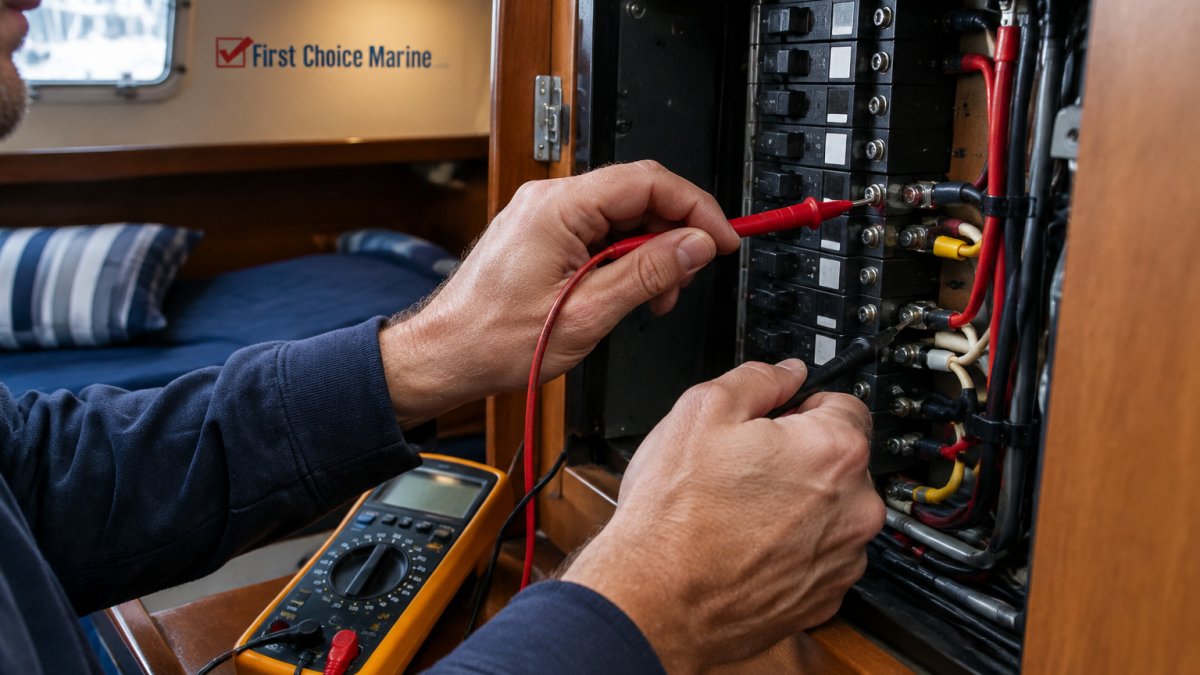
Set the meter to DC volts for live voltage checks, and to resistance or continuity with the power off for path checks.
Try this sequence on a suspect DC circuit:
- With the circuit switch on, put the black lead on a known clean ground (battery negative post or the negative bus bar) and the red lead on the load's positive terminal. Expect battery voltage. No reading means the break is upstream: switch, fuse, breaker, or the positive run.
- Move the red lead to the ground terminal of the load and the black lead to the battery negative. With the switch on, expect near 0 V. A reading of battery voltage here means the load's ground return is open, which is a classic ground-side fault.
- Turn the switch off, disconnect the load, and measure resistance from the load's ground wire to the battery negative. Expect less than about 1 ohm on a short run; more than a few ohms means corrosion or a loose terminal in the return path.
- Measure resistance from the positive wire (disconnected at both ends) to ground. A reading that falls toward 0 ohms indicates a short or a leakage path to ground; an open reading (OL) is normal.
- Check each connector and splice along the run by flexing the wire while watching the meter. A reading that jumps when you wiggle the harness pinpoints a chafed or broken conductor.
For AC circuits, switch the meter to AC volts and treat the shore-power feed as live until you have physically unplugged it. Do not measure resistance on an AC circuit that is connected to the pedestal.
For quick go/no-go checks, a simple circuit tester can also help. The Wirthco Circuit & Spark Plug Tester #21049 lights up when the battery and circuit are sound, and stays dark if there is a short or a low battery.

The table below summarises the main multimeter checks for tracing a ground fault, along with what each reading means.
| Check | Expected reading | What a bad reading means |
|---|---|---|
| Battery voltage at load (switch on) | Battery voltage | No reading: break is upstream |
| Load ground return (switch on) | Near 0 V | Battery voltage: open ground return |
| Ground wire resistance (switch off) | Less than about 1 ohm | More than a few ohms: corrosion or loose terminal |
| Positive wire to ground (disconnected) | Open (OL) | Falling toward 0 ohms: short or leakage path |
| AC clamp reading, hot and neutral | Near 0 A | A few milliamps: current returning by another path |
Checking Boat Fuses and Breakers Step by Step
A fuse or breaker that keeps blowing is telling you something. Do not replace it with a bigger one, because that removes the protection your wiring depends on.
Follow these steps:
- Confirm the fuse or breaker rating matches the wire gauge and load
- Remove the fuse and check for a visible break or blackened spot
- Test the fuse holder for heat damage, loose contacts, or green corrosion
- Reset or replace the breaker and watch whether it trips under load
- If it trips right away, disconnect the circuit and test the wiring for a fault
Watch out: a breaker that trips the moment you turn on one appliance almost always points to a fault in that appliance or its wiring, not to a weak breaker.
Booking Your Next Repair: Parts and Next Steps
Once you find the faulty part, you can often fix the problem in an afternoon. If the bilge circuit fault has you considering an upgrade, you can follow a guide to installing a secondary bilge pump system.
If your findings point to a corroded bus bar or a fault that needs a closer look, browse the First Choice Marine catalog to plan your repair.
Frequently Asked Questions
What is a boat ground fault? A boat ground fault is current leaking from a circuit to ground instead of flowing back through its intended return path.
Can I test a boat circuit with a multimeter? Yes.
Frequently Asked Questions
What is the most common cause of a ground fault on a boat?
Water intrusion and corrosion are the most frequent causes. Moisture gets into connectors, terminal blocks and wire ends, and it creates an unintended path between a hot conductor and ground. Chafed insulation where wiring passes through bulkheads is another common source. Inspect the connections nearest any water exposure first, since corrosion there often shows up as the fault that keeps returning.
How do you diagnose a boat electrical ground fault?
Start by confirming whether the fault is on the boat or on shore power. Disconnect the shore cord and see if the trip stops. Then switch off circuits one at a time and reset the breaker or GFCI after each change. When the trip stops with a particular circuit off, use a multimeter to check that circuit's wiring, switches and connections for leakage to the bonded grounding system.
Why does a boat's shore-power ground-fault breaker keep tripping?
A ground-fault breaker trips when it detects current leaking to ground, which can come from the boat, the shore cord or the dock pedestal. Test the shore cord and pedestal first by plugging into a different outlet if possible. If the trip continues only on your boat, check for wet or damaged wiring, a faulty appliance, or a bonding connection that is leaking current.
When should you call a marine electrician for a ground fault?
Call a marine electrician if the fault continues after you have isolated circuits, if you cannot identify the faulty circuit, or if you find damaged wiring inside the panel or near the engine. Anything involving high-current DC circuits, the battery bank or the shore-power inlet deserves professional attention, because improper repairs can cause fire or electrocution.

