


Table of Contents
- Tools You Need to Test a Boat Battery
- Step 1: Safety Checks Before You Touch a Terminal
- Step 2: Measure Resting Voltage With a Multimeter
- Step 3: Run a Load Test and Check Cranking Amps
- Signs of a Bad Boat Battery You Should Not Ignore
- Battery vs. Charging System: How to Tell Which One Failed
- Testing Lithium (LiFePO4) Batteries vs. Lead-Acid
- Choosing the Best Marine Battery Tester for Your Boat
- Frequently Asked Questions
Last Updated: September 19, 2026
Tools You Need to Test a Boat Battery
Learning how to test boat battery health starts with two tools: a multimeter and a load tester. This First Choice Marine guide walks you through both.
Here's what to gather before you start:
- A digital multimeter with DC voltage settings
- A load tester or digital battery tester
- Safety glasses and gloves
- A wrench for terminal bolts
- A wire brush for cleaning corrosion
Multimeter vs. Digital Battery Tester
A multimeter is best for quick voltage checks and basic troubleshooting. A digital battery tester goes further, reading cranking amps and internal resistance in seconds.
Step 1: Safety Checks Before You Touch a Terminal
Safety comes first because a marine battery holds real energy. One wrong move with a wrench can arc, spark, or burn.
Do these checks before you touch anything:
- Turn off the engine and all accessories
- Remove watches, rings, and metal jewelry
- Put on safety glasses and gloves
- Make sure the boat is well ventilated
- Check for cracks, leaks, or swollen cases
Step 2: Measure Resting Voltage With a Multimeter
Resting voltage is the battery's voltage with no load and no recent charging, the clearest sign of state of charge. Let the battery sit at least two hours before testing; if it was just charged or run, surface charge will throw off your reading.
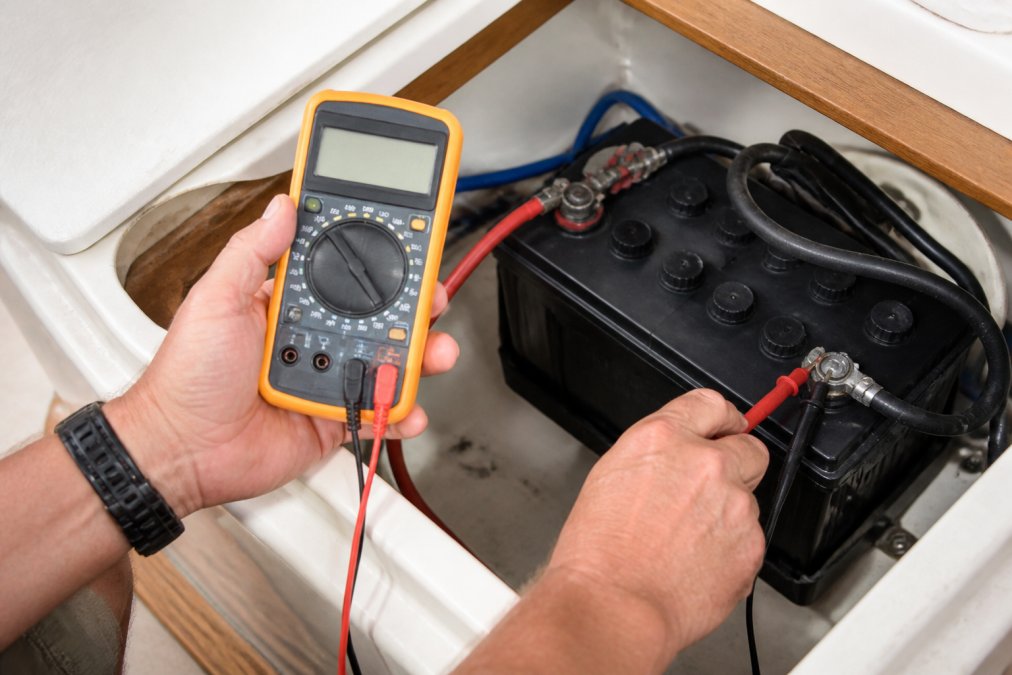
- Set the multimeter to DC voltage, 20V range
- Touch the red probe to the positive terminal
- Touch the black probe to the negative terminal
- Hold steady and read the display
How to Read a Marine Battery Voltage Chart
A marine battery voltage chart turns a number into a state of charge. Use this one as your quick reference:
Voltage |
State of Charge |
What It Means |
|---|---|---|
12.6V+ |
100% |
Fully charged |
12.4V |
75% |
Good, top it off |
12.2V |
50% |
Charge soon |
12.0V |
25% |
Low, charge now |
Below 11.8V |
0% |
Discharged or failing |
Step 3: Run a Load Test and Check Cranking Amps
A resting voltage check tells you state of charge, not whether the battery can deliver the burst of current your starter needs. A battery can sit at a healthy 12.6V and still fail the moment you hit the key, that is why the load test matters.
- Carbon-pile load tester. Applies a fixed heavy draw (often around half the rated CCA) for 15 seconds. Traditional, works on any lead-acid battery, but gets hot after a few tests.
- Digital conductance tester. Sends a small AC signal through the plates and estimates CCA and internal resistance in seconds. Safe, repeatable, and fast, but an estimate, not a true cranking simulation.
- Load test at the engine. Cranking with a voltmeter clipped to the terminals is the most realistic test, using your actual starter and cables. Watch minimum voltage during a 5-10 second crank.
How to Run a Carbon-Pile or Resistive Load Test
- Confirm the battery is at least 75% charged (about 12.4V resting). Never load-test a discharged battery, you will get a false failure.
- Connect the tester's clamps to the correct posts. Red to positive, black to negative.
- Apply the load for 15 seconds and watch the needle or display.
- Read the voltage at the 15-second mark, then release the load.
For a 12V lead-acid battery at room temperature, the pass/fail line is 9.6V under load. Below that, it is weak or failing. A battery that starts near 10.5V and sags to 9.0V within seconds is on its way out even if it still starts on a warm day.
Cranking Amps: What the Number Actually Means
Tester Reading vs. Label CCA |
Verdict |
|---|---|
90-100% |
Healthy |
70-89% |
Aging, monitor closely |
Below 70% |
Replace before it strands you |
When a Voltage Check Is Not Enough
A multimeter cannot measure capacity, only electrical pressure at the terminals. A sulfated battery with almost no usable capacity can still read 12.6V at rest, then collapse under load. If your engine cranks slowly but resting voltage looks fine, the battery has lost capacity, and only a load or conductance test will show it. This is the most common misdiagnosis in marine electrical work.
Signs of a Bad Boat Battery You Should Not Ignore
The signs of a bad boat battery show up before it dies completely. Catching them early saves a day on the water.
Watch for these red flags:
- Slow or sluggish engine cranking
- Dim lights or weak electronics
- A swollen or cracked case
- Corroded terminals that return after cleaning
- A voltage reading that won't hold a charge
- A rotten egg smell, which points to sulfation
Battery vs. Charging System: How to Tell Which One Failed
A dead battery is a symptom, not always a diagnosis. Three failures produce the same no-start result, and each needs a different fix:
- The battery has lost capacity and cannot hold a charge.
- The charging system (alternator, belt, wiring, or connections) is not refilling the battery.
- Something on the boat is draining the battery while it sits (parasitic draw).
Step 1: Establish a Baseline
Charge the battery fully with a shore-powered charger, then let it rest for at least two hours with nothing connected. Read resting voltage:
- Near 12.6V: the battery is holding a charge. Move on to the charging system test.
- Below 12.4V after a full charge and rest: the battery is not accepting or holding charge. It is the likely culprit.
Step 2: Test the Charging System Under Load
Start the engine and let it idle. Clip your multimeter to the battery terminals and read voltage:
Reading at Idle |
What It Means |
|---|---|
13.6-14.4V |
Charging system is working |
12.8-13.5V |
Undercharging, check belt tension, connections, and alternator output |
Below 12.6V |
Not charging, alternator, regulator, or wiring fault |
Above 14.8V |
Overcharging, regulator fault, which cooks the battery |
Step 3: Run a Voltage-Drop Test on the Cables
This is the test most DIYers skip, and where many "bad battery" diagnoses go wrong. Corroded or undersized cables add resistance that steals voltage before it reaches the starter.
- The battery positive post and the starter positive terminal
- The battery negative post and the engine block
Step 4: Check for a Parasitic Draw
- Fully charge the battery and let it rest.
- Disconnect the negative cable.
- Set your multimeter to DC amps (or milliamps) and connect it in series between the negative post and the negative cable.
- With everything off, read the draw.
Testing Lithium (LiFePO4) Batteries vs. Lead-Acid
Lithium batteries don't follow the same rules as lead-acid. This is the part most guides skip.
Key differences:
- Lithium resting voltage sits higher, near 13.2V
- State of charge is harder to read from voltage alone
- A battery management system (BMS) may shut off output to protect the cells
- Load testing needs a tester rated for lithium
Choosing the Best Marine Battery Tester for Your Boat
The best marine battery tester for most boat owners is a digital unit that reads voltage, CCA, and internal resistance in one, faster and safer than a load tester alone.
When you shop, look for:
- DC voltage and CCA readings
- Support for both lead-acid and lithium
- Clear display and simple controls
- Reverse-polarity protection
Frequently Asked Questions
What voltage should a fully charged 12V marine battery read?
A fully charged 12V marine battery should read about 12.6V to 12.8V at rest, meaning it has been sitting for at least a few hours without a charger or load. At 12.4V you are around 75% state of charge, and anything below 12.0V is considered deeply discharged. Let the battery rest before testing, since surface charge from a recent charge can push readings artificially high.
How do I know if my marine battery needs replacing?
Replace the battery if resting voltage stays below 12.4V after a full charge, if it fails a load test, or if it will not hold a charge overnight. Physical clues matter too: swollen cases, cracked housings, or persistent terminal corrosion that returns after cleaning all point to a battery near the end of its life. A hydrometer check on flooded lead-acid batteries can confirm sulfation in individual cells.
How can I tell if the battery is bad or just dead?
A dead battery accepts a charge and holds voltage afterward. A bad battery either will not take a charge or drops back below 12.4V within hours of charging. Charge it fully, let it rest, then measure resting voltage. If it reads low, run a load test. If voltage collapses under load, the battery has failed internally rather than simply being discharged.
Can I use a regular multimeter to test a boat battery, or do I need a special tester?
A basic multimeter measures resting voltage and helps you spot voltage drop, which covers most DIY diagnostics. For cranking amps and load testing, a dedicated digital battery tester gives you a clearer pass or fail result without pulling the battery. Many boat owners keep both: a multimeter for quick checks and a tester for seasonal inspections.
Battery problems can cut a fishing trip short, but they rarely come out of nowhere. With a multimeter, a load tester, and a few minutes at the dock, you can catch a failing battery before it strands you. First Choice Marine carries the electrical gear and maintenance supplies to keep your vessel running, backed by over 100 years of marine hardware experience and free shipping. Sign in to your account and get the right tools for your next battery check.
