


Table of Contents
- Best Fishfinder Electronics for 2026: Top Picks
- How to Choose a Fish Finder: Key Specs That Matter
- CHIRP vs Side Imaging Sonar: Which Is Right for You?
- Fishfinder Installation Tips for a Clean Setup
- Marine Electronics Maintenance: Protect Your Investment
- Power, Networking, and Integration: What Competitors Miss
- Best Fishfinder Electronics for 2026: Final Verdict
- Frequently Asked Questions
Last Updated: September 19, 2026
Best Fishfinder Electronics for 2026: Top Picks
Shopping for the best fishfinder electronics for 2026 starts with one decision: how much technology do you actually need on your boat? At First Choice Marine, we've spent over 100 years helping boaters sort through that question. This guide breaks down the units and features worth your money this year, from budget-friendly depth sounders to live sonar systems that show fish in real time.
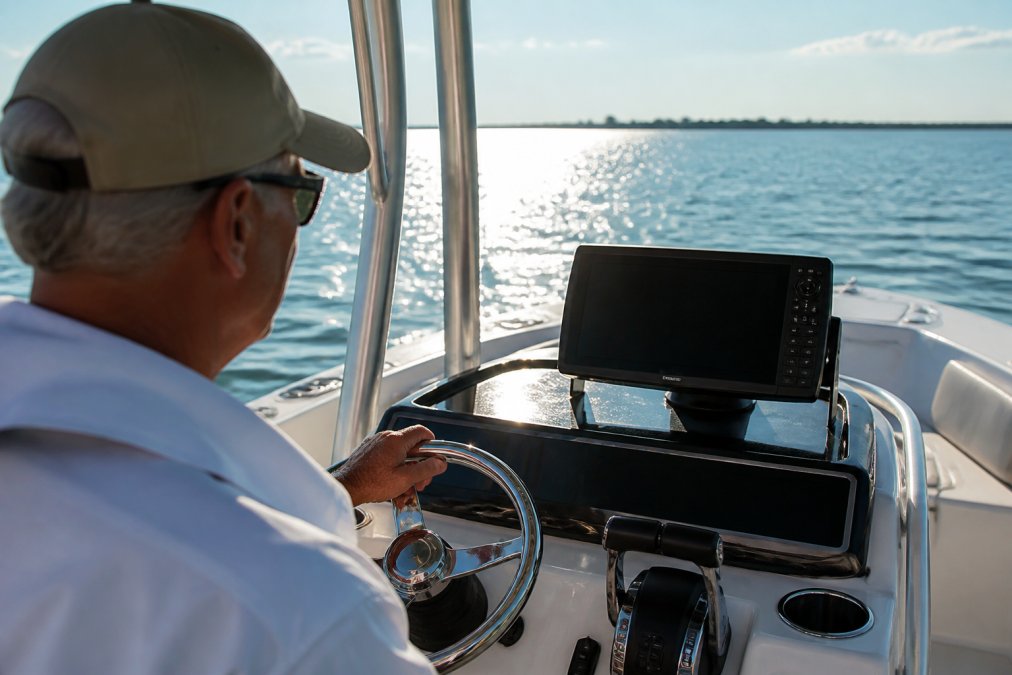
Here's what matters most: modern fishfinders split into three tiers, and each one suits a different kind of boater.
Best Overall Fish Finder
The best overall fishfinder electronics for 2026 combine CHIRP sonar, GPS mapping, and a bright touchscreen in one unit. Look for a display in the 7 to 9 inch range with down imaging and built-in charts. Those three features cover bass lakes, coastal bays, and everything between, which is why this tier suits the widest range of boaters. Expect to pay more for screen size than for sonar capability; the transducer often matters more than the head unit.
Best Fish Finder for the Money
Value shoppers should prioritize a dual-frequency transducer and a 5 inch display over extra features. A unit with 200 kHz and 50 kHz coverage handles shallow and deep water without the price jump that comes with side scan. Many boaters find that a mid-range unit paired with a quality transducer outperforms a premium head unit running a cheap one. Check mounting bracket compatibility before you buy, since older consoles sometimes need an adapter plate.
Best Live Sonar Technology
Live sonar, also called forward-facing sonar, shows fish swimming in real time rather than as static arches. It's the biggest shift in fishfinder electronics in years, and it's genuinely useful for locating suspended fish around structure. The trade-offs are real: these systems draw more power, cost significantly more, and demand careful transducer mounting to work well. For tournament anglers chasing suspended bass, it's worth it. For casual weekend fishing, a good CHIRP unit will do the job.
How to Choose a Fish Finder: Key Specs That Matter
Choosing a fishfinder comes down to five specs: sonar type, frequency, transducer power, screen resolution, and mapping. Everything else is convenience. The most common mistake is buying a large screen to compensate for a weak transducer; that's backwards. Sonar performance starts at the transducer, and the display only shows what the transducer sends back.
Here's how to read each spec without getting buried in marketing language.
Transducer Power: RMS Watts vs. Peak-to-Peak
Transducer power is quoted two ways, and the difference matters. RMS wattage is the continuous, real-world number; peak-to-peak is a marketing figure that can run 8 to 10 times higher. A unit advertised at "4,000 watts" is usually a 500-watt RMS transducer. For freshwater lakes and coastal bays under about 200 feet, 250 to 500 watts RMS is plenty. For deep offshore bottom fishing past 600 feet, step up to 1,000 watts RMS and a lower frequency.
Cone Angle and Coverage
Cone angle determines the diameter of the sonar footprint on the bottom. A 20-degree cone at 100 feet covers roughly a 35-foot circle; a 60-degree cone covers closer to 115 feet. Wide cones find more fish but blur target separation; narrow cones give crisp detail over a small patch. Dual-beam and tri-beam transducers solve this by stacking a narrow high-frequency beam inside a wide low-frequency one, so you get coverage and detail from a single mount.
Screen Resolution and Brightness
Resolution is measured in pixels, and pixel density matters more than raw screen size. A 7-inch display at 800x480 looks coarser than a 7-inch at 1024x600, especially with side imaging, where a single screen splits into multiple panes. Brightness is quoted in nits; anything under 1,000 nits washes out in direct sun. If you fish open water without shade, prioritize nits over inches.
Mapping and Chart Compatibility
Built-in charts are convenient, but the ecosystem matters more. Check whether the unit accepts a chart card you can update, and whether it supports contour mapping you build yourself from sonar logs. Self-generated maps are the single biggest upgrade for anglers who fish the same lakes repeatedly, because they show structure no commercial chart captures.
A Quick Decision Framework
- Under $300: 5-inch display, dual-frequency 200/50 kHz, no side scan. Buy the best transducer you can afford.
- $300 to $800: 7 to 9-inch touchscreen, CHIRP, down imaging, GPS with a chart card slot.
- $800 and up: 9 to 12-inch display, side imaging, live sonar compatibility, NMEA 2000 networking.
Understanding Sonar Frequencies
Sonar frequency determines depth penetration and detail, and it's the spec most buyers skim past. Lower frequencies, around 50 kHz, push deeper with a wider cone angle but return less detail. Higher frequencies, around 200 kHz, deliver sharper target separation in shallower water. Dual-frequency units switch between both, which is why they're the practical choice for boaters who fish varied depths.
CHIRP Sonar Explained
CHIRP sonar is a sonar method that sweeps a range of frequencies in each pulse instead of firing a single one. That sweep returns stronger echoes and cleaner target separation, so individual fish stand out from structure instead of blurring together. CHIRP has moved from premium units into mid-range models, and for most freshwater and nearshore fishing it's the single most useful upgrade you can make.
CHIRP vs Side Imaging Sonar: Which Is Right for You?
CHIRP and side imaging solve different problems, and the right pick depends on how you fish. CHIRP looks straight down and tells you what's below the boat with excellent clarity. Side scan looks left and right across a wide swath, which makes it the better tool for finding structure and covering water fast. Many anglers run both: side scan to locate, CHIRP to confirm.
Sonar Type |
What It Shows |
Best For |
Main Limitation |
|---|---|---|---|
CHIRP |
Detail directly below the boat |
Vertical jigging, suspended fish |
Narrow coverage |
Side scan |
Structure to the sides |
Finding cover, mapping |
Harder to read for beginners |
Down imaging |
Photo-like view below |
Structure identification |
Shallow water only |
Live sonar |
Real-time fish movement |
Tournament fishing |
High power draw |
Fishfinder Installation Tips for a Clean Setup
A clean fishfinder installation protects both your investment and your boat's electrical system. Start with transducer placement: mount it where it stays in contact with smooth water at speed, away from strakes, rivets, and the propeller's turbulence. Route cables with slack at both ends, seal every hull penetration with marine-grade sealant, and keep power runs short and fused. A common mistake is tapping into an existing circuit; dedicated wiring with its own fuse prevents the interference that causes flickering screens and erratic depth readings.
Marine Electronics Maintenance: Protect Your Investment
Marine electronics maintenance comes down to three habits: rinse, inspect, and update. Rinse units and connectors with fresh water after saltwater exposure, inspect transducer faces for growth and nicks, and keep software current. Corrosion at the connector is the most frequent failure point, so a light application of dielectric grease on terminals prevents most of it. Store removable units out of direct sun when the boat sits, and check mounting bracket hardware each season; vibration loosens fasteners long before electronics fail.
Power, Networking, and Integration: What Competitors Miss
Power budget and network integration decide whether your electronics perform or disappoint, and most buying guides skip both. Live sonar and large displays can pull serious current, so check your battery capacity and charging output before adding a second screen. If you plan to network units, confirm NMEA 2000 support and whether your trolling motor can share waypoints with the fishfinder.
Best Fishfinder Electronics for 2026: Final Verdict
The right fishfinder electronics for 2026 depend less on brand and more on matching sonar type to how you fish. Buy the transducer first, the screen second, and skip features you won't use. If you're upgrading an older boat, verify mounting and power compatibility before ordering so the install goes smoothly the first time.
Frequently Asked Questions
What is the latest fish finder technology for 2026?
Live sonar and forward-facing sonar lead the 2026 lineup. These systems show real-time movement of fish and bait around your boat, not just a historical scroll. CHIRP sonar remains standard for depth and target separation. Many units now include GPS waypoints, NMEA 2000 networking, and touchscreen interfaces. When shopping, look for units with software update support so your fishfinder electronics stay current for years.
Is CHIRP better than traditional sonar?
CHIRP sonar sends a sweep of frequencies instead of a single pulse. That gives you better target separation, clearer fish arches, and stronger returns in deep water. Traditional dual-frequency sonar still works for basic depth readings and structure scanning. If you fish deeper than 100 feet or want to tell individual fish apart near structure, CHIRP is worth the upgrade. For shallow flats, the difference is less noticeable.
What features are essential for offshore versus inshore fishing?
Offshore fishing demands higher power output, dual-frequency or CHIRP sonar, and a transducer rated for deeper depth ranges. A larger screen with high resolution helps you read bottom structure at speed. Inshore anglers benefit more from side scan and down imaging for shallow structure, plus a compact mounting bracket. Both setups need reliable GPS waypoints and mapping software. Match your transducer cone angle to your typical fishing depth.
How much should I spend on a quality fishfinder?
Pricing depends on screen size, sonar type, and networking features. First Choice Marine carries a range of options for different budgets. Check the website for current pricing and bundles. Focus on the features you will actually use rather than paying for technology you will not operate.
Upgrading your boat's electronics shouldn't mean guesswork or surprise costs. First Choice Marine carries trusted navigation and fishfinding electronics, marine-grade electrical components, and the maintenance supplies that keep them running, all backed by over 100 years of marine hardware experience and free shipping. Sign in to your account and get the right gear for your next trip on the water.
