


Table of Contents
- Product Overview and Features
- Removing Oxidation From Fiberglass Boat Surfaces
- Sanding Scratch Removal Capabilities
- Marine Compound vs Polish: Understanding the Difference
- Best Marine Polishing Pads and Application Techniques
- Troubleshooting Common Buffing Errors
- Storage and Environmental Best Practices
- Final Verdict: Which Compound System Fits Your Boat
- Frequently Asked Questions
Last Updated: September 20, 2026
Product Overview and Features
The 3M marine compound and finishing material lineup represents the industry standard for restoring fiberglass and gelcoat surfaces. These fast-cutting formulations are engineered to remove heavy oxidation, weathering, and sanding scratches in a single or multi-step process. The marine coatings market itself is valued at $4.56 billion, according to Coherent Market Insights, with specialized gelcoat finishing systems driving growth toward an estimated $7.08 billion by 2033.
3M engineered different cutting levels for different damage depths: the Perfect-It Gelcoat Heavy Cutting Compound removes P800 scratches with a high gloss finish, the Medium Cutting Compound Plus Wax combines cutting, polishing, and wax in one step, and the Super Duty Rubbing Compound handles 1000-grit scratches on paint and gelcoat.

At First Choice Marine, we stock a comprehensive selection of 3M marine compound and finishing materials because restoring a boat's finish requires the right tool for each stage.
| Product | Best For | Starting Price | Key Benefit |
|---|---|---|---|
| Perfect-It Heavy Cutting #36103 | Deep oxidation, P800 scratches | $332.38 (gallon) | Fastest cutting, long wet time |
| Perfect-It Medium Cutting #36106 | General oxidation, P1000 scratches | $69.57 (quart) | Cut + polish + wax in one step |
| Super Duty Rubbing #05955 | 1000-grit scratches, economical use | $148.54 (gallon) | High cut rate, hand or machine application |
| Perfect-It EX Rubbing #36060 | Extreme conditions, best performance | $98.75 (quart) | Extra cutting, smooth handling |
Removing Oxidation From Fiberglass Boat Surfaces
Oxidation is the chalky, dull film that forms when UV rays break down gelcoat's protective resin layer. Oxidized gelcoat is porous and compromised, absorbing water and salt spray that accelerates deterioration. Removing it requires a compound aggressive enough to cut through the oxidized layer without scratching sound gelcoat.
The 3M marine compound and finishing material system addresses oxidation in stages. Heavy oxidation demands the Perfect-It Gelcoat Heavy Cutting Compound, which uses aggressive mineral abrasives to cut through weathering and chalking quickly. According to Practical Sailor, this fast-cutting solution is specifically engineered for heavily oxidized and scratched boat finishes. The formula's long wet time means you use less product, critical when treating large hull areas.
For moderate oxidation, the Medium Cutting Compound Plus Wax removes oxidation and P1000 scratches while leaving a wax finish, eliminating the need for a separate polishing step.

3M compounds contain suspended mineral particles that are harder than the oxidized layer but softer than intact gelcoat. Pressure and pad speed control cutting aggressiveness, too much pressure grinds through sound finish, too little doesn't reach the oxidation layer.
Sanding Scratch Removal Capabilities
Sanding scratches are the visible pattern left by abrasive grit after surface preparation. The 3M marine compound and finishing material formulations are matched to specific grit levels to remove the scratch pattern without creating new defects.
The Perfect-It Gelcoat Heavy Cutting Compound removes P800 scratches or finer in one or two passes with a rotary buffer, achieving high-gloss finish without swirl marks when applied correctly.
The Marine High Gloss Gelcoat Compound (#06025) targets P600 dual-action or P1000 wet sanding scratches, removing the scratch pattern and waterline marks while restoring glossy appearance.
The Super Duty Rubbing Compound removes 1000-grit scratches on all paint and gelcoat surfaces, remains wet longer, and buffs to high gloss with minimum effort, ideal for hand application on areas where a rotary buffer won't fit.
Marine Compound vs Polish: Understanding the Difference
Compound is aggressive, containing coarse mineral abrasives to remove defects, oxidation, sanding scratches, and waterline stains. The 3M marine compound and finishing material compounds (Heavy Cutting, Medium Cutting, Super Duty) cut material away on damaged or heavily oxidized surfaces.
Polish is refinement, containing finer abrasives to smooth the surface after compounding and enhance gloss. Polish removes fine scratches left by compound but won't touch oxidation or deep sanding scratches.
If your boat's gelcoat is dull and oxidized, use compound first, applying polish to oxidized gelcoat seals the problem underneath. Using compound on lightly scratched sound surfaces wastes aggressive abrasive.
The 3M Perfect-It Medium Cutting Compound Plus Wax combines compound and wax in one product for moderate damage, but isn't aggressive enough for heavy oxidation or as refined as dedicated polish for final finishing.
Best Marine Polishing Pads and Application Techniques
The buffing pad is as critical as the compound, the wrong pad will clog, overheat, or leave swirl marks.

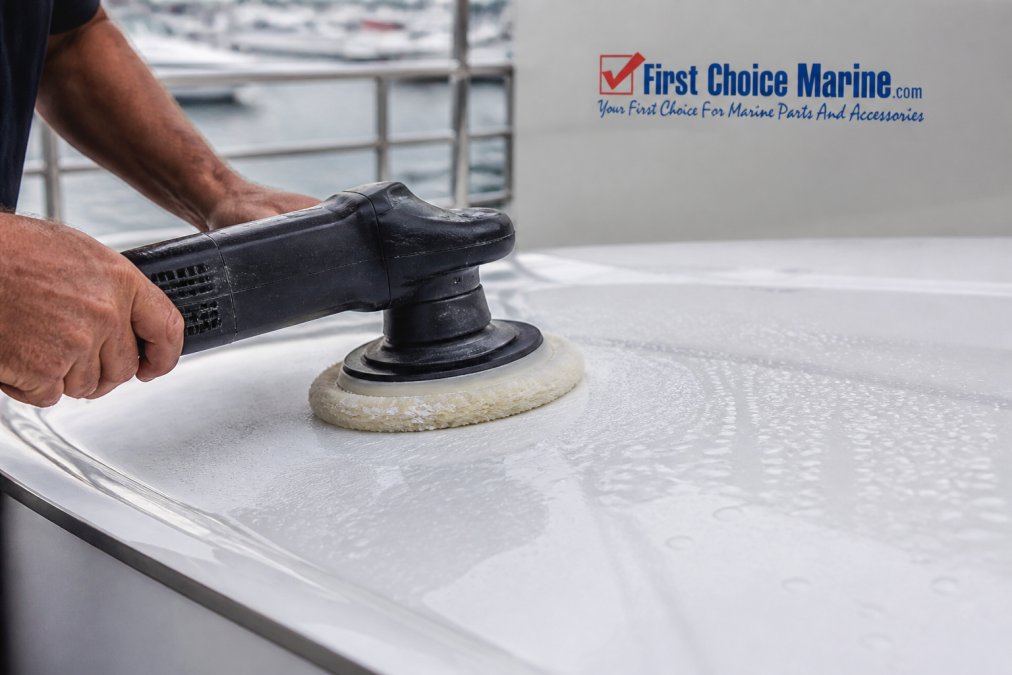
Wool pads cut aggressively. The 3M Perfect-It Wool Compounding Pad (9-inch, $73.67) excels at sand scratch removal and remains cooler than foam, making it ideal for heat-sensitive finishes.
Foam pads are versatile and safer for beginners. The 3M Perfect-It Double-Sided Foam Compounding Pad (8-inch, $71.07) provides more surface contact, holds compound better, and reduces slinging.
3M Perfect-It Gelcoat Heavy Cutting →
Backup pads support the compounding pad and distribute pressure evenly. The 3M Perfect-It Back-Up Pad (7-inch, $144.22) provides cushioning support and allows easy pad removal.
Start at low speed (1200-1500 RPM) to load the pad with compound, then increase to 2000-2500 RPM for cutting. Use overlapping passes, keep the pad flat, and apply light to medium pressure, let the abrasives do the work.
Work in 2-foot by 2-foot sections, wiping away residue with a microfiber cloth after each to inspect the finish and ensure consistent gloss.
Troubleshooting Common Buffing Errors
Swirl marks appear from high pad speed, uneven pressure, or wrong compound-pad combination. If visible, clean the pad, reload with fresh compound, and work at lower speed with lighter pressure.
Uneven gloss results from over-working some areas and under-working others. Mark sections with tape, work methodically, and inspect frequently to prevent this.
The pad clogs when compound dries in the fibers, reducing cutting efficiency. Prevent clogging by reloading with fresh compound every 30-45 seconds on small areas, every 60 seconds on larger sections.
Compound residue that won't wipe clean usually means you've applied too much or the compound has dried. Work in smaller sections so compound doesn't dry before you buff it out. If residue remains, dampen a microfiber cloth slightly and wipe in circular motions. Dry compound is harder to remove than wet compound.
Heat buildup occurs on dark-colored gelcoat when you're applying too much pressure or working too fast. The friction heats the compound and can soften or damage the finish. Solution: reduce speed, lighten pressure, and take breaks. Work in shorter sessions on dark hulls, especially in direct sunlight.
Storage and Environmental Best Practices
3M marine compound and finishing material products are liquid or paste formulations that degrade if exposed to extreme temperatures, sunlight, or contamination.
Store compounds in a cool, dry place away from direct sunlight. Temperature swings cause separation, the liquid base and abrasive particles settle unevenly. Ideal storage is 60-75°F. Avoid unheated garages in winter or hot sheds in summer. A climate-controlled shop or storage cabinet is best.
Keep containers sealed tightly. Exposure to air causes the liquid base to evaporate, thickening the compound and reducing its cutting ability. If a container has been open for months, the product inside may be unusable. Purchase only what you'll use within a season or two.
Shake or stir compounds before use if separation has occurred. The abrasive particles settle to the bottom during storage. Mixing them back into suspension restores proper consistency and cutting performance. Don't assume a compound that looks separated is ruined, most can be restored with thorough mixing.
Dispose of leftover compound responsibly. Many compounds contain mineral oils and abrasives that shouldn't enter storm drains or landfills. Check local hazardous waste disposal guidelines.
Final Verdict: Which Compound System Fits Your Boat
For most recreational boaters with moderate oxidation and light to medium sanding scratches, the 3M Perfect-It Medium Cutting Compound Plus Wax (#36106, $69.57 per quart) is the smart choice. It handles oxidation and P1000 scratches in one step, includes wax protection, and costs less than buying separate compound and polish. One quart covers a 25-30 foot boat with room to spare.
Frequently Asked Questions
What is the difference between 3M marine compound and marine polish?
3M marine compound is a cutting compound designed to remove heavy oxidation, sanding scratches, and surface defects from gelcoat. Marine polish, by contrast, is a finer finishing product that refines the surface after compounding and prepares it for wax. The compound does the heavy work; polish brings out the gloss. Many 3M products combine both steps, like the Perfect-It Medium Cutting Compound, to save time and reduce application steps on your boat.
Does 3M Marine Compound remove oxidation from fiberglass?
Yes. 3M's heavy-cutting compounds like the Perfect-It Gelcoat Heavy Cutting Compound ($95.32 quart, $332.38 gallon) are engineered to remove heavy oxidation, weathering, and chalking from gelcoat surfaces. The premium mineral formula cuts through oxidized layers quickly while leaving a high-gloss finish. For moderate oxidation, the Medium Cutting Compound Plus Wax ($69.57) works in a single step, combining cutting and wax protection.
What grit level should I sand before using 3M marine compound?
3M compounds are designed to remove sanding scratches from P600 to P1000 grit or finer, depending on the product. The Heavy Cutting Compound handles P800 scratches and coarser; the Medium Cutting Compound removes P1000 scratches. Sand your gelcoat to P600 or P800 before compounding, then apply the appropriate compound formula. This ensures the compound removes the scratch pattern without creating new surface defects.
Can I apply 3M marine compound by hand or do I need a rotary buffer?
Both methods work. The 3M Super Duty Rubbing Compound ($148.54 gallon) and Perfect-It EX Rubbing Compound ($98.75 quart) can be applied by hand or machine. Hand application requires more effort but offers greater control in tight areas. A rotary buffer or dual action sander paired with a wool or foam compounding pad delivers faster, more uniform results. For best results on large surfaces, use the Perfect-It Wool Compounding Pad ($73.67) with a rotary polisher.
