


Table of Contents
- What Makes a Smart Boat Battery Charger Worth Buying in 2026
- Quick Comparison: Top Smart Marine Chargers at a Glance
- Victron Phoenix Smart IP43: Best for Multi-Bank Flexibility
- Victron Blue Smart IP22: Best Value Onboard Boat Battery Charger
- Mastervolt ChargeMaster Plus: Best for Large Battery Banks
- ProMariner ProNautic: Best for Flooded, AGM, and Gel Batteries
- Dolphin ProLite: Best 4-Bank Charger for Complex Systems
- Boat Battery Charger Size Guide: Matching Amperage to Your Battery Bank
- Frequently Asked Questions
Last Updated: October 12, 2026
What Makes a Smart Boat Battery Charger Worth Buying in 2026
Smart boat battery chargers are microprocessor-controlled devices that automatically adjust voltage and current across multiple charging stages to match your battery's chemistry and state of charge.
The best smart boat battery chargers in 2026 share three traits: adaptive charging profiles that respond to how deeply a bank was discharged, Bluetooth or app-based monitoring so you can check status from the dock, and chemistry-specific settings for flooded, AGM, gel, and lithium batteries.
How We Selected and Scored These Chargers
Most roundups on this topic are assembled from spec sheets. Every charger in this guide was evaluated against the same five-criteria rubric, weighted by what actually matters once the unit is bolted into a locker:
- Charging intelligence (25%), Number of stages, whether the algorithm is adaptive or fixed, and whether it re-reads battery response mid-cycle rather than running a timer.
- Chemistry coverage (20%), Whether flooded, AGM, gel, and lithium each get a dedicated profile, and whether lithium charging accounts for a battery management system that can disconnect mid-charge.
- Monitoring and diagnostics (15%), Bluetooth or app visibility into voltage, current, and phase; fault logging; and whether alerts fire before damage occurs.
- Marine durability (20%), Ingress protection rating, corrosion-resistant terminals, fanless vs. fan-cooled design, and how the unit behaves in a hot, humid engine room.
- Installation and support (20%), Wiring clarity, fuse and breaker guidance, mounting options, and the length and quality of the included DC cables.
Multi-Stage Charging and Adaptive Profiles
Multi-stage charging moves a battery through bulk, absorption, and float phases, with recondition and storage stages on better units. A smart charger reads the battery's response and adjusts timing rather than pushing a fixed current. As Victron Energy's charging documentation explains, adaptive algorithms optimize the process based on how the battery is actually being used.
The practical difference shows up on a deeply discharged bank. A fixed-timer charger can push a bank into absorption too early, cook off electrolyte, and still leave the bank undercharged.
Bluetooth Monitoring and Remote Diagnostics
Bluetooth monitoring lets you see voltage, current, and charge phase from your phone. That matters on a boat, where the charger often sits behind a panel in a locker you'd rather not open every weekend. Remote diagnostics also flag wiring faults and reverse-polarity issues before they become expensive.
The feature worth paying for is history, not just live readouts. A charger that logs charge cycles lets you spot a bank that is taking longer to reach float than it did last season, an early warning of capacity loss that a voltage-only gauge will never show you.
Quick Comparison: Top Smart Marine Chargers at a Glance
| Charger | Output | Banks | Best For | Price |
|---|---|---|---|---|
| Victron Phoenix Smart IP43 12/50 (1+1) | 50A | 1+1 | Multi-bank flexibility | $508.58 |
| Victron Blue Smart IP22 12/30 (1-bank) | 30A | 1 | Value onboard charging | $207.45 |
| Mastervolt ChargeMaster Plus 12/75 | 75A | 3 | Large battery banks | $1,880.99 |
| ProMariner ProNautic 1230P | 30A | 3 | Flooded, AGM, and gel | $664.94 |
| Dolphin ProLite 4-Bank | 40A | 4 | Complex multi-bank systems | $1,236.64 |
Victron Phoenix Smart IP43: Best for Multi-Bank Flexibility
The Phoenix Smart IP43 is our top pick for boats running separate house and starter banks. The 1+1 configuration sends 3A to the starter battery and the remainder to the house bank, which is exactly what you want when the starter only needs a top-off. It's an adaptive 5-step charger rated at 30A or 50A, Bluetooth enabled, and available in 24V models.

1+1 vs 3-Output Models: Which Configuration Fits Your Boat
Choose 1+1 when you have one large house bank plus a small starter battery. Choose the 3-output model when you have three similar banks that each need independent charging. The American Boat and Yacht Council publishes standards for DC electrical systems that are worth reviewing before any onboard installation.
Victron Phoenix Smart IP43 Charger 12/50 (1+1)
Victron Blue Smart IP22: Best Value Onboard Boat Battery Charger
If you need one reliable bank charged well, the Blue Smart IP22 12V 30A is the value pick.

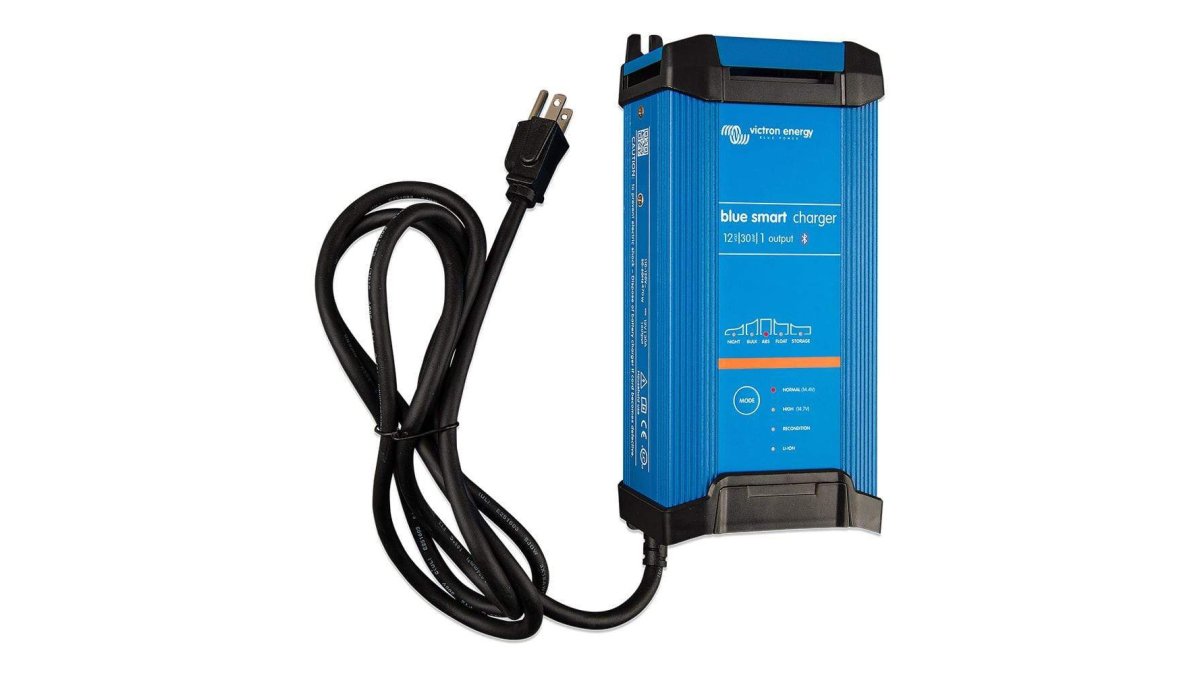
Storage mode kicks in after 24 hours without discharge, dropping float voltage to 13.2V on a 12V battery to reduce gassing and plate corrosion. A weekly absorption bump prevents electrolyte stratification and sulfation.
Victron Blue Smart IP22 12V 30A 1-Bank Charger
Mastervolt ChargeMaster Plus: Best for Large Battery Banks
Big boats with big draws need serious amperage, and the ChargeMaster Plus 12/75-3 delivers 75A across three outputs using a 3-step+ charge method. It replaces auxiliary chargers, battery isolators, and VSRs in one device, which simplifies installation and cuts component count.

Revival mode recovers fully depleted batteries, and Priority Charge redirects available power to the lowest battery for faster recovery. The unit is CE, ABYC, UL, SAE, CEC, and RCM/C-Tick compliant for marine use. For the largest systems, the 12/100-3 steps up to 100A.
Mastervolt ChargeMaster Plus 12/75-3
ProMariner ProNautic: Best for Flooded, AGM, and Gel Batteries
Boaters running traditional lead-acid chemistries get the most from the ProNautic's twelve selectable charging profiles. It ships set for flooded batteries, with AGM and gel selectable, plus four-stage charging (charge, condition, maintain, recondition). Distributed On Demand technology sends 100% of available amps to any single bank or a combination.
A remote temperature probe is included for compensation.
ProMariner ProNautic 1230P 30A 3-Bank Charger
Victron Phoenix Smart IP43 Charger 12/50 (1+1) 120-240vac #PSC125051095 →
Dolphin ProLite: Best 4-Bank Charger for Complex Systems
Four independent DC outputs make the Dolphin ProLite the pick for boats with separate house, starter, thruster, and windlass banks. It pushes 40A across four outputs, ships with 6-foot tinned marine-grade cables and integrated fusing, and carries an IP55 fanless rating for splash resistance.
Bluetooth connectivity through the Dolphin Connect App handles monitoring and control. It charges AGM, gel, lithium, and lead-acid batteries, and the compact, lightweight housing fits tight lockers.
Dolphin ProLite 4-Bank 12V 40A Charger
Boat Battery Charger Size Guide: Matching Amperage to Your Battery Bank
The common rule of thumb, size a marine battery charger at roughly 10% to 20% of your battery bank's amp-hour capacity, is a starting point, not an answer. It ignores how deeply you discharge, how fast you need to recharge, and what the battery will actually accept.
Step 1: Find Your Usable Amp-Hours
Start with the bank's rated capacity, then apply the depth of discharge you actually run. A 400Ah house bank discharged to 50% has 200Ah to replace. Discharged to 80% (common on an overnight anchor-out with a fridge and inverter running), it has 320Ah to replace. Lead-acid banks should not be routinely drawn below 50%; lithium banks can typically go to 80-90% without harm, which changes the recharge load substantially.
Step 2: Divide by Your Recharge Window
Charger output (amps) × hours available = amp-hours delivered, minus efficiency losses. A charger is not 100% efficient, and the last 20% of a charge is slow because acceptance current tapers.
Example: 320Ah to replace, 8 hours at the dock before you leave.
- 320 ÷ 8 = 40A needed per hour
- 40 ÷ 0.8 (efficiency and taper) = 50A charger minimum
If you only have 4 hours, the same bank needs roughly 100A. That is the number that should drive your purchase, not the bank's nameplate capacity.
Step 3: Confirm the Battery Will Accept It
A charger can only push what the battery will take. Flooded lead-acid banks generally accept charge at 10-20% of capacity, so a 400Ah flooded bank tops out around 40-80A regardless of what the charger can deliver. AGM accepts somewhat more. Lithium accepts far more, often 0.5C or higher, meaning a 400Ah lithium bank could accept 200A, but the battery management system is the final gatekeeper. If the BMS disconnects mid-charge (over-voltage, over-temperature, cell imbalance), the charger sees an open circuit.
Sizing Cheat Sheet by Bank Size and Chemistry
| Bank Size | Flooded / Gel | AGM | Lithium |
|---|---|---|---|
| Under 200Ah | 20-30A | 20-40A | 30-60A |
| 200-400Ah | 30-50A | 40-60A | 60-120A |
| 400-600Ah | 50-75A | 60-90A | 100-200A |
| Over 600Ah | 75-100A | 90-120A | 150A+ |
These ranges assume an overnight-to-full recharge window. If you charge only on shore power at the dock and can leave the boat plugged in for days, you can size smaller and let the charger work slowly, but check that the charger's float and storage stages are gentle enough to sit on the bank indefinitely without gassing or sulfation.
Don't Forget the Other Charging Sources
Your shore charger is one input in a system that also includes the alternator, and possibly solar. If the alternator regulator and the shore charger both target the same absorption voltage, they can fight each other when the engine runs at the dock. Solar controllers with their own multi-stage algorithms add a third opinion. Before you buy, sketch how each source will behave when two are active at once.
BoatUS Foundation on marine electrical safety
Frequently Asked Questions
What size battery charger do I need for my boat?
Match charger amperage to your battery bank's amp-hour capacity. A common rule is 10% of the bank's Ah rating. For a 200Ah bank, a 20A charger works; for a 400Ah bank, aim for 40A. Charging time is another factor: a 100Ah battery at 50% depth of discharge needs roughly 5 hours at 10A or 2.5 hours at 20A. Size up if you want faster turnaround between trips.
Can a smart marine battery charger charge lithium batteries?
Yes, but the charger must have a lithium-specific charging profile. The Victron Blue Smart IP22 includes a Li-ion mode, and the Dolphin ProLite supports AGM, Gel, Lithium, and Lead-Acid chemistries. Lithium batteries require different absorption voltages than flooded or AGM types. Using a charger without a lithium profile can undercharge the battery or trigger the BMS to disconnect prematurely.
What is the difference between an onboard and portable boat battery charger?
An onboard boat battery charger is permanently mounted and wired to your battery banks, typically powered by shore power. A portable marine battery charger is a standalone unit you connect when needed. Onboard chargers suit boats kept at a dock with regular shore power access. Portable chargers work better for trailered boats or situations where you need to charge batteries away from the vessel.
How many banks should a boat battery charger have?
Count your separate battery banks first. Most boats have a starting battery and a house bank, requiring at least two outputs. Boats with a trolling motor battery add a third bank. The Victron Phoenix Smart IP43 1+1 model sends 3A to the starter and the rest to the house bank, while the 3-output version distributes charge across three banks independently. Choose based on how many isolated batteries you maintain.
Can you leave a smart battery charger on all the time?
Smart chargers with float and storage modes are designed for continuous connection. The Victron Blue Smart IP22 enters storage mode after 24 hours without discharge, reducing float voltage to 13.2V for a 12V battery to minimize gassing and plate corrosion. It raises voltage weekly to equalize the battery. This prevents stratification and sulfation, two common causes of early battery failure.
Battery chemistry, bank count, and amp-hour capacity all shape the right charger choice, and getting it wrong means shorter battery life and more time at the dock instead of on the water. First Choice Marine stocks Victron, Mastervolt, ProMariner, and Dolphin chargers with free shipping, backed by over a century of marine hardware experience and guides that help you repair rather than replace. Sign in to your account and match the right smart charger to your boat's electrical system today.
