


Table of Contents
- Why Marine Wire vs Automotive Wire Matters on a Boat
- Tinned Marine Wire: The Corrosion Problem It Solves
- How to Choose the Right Marine Electrical Wire Gauge
- Boat Wiring Corrosion Protection Beyond the Wire Itself
- Crimping and Termination: Getting the Connection Right
- Your Marine Wiring Safety Checklist Before You Order
- Frequently Asked Questions
Last Updated: October 9, 2026
Why Marine Wire vs Automotive Wire Matters on a Boat
If you want to buy marine grade electrical wiring online, understand first that marine wire and automotive wire are not interchangeable, even at the same gauge.
Automotive wire is designed for a protected, dry environment, a harness inside a body panel or under a dash. A boat asks for salt spray, bilge water, and thousands of flex cycles a season, all at once.
What Happens When You Use Automotive Wire on a Boat
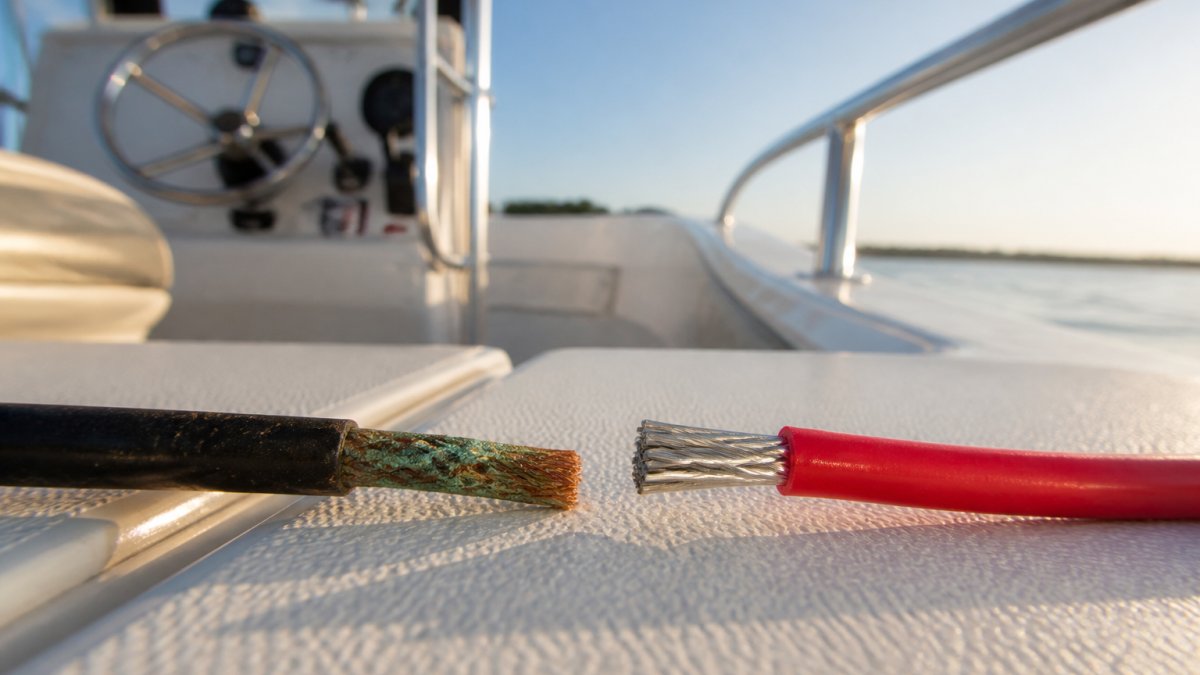
The failure is predictable and starts where you cannot see it. Automotive wire uses bare copper strands; in a marine environment, moisture works under the insulation and the copper corrodes.
The second problem is flexibility. Automotive wire uses fewer, thicker strands that resist bending.
Tinned Marine Wire: The Corrosion Problem It Solves
Tinned marine wire solves corrosion at the strand level, before moisture reaches the copper. Each copper strand is coated in a thin layer of tin during manufacturing.
The product we stock reflects this standard. The Ancor Red 12 AWG Primary Wire 100' uses tinned copper stranding for maximum protection against corrosion and electrolysis, with ultra flexible Type 3 stranding that resists fatigue from vibration and flexing.

That last part matters. UL 1426 separates genuine marine cable from wire merely sold near boats. If a listing does not name it, ask why.
Tinned Copper vs. Bare Copper: What the Stranding Does
Tinning is only half the story; stranding is the other half.
Marine cable uses many fine strands rather than a few thick ones, which lets the wire bend repeatedly without cracking and gives the conductor more surface area, why tinned stranding is standard for anything living in a moving, wet environment.
Bare copper is not a bad material, just the wrong one for a boat.
How to Choose the Right Marine Electrical Wire Gauge
Choosing the right marine electrical wire gauge comes down to two numbers: the current the circuit will carry and the distance it must travel. Get those wrong and the wire runs hot, drops voltage, or both.
American Wire Gauge (AWG) describes conductor diameter. Lower numbers mean thicker wire: 12 AWG is thicker than 14 AWG.

Most boat owners underestimate distance: a run fine at three feet can be inadequate at fifteen.
Voltage Drop and Ampacity: The Two Numbers That Decide Your Gauge
Ampacity is the maximum current a conductor carries safely without overheating; voltage drop is the loss as current travels through resistance over distance. Both push you toward heavier wire, and voltage drop usually decides it.
The voltage drop formula for a DC circuit is straightforward:
VD = (2 × K × I × L) ÷ CM
- VD = voltage drop in volts
- 2 = accounts for the round trip (positive and negative conductors)
- K = resistivity constant for copper, commonly taken as 10.75 for tinned copper at 75°C
Circular mils are the number that trips people up. Common marine gauges:
| AWG | Circular Mils |
|---|---|
| 16 AWG | 2,580 |
| 14 AWG | 4,110 |
| 12 AWG | 6,530 |
| 10 AWG | 10,380 |
| 8 AWG | 16,510 |
| 6 AWG | 26,240 |
| 4 AWG | 41,740 |
| 2 AWG | 66,360 |
| 1/0 AWG | 105,600 |
A Worked Example: 12 AWG Over a 20-Foot Run
Say you are feeding a 10-amp load 20 feet away on a 12V DC system, and you are considering 12 AWG.
VD = (2 × 10.75 × 10 × 20) ÷ 6,530 VD = 4,300 ÷ 6,530 VD ≈ 0.66 volts
That is roughly 5.5% of a 12V system.
The practical rule: size for ampacity first, then check voltage drop over the actual run length and go up a gauge if needed.
Ampacity: What Each Gauge Can Actually Carry
Ampacity tables vary slightly by insulation temperature rating and how the wire is bundled. For 105°C-rated marine primary wire in open air, common working figures are:
| AWG | Typical Ampacity (105°C, open air) |
|---|---|
| 16 AWG | 25 A |
| 14 AWG | 35 A |
| 12 AWG | 45 A |
| 10 AWG | 60 A |
| 8 AWG | 80 A |
| 6 AWG | 120 A |
| 4 AWG | 160 A |
| 2 AWG | 210 A |
| 1/0 AWG | 285 A |
These are starting points, not gospel. Bundled runs, engine-room heat, and long duty cycles all push you toward heavier wire. When in doubt, go up a gauge.
Ancor Red 12 AWG Primary Wire 100' #106810 →
| Circuit Type | Typical Gauge | Why |
|---|---|---|
| Short runs to lights and small accessories | 14 AWG | Low current, short distance |
| General branch circuits, pumps, electronics feeds | 12 AWG | Handles moderate load with margin |
| Longer runs or higher-load accessories | 10 AWG or heavier | Limits voltage drop over distance |
| Battery cable and high-current interconnects | Sized to load and length | Carries starting and charging current |
Sizing for Lithium (LiFePO4) Systems
Most gauge guides skip this: modern lithium banks change the math. A LiFePO4 bank holds a higher, flatter voltage under load than lead-acid and accepts much higher charge current, so a charger-to-bank run sized for a flooded bank may be undersized on lithium, the bank pulls the charger's full output, for longer. Size the charge circuit for the charger's maximum output, not the battery's nominal rating, and check voltage drop at that current.
Boat Wiring Corrosion Protection Beyond the Wire Itself
Boat wiring corrosion protection does not stop at the conductor. Even the best wire fails if the connections at each end are exposed to salt air and moisture. Protection is a system, not a single part.
Adhesive-Lined Heat Shrink: Why the Adhesive Matters
Adhesive-lined heat shrink is the standard. When heated, the adhesive flows and seals the joint against moisture. Plain heat shrink keeps water out for a while, then lets it in, and the difference in service life is significant.
Look for marine-rated tubing with a meltable inner adhesive, typically a polyolefin jacket with a hot-melt liner. Shrink ratio matters: 3:1 covers irregular shapes like a crimped butt connector and its insulation better than 2:1.
Terminals, Lugs, and Plating
Terminal lugs and connectors should be tinned or plated for the same reason the wire is. A bare copper lug in a bilge is a corrosion point waiting to happen; tinned or tin-plated lugs resist the same galvanic and salt-air attack as tinned wire.
Match the terminal to the wire gauge and stud size. An oversized barrel on undersized wire leaves a gap the crimp cannot close, and a ring terminal too small for the stud will not seat flat, a loose connection is a heat source.
Dielectric Grease and the Connection Interface
Even a perfect crimp has a boundary where dissimilar metals meet air. A thin film of dielectric grease on the terminal-to-stud interface and inside the barrel before crimping displaces moisture and slows corrosion at that boundary. It is not a substitute for a good crimp or adhesive-lined heat shrink, it is the third layer of the same defense.
Chafe Protection and Routing
Corrosion is not the only enemy. Vibration wears insulation against hard edges, and a chafed jacket is an open door for moisture. Split loom, grommets at every bulkhead pass-through, and standoff from engine mounts and sharp fiberglass edges extend connection life. Support wire every 18 inches or so, and never let it hang from a single tie.
Grounding: The Connection Everyone Forgets
Grounding deserves its own attention. A poor ground causes faults that mimic other problems, one of the most common issues we hear about from customers chasing electrical gremlins. Grounds live in the bilge, at the engine block, and on the negative bus, the wettest, most corrosive places on the boat. Treat every ground with the same tinned lug, adhesive-lined heat shrink, and dielectric grease you would use on a positive feed.
Lithium Banks Raise the Stakes
A modern LiFePO4 bank makes corrosion protection more important, not less. Lithium systems push higher continuous current through the same connections, so a joint merely warm on lead-acid can become a hot spot, and higher current accelerates galvanic action at a compromised terminal. When upgrading to lithium, re-terminate the main feeds with fresh tinned lugs and adhesive-lined heat shrink rather than reusing old connections.
The wire is only as good as the connection at each end. Tinned lugs, adhesive-lined heat shrink, dielectric grease, chafe protection, and a clean ground together are what make a marine circuit last.
Crimping and Termination: Getting the Connection Right
A proper crimp is a cold weld between terminal and conductor, and it is where most DIY wiring jobs go wrong.
The correct process is straightforward:
- Strip the insulation to the depth marked on the terminal, no deeper
- Confirm the strands are clean, bright, and untinned only if the wire itself is untinned
- Insert the conductor fully so it bottoms out in the barrel
What most guides miss is the tug test. It takes five seconds and catches most bad crimps before they carry current.
For duplex runs, pre-made cable simplifies the job. The Ancor Safety Duplex Cable 14/2 100' uses ultra flexible Type 3/Class K stranding, an abrasion-resistant outer jacket, and inner conductors color-coded to ABYC standards.

Your Marine Wiring Safety Checklist Before You Order
A marine wiring safety checklist before you order saves return shipping and a second trip into the bilge. Run through these before you add anything to a cart.
- Confirm the wire is tinned copper, not bare copper
- Confirm the listing names UL 1426, ABYC, and Coast Guard Charter boat standards
- Match the gauge to both the load and the run length, not just the load
Does marine-grade product work on older boats? Yes, often better than what was originally installed.
We stock top brands including Ancor, Cobra Wire & Cable, Pacer, and Sea-Dog, and our full selection of marine wiring and supplies covers primary wire, duplex and triplex cable, terminals, and heat shrink.
The challenge with boat wiring is not finding wire, it is buying the right wire the first time, so this season's job still holds up three seasons from now.
Frequently Asked Questions
What is the difference between marine-grade wire and automotive wire?
Marine-grade wire uses tinned copper stranding to resist corrosion, while automotive wire uses bare copper. Marine wire also carries a 600-volt, 105°C dry / 75°C wet insulation rating and must meet UL 1426, ABYC, and US Coast Guard CFR Title 46 standards. Automotive wire has none of these requirements. In a wet, vibrating boat environment, bare copper corrodes quickly and insulation cracks, causing failures.
Can you use automotive wire in a boat?
You can physically install it, but it will fail faster. Automotive wire lacks tinned stranding, so salt water and moisture attack the bare copper. Its insulation is not rated for the same heat or moisture exposure. ABYC standards, which govern boat electrical systems, call for marine-grade cable. Using automotive wire risks short circuits, electrical fires, and failed electronics. Marine grade wiring costs slightly more but lasts far longer.
How do I choose the right wire gauge for a boat?
Start with the electrical load in amps and the round-trip cable length. Use an AWG gauge chart that accounts for voltage drop, not just ampacity. ABYC recommends keeping voltage drop under 3% for critical circuits and 10% for non-critical ones. For a 12V DC system, a 10-amp load at 20 feet round trip typically needs 12 AWG. When in doubt, go one size larger.
How do I protect boat wiring from corrosion?
Start with tinned marine wire, which resists corrosion at the conductor level. Use adhesive-lined heat shrink tubing on every connection to create a moisture barrier. Apply dielectric grease to terminals and lugs. Choose tinned copper terminal lugs, not bare copper. Keep connections above the bilge water line where possible. Inspect annually and replace any wire with green discoloration or stiff, cracked insulation.
