


Table of Contents
- Quick Comparison Table
- Why Proper Charging Extends Marine Battery Life
- Understanding Battery Chemistry and Charging Profiles
- How to Choose the Right Charger for Your Boat
- Smart vs. Manual Marine Battery Chargers
-
Top Marine Battery Chargers for Extended Battery Life
- ProMariner ProSportHD 15 Gen 4: Best Budget Option
- Dual Pro Professional Series 45A: Best for Tournament Fishermen
- ProMariner ProNautic 1230P: Best Mid-Range Multi-Stage Charger
- ProMariner ProNautic 1260P: Best High-Amperage Option
- Mastervolt ChargeMaster Plus 12V 75A: Best for Advanced Systems
- Victron Skylla-IP65: Best Waterproof Marine-Grade Design
- How to Test Boat Battery Health and Charging Performance
- Marine Battery Maintenance Tips for Maximum Longevity
- Frequently Asked Questions
Last Updated: September 27, 2026
Quick Comparison Table
| Charger | Output | Banks | Best For | Starting Price |
|---|---|---|---|---|
| ProMariner ProSportHD 15 Gen 4 | 15A | 3 | Budget-conscious boat owners | $164.39 |
| Dual Pro Professional Series 45A | 45A | 3 | Tournament fishermen | $630.91 |
| ProMariner ProNautic 1230P | 30A | 3 | Mid-range recreational boaters | $659.99 |
| ProMariner ProNautic 1260P | 60A | 3 | High-amperage systems | $1,122.99 |
| Mastervolt ChargeMaster Plus 12V 75A | 75A | 3 | Advanced integrated systems | $1,880.99 |
| Victron Skylla-IP65 12/70 | 70A | 3 | Waterproof marine-grade environments | $881.37 |
Why Proper Charging Extends Marine Battery Life
The single biggest factor determining how long your marine battery lasts isn't the battery itself, it's how you charge it. LiTime's marine battery research identifies proper charging as the most critical element in extending battery longevity. Batteries charged with multi-stage smart chargers typically last 5-8 years, while those charged haphazardly often fail within 3-4 years.

Using a dedicated maintenance charger extends service life to 5-8 years, saving an estimated $300 per battery compared to frequent replacement cycles.
Most boat owners assume any charger works, but basic chargers don't understand modern battery chemistry. Smart chargers automatically adjust voltage and current based on battery type, flooded lead-acid, AGM, gel, or lithium-ion, preventing overcharge and undercharge damage.
Understanding Battery Chemistry and Charging Profiles
Different battery types require fundamentally different charging approaches. This is where most DIY boat owners stumble, they apply the same charger to every battery and wonder why one dies prematurely.
Flooded Lead-Acid vs. AGM vs. Gel vs. Lithium-Ion
Flooded lead-acid batteries require three-stage charging, bulk, absorption, and float modes, to prevent sulfation, the buildup of lead sulfate crystals that permanently damages the battery.
AGM batteries are sealed and sensitive to overcharging, requiring tighter voltage control than flooded batteries.
Gel-cell batteries are extremely voltage-sensitive; overcharging by 0.1 volts causes permanent damage, requiring chargers with precise voltage regulation.
Lithium-ion (LiFePO4) batteries represent a different animal entirely. They charge faster than lead-acid, don't tolerate deep discharge, and require chargers with dedicated lithium profiles. Battery Tender's lithium charging guide emphasizes that using a standard lead-acid charger on a lithium battery will destroy it. This is the fastest way to waste $2,000+.
How to Choose the Right Charger for Your Boat
Selecting a marine battery charger comes down to three variables: amperage output, number of banks, and features you actually need.
Calculating Amperage Output
Start with your battery's Ah (Amp-hour) rating. A 100Ah battery should charge at 10-20A according to Fawcett Boat Supplies marine charging guidelines. This is the industry standard for safe, complete charging without damaging the battery.
A 200Ah system needs 20-40A; a 300Ah bank needs 30-60A. Undersizing leaves batteries half-charged; oversizing risks overcharging sealed batteries.
Multi-Bank Charging Capability
Most boats have two or more battery banks. A multi-bank charger charges all simultaneously without an isolator, critical for winter storage. A three-bank charger suits recreational boats; commercial vessels need four or more. Match bank count to your actual setup.
Smart vs. Manual Marine Battery Chargers
Manual chargers apply constant voltage and amperage regardless of battery state. Smart chargers adjust automatically using multi-stage algorithms: bulk charging (maximum amperage), absorption (constant voltage), and float mode (maintenance only). Manual chargers risk overcharge if left connected too long or partial depletion if disconnected early.
Smart chargers preserve battery health through desulfation, reversing sulfate buildup. Battery Tender's data shows 5-8 year lifespans with smart chargers versus 3-6 years with standard approaches. For winter storage, a smart charger is essential.
Top Marine Battery Chargers for Extended Battery Life
ProMariner ProSportHD 15 Gen 4: Best Budget Option
The ProSportHD 15 Gen 4 is your entry point to smart charging without breaking the bank at $164.39. This 15-amp three-bank charger delivers fully automatic five-stage charging with selectable profiles for flooded, AGM, and gel batteries.
Strengths: tri-surface heatsink, LED indicators, fuel gauge-style completion monitor. Weaknesses: 15 amps is tight for banks larger than 100-150Ah; lacks temperature compensation.
Best for: Recreational boat owners with modest battery banks who want smart charging without a premium price tag.
Dual Pro Professional Series 45A: Best for Tournament Fishermen
Trusted by 50+ boat manufacturers and tournament anglers, the 45-amp output charges large systems quickly. Zero-spark technology and ISO 8846 marine rating ensure durability. Strengths: automatic operation, temperature compensation, diagnostic codes. Weakness: no multi-stage profile selection.
Best for: Fishing enthusiasts and commercial operators who need reliable, fast charging and don't need advanced features.
Dual Pro Professional Series 45a 3-Bank →
ProMariner ProNautic 1230P: Best Mid-Range Multi-Stage Charger
This 30-amp three-bank charger offers twelve digitally-controlled charging profiles, dual digital displays, and auto-ranging global AC input (100-250VAC, 50-60Hz). Standout feature: automatic desulfation every 21 days reverses sulfate buildup and extends battery life. Energy saver mode reduces consumption during storage. Weakness: 30 amps is moderate for larger banks.
Best for: Recreational cruising boats with mixed battery types or owners who want maximum battery longevity.
ProMariner ProNautic 1260P: Best High-Amperage Option
This 60-amp three-bank charger doubles the amperage of the 1230P, fully charging a 300Ah bank in hours. Includes twelve profiles, dual displays, auto-ranging AC input, and automatic desulfation. Best for larger cruising sailboats and commercial vessels. Weakness: overkill for small boats; verify marina can handle higher power consumption.
Best for: Larger vessels or boats with demanding 12-volt systems that need fast, complete charging.
Mastervolt ChargeMaster Plus 12V 75A: Best for Advanced Systems
This 75-amp integrated power management system charges any battery chemistry combination. Revival mode revives deeply depleted batteries; priority charge optimizes multi-battery charging. NMEA 2000 and CZone communication integrate with navigation and monitoring systems. Best for advanced cruising sailboats with integrated electrical systems. Weakness: complexity and high cost; overkill for basic boats.
Best for: Advanced cruising sailboats, expedition vessels, or commercial operations with integrated electrical systems.
Victron Skylla-IP65: Best Waterproof Marine-Grade Design
The Victron Skylla-IP65 12/70 at $881.37 prioritizes environmental durability. The IP65 rating means it withstands moisture, vibration, humidity, and salt air, the real enemies of marine electronics.
The seven-stage adaptive charge algorithm automatically adjusts to battery type. Dedicated lithium-ion charging profiles mean this charger works with modern LiFePO4 batteries without modification. Wide-range universal input voltage (80-275VAC, 35-70Hz) handles generator power, shore power, or anything in between.
What works: Durability in harsh environments. The IP65 rating is genuine, this charger survives covered boat storage where salt air corrodes lesser equipment.
How to Test Boat Battery Health and Charging Performance
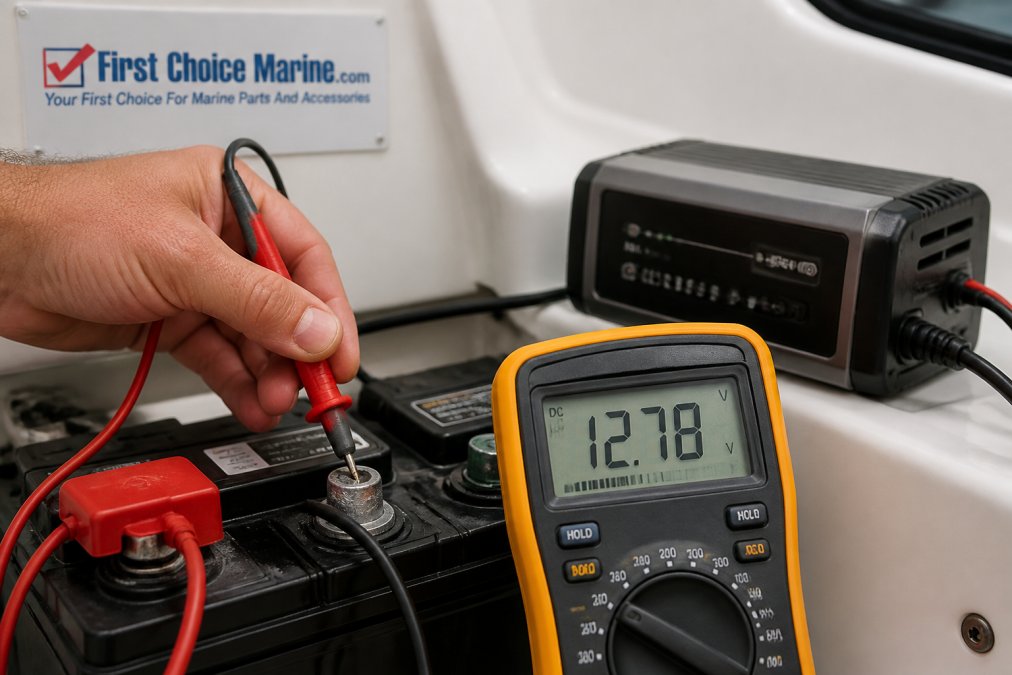
A multimeter tells you whether your battery is actually charging. Set the meter to DC voltage and connect the red probe to the positive terminal, black to negative. A healthy 12-volt battery at rest should read 12.6-12.8 volts. Anything below 12.4 volts means the battery is partially discharged.
Marine Battery Maintenance Tips for Maximum Longevity
Desulfation and Recovery Modes
Sulfation is the enemy of battery longevity. When a battery sits partially discharged, lead sulfate crystals form on the plates. Over time, these crystals harden and become permanent, reducing capacity and lifespan.
Winter Storage and Float Mode
Winter storage is where battery longevity is won or lost. A battery sitting idle for three months without proper maintenance will age years. Float mode prevents this.
Thermal Management and Temperature Compensation
Temperature affects charging. Cold slows chemical reactions and requires higher voltage. Heat speeds reactions and demands lower voltage. A charger that doesn't compensate for temperature will overcharge in summer and undercharge in winter.
Victron, ProMariner, and Mastervolt chargers all include temperature compensation.
Frequently Asked Questions
How long should a marine battery last with proper charging?
With a dedicated multi-stage smart charger, marine batteries typically last 5 to 8 years, compared to the average 3 to 6 years without specialized maintenance charging. Proper charging is the single biggest factor in determining battery longevity. Using a charger that matches your battery chemistry (flooded lead-acid, AGM, gel, or lithium-ion) and maintaining correct voltage and amperage output prevents sulfation and extends cycle life significantly.
What is the best type of charger for AGM marine batteries?
AGM batteries require a multi-stage smart charger with a dedicated AGM charging profile. The charger should deliver 10-20% of the battery's Ah capacity as output amperage and include automatic voltage regulation and temperature compensation. Chargers like the ProMariner ProNautic series offer selectable AGM profiles that prevent overcharging and maintain battery health during storage. Avoid one-size-fits-all chargers, which can damage AGM batteries by applying incorrect voltage.
Can I leave my marine battery charger on all the time?
Yes, if you use a smart charger with float mode and automatic shut-off. Modern multi-stage chargers automatically switch to maintenance mode after full charge, preventing overcharging and trickle-charging the battery at safe voltage levels. The Dual Pro Professional Series and ProMariner chargers include auto-maintain energy saver modes that monitor and charge only when needed. Older manual chargers should not be left unattended indefinitely, as they lack the intelligence to prevent overcharging.
How do I know if my marine battery charger is smart?
A smart marine battery charger has a microprocessor that automatically adjusts voltage and current through multiple charging stages: bulk charging, absorption, and float modes. Look for features like LED status displays, selectable battery chemistry profiles (flooded, AGM, gel, lithium), temperature compensation, and desulfation modes. Smart chargers also include safety protections such as reverse polarity protection, over-temperature shutdown, and short-circuit protection. The ProMariner ProNautic and Mastervolt ChargeMaster Plus are examples of fully intelligent chargers.
