


Last Updated: October 29, 2026
Quick Summary
There is no single best BMS for every boat, because the right choice depends on your battery chemistry, cell count and monitoring needs. Start by matching the board's series cell count and continuous discharge rating to your LiFePO4 bank, then compare brands such as REC BMS, JBD, Victron Energy and Renogy against that shortlist.
- Confirm the BMS cell count matches your pack, since a 4S board suits 12-volt LiFePO4 and 8S suits 24-volt.
- Choose a continuous discharge rating comfortably above the sum of your running loads.
- Check whether the board balances passively or actively, which matters for larger banks.
- Ask whether the app shows per-cell voltage, protection history and regular firmware updates.
- Verify that the BMS and your inverter or charger share the same CAN bus or RS485 protocol.
Table of Contents
- What a Battery Management System Actually Does on a Boat
- Choosing a BMS for Your LiFePO4 Battery Bank
- Which Manufacturers Get Recommended Most, and Why
- Smart BMS With Bluetooth: Useful Feature or Extra Cost?
- Common Mistakes When Picking a BMS for a Marine Battery
- Getting the Right BMS Installed on Your Boat
- Frequently Asked Questions
A battery management system (BMS) is the part of a boat's lithium battery that keeps the cells safe, balanced and working together. There is no single answer to "who makes the best BMS?", the right brand depends on your battery chemistry, cell count and how much monitoring you want. This guide from First Choice Marine covers what a BMS does on a boat, how to match one to your battery bank, and the mistakes that cost boat owners time and money.
What a Battery Management System Actually Does on a Boat
A BMS monitors each cell in a lithium pack and protects it from damaging conditions (Standards and Regulations for Battery Management Systems in Germany). It watches voltage, current and temperature, and cuts the charge or discharge path when something goes out of range.
The main protections most boat owners rely on include:
- Over-voltage protection during charging
- Under-voltage protection during discharge
- Over-current and short-circuit protection
- Temperature monitoring
Cell balancing deserves special attention. Passive balancing bleeds energy from the highest cells, while active balancing moves charge between cells. Some budget boards cannot balance actively at all, a real limitation for larger banks.
Choosing a BMS for Your LiFePO4 Battery Bank
Most marine battery banks today use LiFePO4 chemistry, so a BMS designed for that chemistry is the starting point. Boards built for other chemistries can overcharge or underprotect LiFePO4 cells, so check the chemistry rating first.
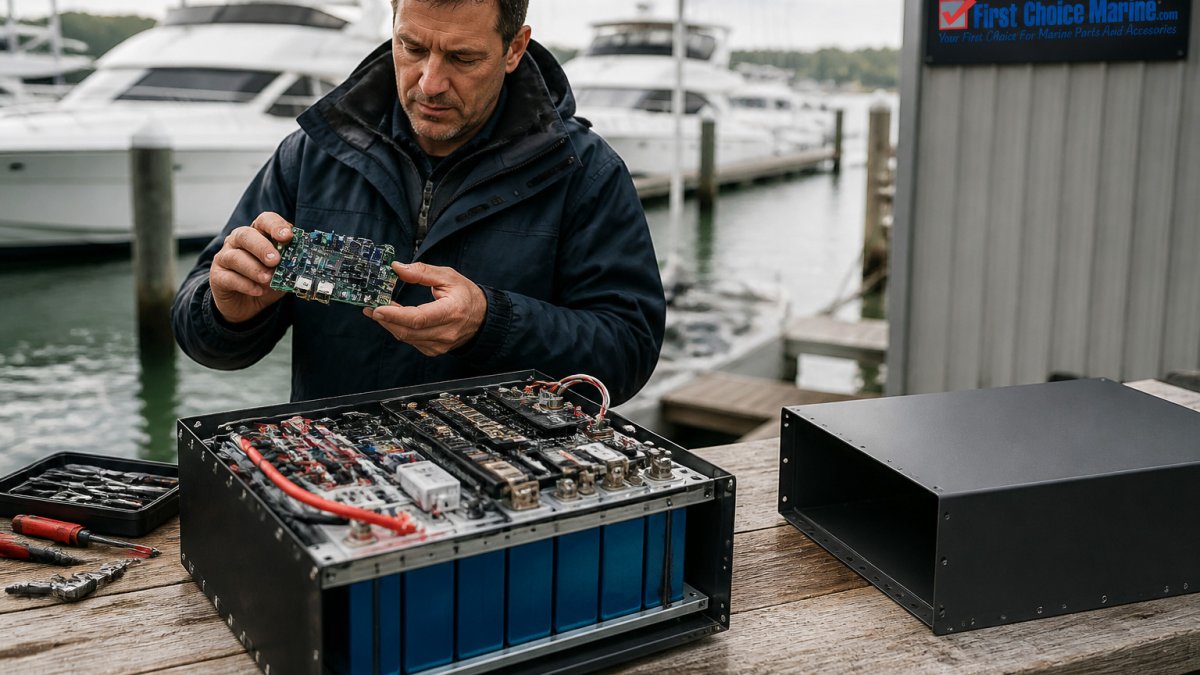
Start with three numbers from your battery and your boat:
- The series cell count and nominal system voltage
- The maximum continuous discharge current your loads will draw
- The maximum charge current your charger or alternator will deliver
Write these down before you compare brands. A board rated correctly for one bank can be the wrong part for another.
Matching Cell Count and Voltage
A BMS is built for a specific number of series cells. A 4S board suits a 12-volt LiFePO4 pack, while an 8S board suits a 24-volt pack. Buying the wrong cell count is the most common error in this category and cannot be fixed with settings alone. Confirm the cell count on the product listing against the pack label; if your pack uses parallel groups, the series count is still what matters.
Checking Continuous Discharge Ratings
The continuous discharge rating tells you how much current the BMS can pass without overheating or tripping. Add up your running loads, trolling motor, fishfinder, bilge pump, refrigerator, then choose a BMS rated comfortably above that sum. Starting surges from motors can exceed the continuous rating briefly, so check whether surge tolerance is listed too.
Which Manufacturers Get Recommended Most, and Why
Recommendation patterns in forums and buyer guides reflect different priorities, so treat them as input rather than verdict.
Buyers frequently mention these factors when they discuss brands:
- Price and the total cost of the battery installation
- Communication options such as Bluetooth or CAN bus
- Charging and discharging current limits
- Build quality and component choices
Several brands come up repeatedly, and it helps to know what each is actually known for rather than just that it is 'popular.'
REC BMS is a Slovenian manufacturer.
JBD is a BMS brand. Check each model's balancing method and app support against your battery bank before buying.
Victron Energy is a power-electronics manufacturer.
Renogy is a power-equipment manufacturer.
Treat these as starting points for your shortlist, not a ranking.
The Software and Firmware Question Most Guides Skip
Hardware specs are easy to compare; the software is where brands actually separate. A BMS app is not a cosmetic add-on, it is how you read cell voltages, set protection thresholds and diagnose a shutdown. When you shortlist brands, ask three questions most buyer guides never address:
- Can you set the protection thresholds yourself, or are they fixed? A board with fixed thresholds may not match your battery manufacturer's limits.
- How is firmware updated, and how often? A board whose app has not been updated in years is a long-term risk, especially if the app is the only way to configure it.
- Does the app log history, or only show live data? History is what lets you spot a slowly drifting cell before it causes a shutdown on the water.
Budget boards often ship with a generic app shared across many models, while higher-end boards ship with a brand-specific app that exposes more settings. Neither is automatically better, the generic app is often simpler, the brand-specific app more capable but harder to learn. Check before you buy, because you cannot add software depth later.
Inverter and Charger Compatibility
This is the gap most brand comparisons leave vague. A BMS that cannot talk to your inverter or charger may still protect the battery, but it cannot coordinate charging, which is where many marine installations go wrong. The practical questions are:
- Does the BMS support CAN bus, and which protocol? Common protocols in this space include those used by Victron, Pylontech, and other system vendors. A board that speaks the protocol your inverter expects can share state of charge and charge limits; one that does not will leave the inverter guessing.
- Does it support RS485? Many chargers and inverters use RS485 for the same coordination role, and some boards support one but not the other.
- What happens when communication drops? A well-designed system fails safe, the charger stops or falls back to a conservative profile. Confirm this behavior before you rely on it.
If you are building around a specific inverter or charger, check its documentation for the BMS protocols it accepts, then confirm the BMS lists that protocol explicitly. Do not assume 'CAN bus' on both sides means they will understand each other; the physical layer can match while the protocol does not.
Brands that come up most often in forums and buyer guides, and what each is known for:
| Brand | Known for | Note |
|---|---|---|
| REC BMS | Slovenian manufacturer | Check balancing and app support |
| JBD | BMS brand | Check each model's balancing method |
| Victron Energy | Power-electronics manufacturer | Treat as shortlist, not ranking |
| Renogy | Power-equipment manufacturer | Fit depends on bank size and charging |
Smart BMS With Bluetooth: Useful Feature or Extra Cost?
A smart BMS with Bluetooth lets you read cell voltages, state of charge and temperature from a phone.
Whether it is worth the extra cost depends on how you use the boat. Owners who anchor for days or cannot easily reach the battery benefit most; owners who check the battery in person every trip may find a basic board sufficient.
What a Good BMS App Actually Shows You
A useful app does more than display a number. When you evaluate one, look for these screens and behaviors:
- Per-cell voltage, not just pack voltage. Pack voltage can look healthy while one cell drifts.
- Cell voltage spread or delta, so you can see balance at a glance rather than subtracting numbers yourself.
- State of charge with a clear method (coulomb counting versus voltage-based estimate), because the two behave very differently under load.
- Temperature, ideally per sensor, so you can see whether one part of the pack runs hotter.
If the app shows only pack voltage and a percentage, it is a monitoring tool, not a diagnostic tool. That distinction matters on a boat, where a shutdown often happens far from shore and you need to know which cell or limit caused it.
Range, Logging and Firmware in Practice
Bluetooth range is limited, and on a large vessel the battery compartment may be well outside it, the app often works at the dock and drops out from the helm.
Logging is the other differentiator. Some apps keep a history you can scroll back through; others show only live data and forget it when you close the app.
Firmware support is the long-term question. Ask how updates are delivered, through the app, a separate tool, or not at all, and check whether the app has been updated recently.
When a Basic Board Is the Better Buy
A basic board without Bluetooth can be the right choice when the battery is easy to reach, the bank is small and well-matched, and you already have a separate monitor you trust. You are paying for protection, not an app, and a simple board does that job. The mistake is buying a smart board and never using the app, at that point you paid for software you are not reading and would have been better off putting the money into a higher continuous discharge rating or better cabling.
Common Mistakes When Picking a BMS for a Marine Battery
Most problems with marine BMS installations come from a few predictable errors:
- Buying on brand name alone. A well-known brand can still have the wrong cell count for your pack.
- Ignoring the discharge rating. Undersized boards trip under load, often at the worst moment.
- Skipping the wiring check. Undersized cables run hot and cause voltage drop. If you are unsure how to size your conductors, a guide on boat electrical system problems can help you spot early warning signs.
- Assuming all boards balance the same way. Passive-only boards may struggle with mismatched cells over time.
If a battery has already failed or lost capacity, check whether it can be recovered before you replace the BMS and the pack. A guide on how to bring a marine battery back to life explains which symptoms are worth testing first. A guide on how to bring a marine battery back to life explains which symptoms are worth testing first.
Getting the Right BMS Installed on Your Boat
Installation is where a good board can still go wrong. Tinned copper wire is often recommended for marine environments because it resists corrosion; you can read more in the article on whether tinned copper wire is worth the extra cost for boats.
Pair the BMS with a charger that matches the battery chemistry and bank configuration. Choose a charger that matches your battery chemistry and bank configuration, and confirm its charge profile against your pack's specifications before connecting.
Frequently Asked Questions
Are there different types of BMS?
Yes. Battery management systems are commonly split into passive and active balancing designs, and into relay-based or MOSFET-switched designs. Passive balancing bleeds excess charge from the highest cells as heat, while active balancing moves charge between cells, which can help packs with mismatched cells. Relay-based units click open and closed to disconnect the pack, while MOSFET units switch electronically. For a marine LiFePO4 bank, the more important differences are the continuous discharge rating, the protection thresholds, and whether the unit offers Bluetooth monitoring or a communication protocol your charger or inverter can read.
Which BMS is best for a LiFePO4 battery?
No single BMS suits every boat. The right choice depends on price, communication options, charge and discharge current, and build quality, and some budget units lack active balancing. Match the unit to your cell count, your continuous current draw, and how much setup you are willing to do.
Do I need a BMS for a marine lithium battery?
In practice, yes. A LiFePO4 cell can be damaged by overcharging, over-discharging, or running too hot, and a boat has several ways for those conditions to occur, including a stuck charger, a failed alternator regulator, or a bilge pump that runs the bank flat. A BMS watches each cell or the pack as a whole and disconnects the load or charge source before damage occurs. Check that the unit's protection thresholds and continuous discharge rating match your battery datasheet and your largest expected load, such as a windlass, trolling motor, or inverter.

