


Table of Contents
- Why Boat Electrical Problems Start With the Battery
- Boat Battery Keeps Dying: Parasitic Draw and Charging Faults
- Boat Fuse and Circuit Breaker Problems
- Wiring, Ground, and Bus Bar Failures
- Voltage-Sensitive Relays and Accessory Circuits
- Boat Electrical Troubleshooting: A Symptom-to-Cause Chart
- Marine Electrical System Maintenance and When to Call a Pro
- Frequently Asked Questions
Last Updated: October 17, 2026
Why Boat Electrical Problems Start With the Battery
Most common boat electrical system problems trace back to one place: the battery and its connections. This pattern explains why a motor that cranked fine last weekend suddenly goes silent at the ramp.
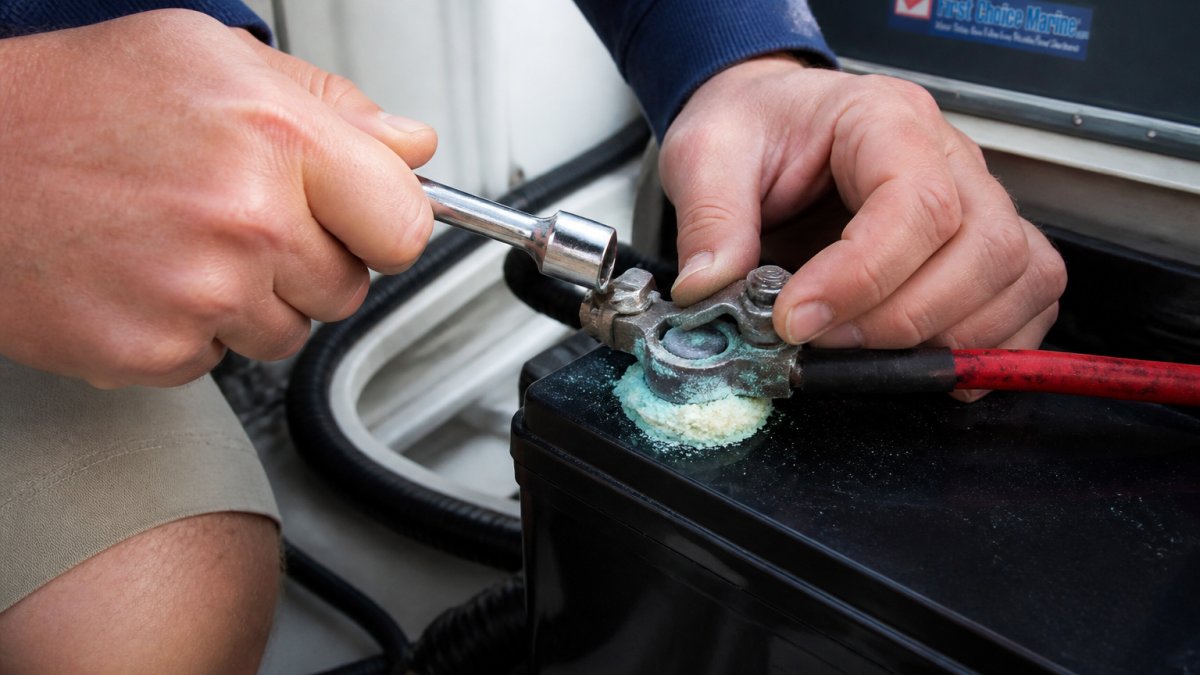
A battery terminal is the metal post where the cable clamp transfers current from the battery to the rest of the boat's wiring.
Here is the part most guides get wrong: a dead battery is usually a symptom, not the disease.
Battery Terminal Corrosion and Loose Clamps
Corrosion builds a barrier between the post and the clamp, and that barrier adds resistance to every circuit on the boat. Look for the white-green crust, but also check for clamps that twist by hand.
Clean the post and clamp with a battery brush until both shine, then tighten the clamp so it cannot rotate. Coat the assembly with a corrosion inhibitor.
Boat Battery Keeps Dying: Parasitic Draw and Charging Faults
A parasitic draw is current that flows from the battery to an accessory even when the switch is off.
Test the draw with everything switched off. Disconnect the negative cable and place a multimeter set to DC amps between the post and the cable end. A healthy reading is a small fraction of an amp.
Charging-system diagnosis works the other way. Start the engine and read voltage at the battery posts.
Battery packs that go out of balance cause the same symptom from a different direction. The Dual Pro PS3 Auto 3-Bank Battery Charger with 3-Bank BOS ($1,006.40) shuttles energy between batteries in a series pack to keep voltage equal before, during, and after charging, which addresses premature failure from an unbalanced pack.

Boat Fuse and Circuit Breaker Problems
Boat fuse and circuit breaker problems almost always show up as one of two symptoms: a circuit that dies with no obvious cause, or a fuse that blows again within minutes of replacement.
Start at the fuse panel. Pull the fuse for the dead circuit and hold it to a light. A fuse can look intact and still be open at the element. Test continuity with a meter if you have one.
Fuses That Blow Again and Again
A fuse that fails once is normal. A fuse that fails three times in a row means current is reaching ground where it should not.

Replace breakers with the correct amperage. The Blue Sea AC/DC Single-Pole Magnetic World Circuit Breaker 30a ($29.20) combines switching and circuit protection in one device and meets ABYC standards, which matters when you are protecting electronics on a boat that sees salt and vibration.
Wiring, Ground, and Bus Bar Failures
Ground faults cause some of the strangest symptoms on a boat: accessories that work only when another switch is on, lights that glow dim, gauges that sweep at random.
Trace the ground path from the accessory back to the ground bus bar.
A bus bar is the common junction where multiple circuits share a single power or ground point. The Blue Sea MiniBus 100a BusBar ($23.10) uses tin-plated copper for conductivity and corrosion resistance, with stainless studs that accept proper torque and a snap-on cover that keeps accidental shorts off the terminals.
Voltage-drop testing is a diagnostic step. Measure voltage at the battery, then at the load, with the circuit running.
Voltage-Sensitive Relays and Accessory Circuits
A voltage-sensitive relay (VSR) automatically connects or separates battery banks based on voltage, so the house bank charges when the engine runs and isolates when it stops.
Relays in general are the quiet culprits behind starter, trim, and accessory failures.
For Mercury outboards, the Mercury Relay #8M0210756 ($44.99) is a genuine OEM replacement built to spec for starter, power trim, main power, and fuel pump systems.

Accessory circuits also fail at the switch and at the harness. The Mercury Dash Harness Analog 9-Pin 5' ($49.46) replaces a damaged dash-side harness with a proper 9-pin connector instead of piecing individual wires together.
Boat Electrical Troubleshooting: A Symptom-to-Cause Chart
Boat electrical troubleshooting gets faster when you match the symptom to the most likely cause before you pick up a tool. Use this chart as a starting point, then confirm with a meter.
| Symptom | Most Likely Cause | First Test | Diagnostic Threshold | Typical Fix |
|---|---|---|---|---|
| Nothing works, no lights | Dead battery or open main switch | Voltage at battery posts, all off | Below 12.0 V resting indicates a depleted battery | Charge or replace battery; check main switch continuity |
| Engine cranks slowly | Corroded or loose terminal | Voltage drop from post to clamp under crank load | More than 0.5 V drop points to a bad connection | Clean and tighten; replace cable if green under insulation |
| Battery dies overnight | Parasitic draw | DC amp reading with everything off | Above 50 mA warrants isolation testing | Isolate circuit; repair or replace accessory |
| Battery never fully charges | Charging system fault | Voltage at posts, engine running at fast idle | Below 13.2 V suggests alternator or wiring fault | Inspect alternator, regulator, and charge wiring |
| One circuit dead | Blown fuse or tripped breaker | Continuity on fuse; breaker reset | No continuity means open fuse | Replace fuse with correct amperage; reset breaker |
| Fuse blows repeatedly | Short to ground | Isolate accessories one by one | Fuse opens within minutes of replacement | Repair chafed wire; inspect bulkhead pass-throughs |
| Accessories dim or erratic | Ground or bus bar resistance | Voltage drop from accessory ground to battery negative | More than 0.3 V drop indicates resistance | Clean grounds; replace bus bar |
| Trim or starter dead, switch fine | Failed relay | Swap with known-good relay of same rating | Accessory works with substitute relay | Replace relay |
How to Read Voltage-Drop Results
Voltage-drop testing is the step most troubleshooting charts skip, and it is the one that tells you whether to replace a component or repair a wire.
For continuity checks, disconnect power first and confirm the meter reads near zero ohms across a known-good fuse or switch. A fuse that looks intact but reads open on continuity is blown. A breaker that trips again immediately after reset is telling you the fault is downstream, not in the breaker.
For a systematic walk-through of fault finding on 12-volt systems, the American Boat and Yacht Council standards program publishes the electrical standards marine technicians work to, and the U.S. Coast Guard boating safety resources cover the regulatory side of onboard electrical systems.
Marine Electrical System Maintenance and When to Call a Pro
Marine electrical system maintenance is mostly inspection, and it pays for itself in avoided breakdowns. The marine environment attacks connections three ways: moisture films that bridge terminals, salt crystals that draw water into crimps, and vibration that loosens hardware. A routine built around those three forces catches most failures before they strand you.
A Practical Inspection Schedule
- Before every trip: Read battery voltage at the posts. A resting 12-volt battery in good condition typically reads about 12.6 V fully charged; below 12.0 V means charge it before you leave the dock.
- Monthly: Check battery terminals and clamps for looseness and crust. A clamp that twists by hand needs tightening or replacement.
- Each season: Inspect the fuse panel and bus bars for corrosion, look for chafed wire where it passes through bulkheads, and confirm that ring terminals are tight on their studs.
- Annually: Pull and inspect shore-power cords and inlets for scorching, cracked housings, or water intrusion, and have the AC side checked by a qualified technician if anything looks suspect.
Prevention comes down to three habits. Keep connections tight and coated with a corrosion inhibitor. Keep wire runs supported and away from standing water. Replace tinned copper wire and marine-grade terminals before they fail, not after. Household crimps and tape splices are the most common shortcuts that come back as intermittent faults.
When to Call a Marine Electrician
Know when to stop. Shore-power AC faults are a different animal from 12-volt DC problems, and they carry shock and fire risk. The Marinco Non-Metallic Inlet 50a ($119.47) is a proper 50-amp, 125/250-volt four-wire replacement inlet with a watertight cap, but installation on the AC side is a job for someone qualified.
On the DC side, bring in a professional when a voltage-drop test shows resistance buried inside a wire run you cannot access, when a fuse blows repeatedly after you have isolated accessories, or when a charging system reads below 13.2 V at fast idle after you have confirmed the wiring is sound. The NFPA 70 Article 555 guidance on marinas and boatyards is worth knowing if your dock wiring is part of the equation.
Frequently Asked Questions
What should I check first when my boat loses electrical power?
Start at the battery: inspect both terminals for corrosion, confirm the clamps are tight, and check the battery switch is in the correct position. If the battery reads below roughly 12.4 volts at rest, charge it before chasing anything else. From there, test the main fuse or circuit breaker at the panel. Most total power loss traces back to a loose or corroded connection, a tripped breaker, or a battery that never got charged, so work outward from the source rather than guessing at individual accessories.
Why does my boat battery keep dying even after I charge it?
A battery that keeps dying usually has one of three causes: a parasitic draw draining it while the boat sits, a charging system that is not putting out enough voltage, or a battery at the end of its service life. Test for draw with everything switched off, and check charging voltage at the battery with the engine running. On multi-battery setups, an unbalanced pack is a frequent culprit, which is why systems like the Dual Pro B.O.S. shuttle energy between batteries to keep them level.
How can I tell if a boat fuse or circuit breaker has failed?
A blown fuse shows a visibly broken element or reads no continuity on a multimeter. A tripped breaker may simply need resetting, but if it trips again immediately, stop and find the fault rather than holding it on. A cheap circuit tester such as the Wirthco 21049 ($11.22) lights up to confirm power is reaching a circuit and goes dark when there is a short or a low battery, which narrows the search fast. Replace fuses with the same amperage rating, never a higher one.
When should I call a marine electrician instead of fixing it myself?
Call a professional for anything involving shore-power AC wiring, burning smells, melted insulation, or repeated breaker trips you cannot trace. AC faults carry shock and fire risk that DC work does not, and ABYC-compliant repairs on inlets and panels need proper testing. Also call a marine electrician if you have replaced a battery, cleaned every connection, and the problem persists, since that points to a fault inside a harness or a component you cannot easily isolate on the water.
Why do my boat electronics keep shutting off while I am running?
Intermittent shutdowns usually mean voltage is dropping below what the electronics need, often from a loose connection, undersized wiring, or a ground bus bar with corrosion on it. Voltage-sensitive relays can also cut power deliberately when they sense low voltage. Test voltage at the device while it is running, not at the battery, and compare the two readings. A drop of more than about 0.5 volts across a circuit points to resistance in the wiring or connections that needs cleaning or replacing.
Boat electrical faults rarely announce themselves, and the ones that strand you on the water usually started as a loose clamp or a corroded bus bar months earlier. First Choice Marine stocks the marine-grade components that fix these problems properly, from genuine Mercury relays and OEM dash harnesses to Blue Sea bus bars and circuit breakers, all with free shipping and a catalog built for repair rather than replacement. Sign in to your account and get the right part the first time.
