


Table of Contents
- What Marine Navigation Electronics Do You Actually Need
- Marine GPS Chartplotter Systems: Core Navigation
- Building a Boat Navigation System Around Your Chartplotter
- Marine Radar and Advanced Navigation Tools
- Marine Electronics Compatibility: NMEA 2000 and Networking
- Choosing Electronics by Boat Type and Intended Use
- Total Cost of Ownership and Installation Considerations
- Frequently Asked Questions
Last Updated: October 17, 2026
What Marine Navigation Electronics Do You Actually Need
The marine electronics market was valued at $7.0 billion in 2025 and is projected to reach $12.5 billion by 2033, according to Grand View Research's Marine Electronics Market analysis.
At First Choice Marine, we help boat owners navigate this landscape. The challenge isn't whether you need marine navigation electronics, it's figuring out which ones matter for your boat and boating style.
You need a core foundation of marine navigation electronics, then you layer in specialized equipment based on how you use your boat.
Core Systems vs. Nice-to-Have Upgrades
Start here: marine navigation electronics fall into two clear buckets.
Core systems keep you safe and oriented, and they're non-negotiable. A chartplotter with reliable electronic charts, a GPS unit with solid positioning accuracy, and basic depth sounding form the foundation.
Everything else is optimization. Fish finders help you locate fish, radar adds situational awareness in poor visibility, autopilot reduces fatigue on longer runs, and networking improves efficiency.
The mistake most boat owners make is treating upgrades as necessities.
Marine GPS Chartplotter Systems: Core Navigation
A chartplotter is the centerpiece of modern marine navigation, combining GPS positioning, electronic chart display, and route planning into a single interface. For most boat owners, this is where the marine navigation electronics decision starts and often ends.
The chartplotter does three critical things: it tells you where you are (GPS), shows the water and obstacles around you (electronic charts), and lets you plan and follow routes. Everything else in your system either feeds data into it or takes instructions from it.
Standalone Chartplotters vs. Multifunction Displays
Here's where clarity matters: not all chartplotters are the same device.
A standalone chartplotter is a dedicated GPS and chart display that handles navigation and nothing else. These are smaller, often 5-7 inches, and straightforward: mount it, connect your GPS antenna, load your charts, and you're navigating.
A multifunction display (MFD) is a chartplotter with additional capability built in, displaying sonar data, radar, engine diagnostics, weather, and more on the same screen.
The choice depends on your boat and budget.
Screen Size, Chart Coverage, and Sunlight Readability
Screen size matters more than most boat owners realize. The Garmin GPSMAP 8616 Chartplotter GN+, with its 16-inch IPS display, is built for serious navigators who want maximum chart detail at the helm.

But size alone doesn't guarantee usability. Sunlight readability is critical, and a high-resolution screen is useless if you can't see it in bright daylight.
Chart coverage is equally important, since your chartplotter is only as good as the charts it displays. Garmin Navionics+ and C-MAP are the industry standards for coastal and inland charts in U.S. waters.
Building a Boat Navigation System Around Your Chartplotter
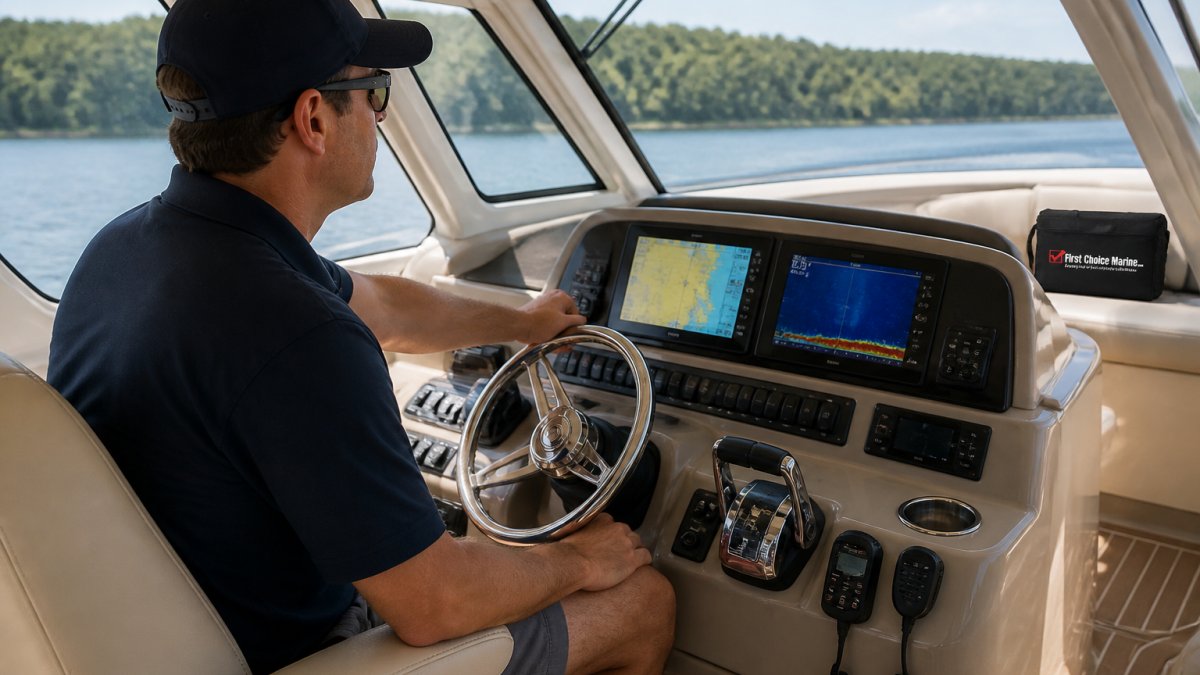
Your chartplotter doesn't operate in isolation. It's the hub of a larger marine navigation electronics ecosystem, and every other piece of equipment either feeds data into it or receives commands from it.
Fish Finders and Sonar Integration
A fish finder is a sonar system that locates fish and maps bottom structure by sending sound waves down and interpreting the returning echoes. For fishing boats, this is essential; for cruising boats, it's optional but increasingly popular.
The key specification is transducer frequency. The Simrad NSS12 EVO3S Combo MFD No HDMI Video Out Port includes 1 kW CHIRP sonar with dual transducer ports.

Integration matters. A standalone fish finder works fine, but an MFD combining charting and sonar on one screen is more practical: you see your position on the chart and the bottom structure in sonar, and correlate them instantly.
Autopilot and Course Control
An autopilot maintains your heading or course automatically, reducing fatigue on longer runs and improving fuel efficiency by maintaining consistent speed and direction. For cruising boats, this is valuable; for fishing boats running to offshore structure, it's useful but less critical.
Autopilots connect to your chartplotter and steering system, receiving course commands and making continuous steering adjustments to maintain them.
The practical reality: if you're running a boat longer than 30 feet or regularly make runs longer than a few hours, an autopilot pays for itself in reduced fatigue and improved comfort.
Marine Radar and Advanced Navigation Tools
Radar detects objects at a distance by transmitting radio waves and measuring reflections, working in fog, rain, and darkness where eyes and GPS alone aren't enough.
Radar integrates with your chartplotter, overlaying returns on your chart display so you see other boats, landmasses, and weather systems on the same screen as your navigation chart.
The tradeoff is cost and complexity. A quality radar system runs $1,500 to $4,000 installed and requires antenna space, power, and chartplotter integration. For most recreational boats it's not necessary; for boats running in frequent fog or heavy traffic, it's worth the investment.
Garmin GPSMAP 8616 Chartplotter GN+ #010-02093-50 →
Marine Electronics Compatibility: NMEA 2000 and Networking
NMEA 2000 is the networking standard that lets your marine electronics talk to each other. It's a digital language your chartplotter, autopilot, sonar, engine instruments, and other devices use to share data.
Without NMEA 2000, each device operates independently. Your chartplotter doesn't know what your sonar is seeing. Your autopilot doesn't know your GPS position. Your engine display doesn't talk to your fuel management system. With NMEA 2000, all of this data flows between devices, creating a unified boat navigation system.
System Integration and Wireless Connectivity
NMEA 2000 uses a backbone cable that runs through your boat, with drop cables connecting each device. The backbone carries power and data, so every connected device can both receive power and communicate.
Wireless connectivity is increasingly common. Devices like the Digital Yacht Navlink 2 NMEA to Wi-Fi Gateway create a Wi-Fi gateway from your NMEA 2000 network, letting you view navigation data on tablets or smartphones.
If you're building a new system or upgrading an older boat, plan for NMEA 2000 connectivity. It costs more upfront but gives you flexibility to add equipment later and ensures everything works together.
Choosing Electronics by Boat Type and Intended Use
The best marine navigation electronics for your boat depend entirely on what you do with it. A fishing boat's priorities differ from a cruising sailboat's, and a center console running inshore differs from a trawler running offshore.
Fishing Boats vs. Cruising Vessels
A fishing boat needs sonar above all else. Many fishing boats run dual sonar systems, one for structure fishing and one for open-water work; the Simrad NSS12 EVO3S Combo MFD No HDMI Video Out Port with dual transducer ports is popular for this reason.

Fishing boats also benefit from autopilot, especially for longer offshore runs. They often run radar if they operate at night or in marginal visibility. The goal is efficiency, get to the fishing grounds, find fish, and focus on fishing rather than navigation.
A cruising sailboat or trawler has different priorities. With long hours underway, comfort and ease of use matter more.
A cruising boat benefits from larger, easier-to-read displays. The Garmin GPSMAP 8616 Chartplotter GN+ with its 16-inch screen is popular because the large display makes navigation less fatiguing over long passages.
Coastal, Inland, and Offshore Navigation Needs
Coastal navigation means staying within sight of land, typically within 10-20 miles of shore.
Inland navigation on lakes and rivers requires different charts and sonar. Lakes have variable depth and structure; rivers have current and narrow channels. Your chartplotter needs inland-optimized charts, and C-MAP and Navionics both offer excellent inland coverage.
Offshore navigation means running beyond sight of land, often 50+ miles out. You need reliable GPS, extensive chart coverage, and redundancy, so many offshore boats run dual chartplotters as backup.
Total Cost of Ownership and Installation Considerations
The price of marine navigation electronics is only part of the equation. Installation, transducers, power requirements, and ongoing chart updates add significant cost.
| Component | Typical Cost Range | Notes |
|---|---|---|
| Chartplotter or MFD | $1,500-$5,000 | Larger screens and more features increase cost |
| Sonar transducer | $300-$800 | Dual transducers cost more; installation varies by boat |
| Autopilot | $1,800-$3,500 | Hydraulic systems more expensive than mechanical |
| Radar | $1,500-$4,000 | Antenna and installation add significant cost |
| NMEA 2000 cabling | $400-$800 | Professional installation recommended |
| Annual chart updates | $100-$300 | Varies by chart provider and coverage area |
Transducers, Power Requirements, and Chart Updates
A transducer is the sensor that sends sonar signals and receives echoes, mounted on the hull, typically through the transom.
Power is often overlooked. Plan for adequate battery capacity and charging capability.
Chart updates are an ongoing cost. If you update charts annually and run multiple coverage areas, budget for chart subscriptions.
Choosing the right marine navigation electronics requires understanding what your boat actually needs, not what marketing tells you to buy.
At First Choice Marine, we stock proven marine navigation electronics from manufacturers like Garmin, Raymarine, and Simrad.
Frequently Asked Questions
What marine navigation electronics do I need for a recreational fishing boat?
A GPS chartplotter with sonar capability is the foundation. Add a fish finder with a quality transducer for bottom tracking and structure detection. If you fish offshore, consider radar for weather and navigation in low-visibility conditions. For coastal or inland fishing, a mid-range multifunction display with preloaded charts and 1 kW sonar (like the Simrad NSS12 EVO3S Combo MFD No HDMI Video Out Port at $3,699.00) covers most needs. Ensure your system supports NMEA 2000 networking so you can add components later without replacing everything.
How do I know if marine electronics will work together?
Check NMEA 2000 and NMEA 0183 compatibility first, these are the standards that let marine electronics communicate. Most modern systems support NMEA 2000 networking, which allows chartplotters, sonar, autopilots, and radars to share data through a single backbone cable. Verify that your chosen chartplotter and sonar/radar units support the same networking protocol. Wireless gateways like the Digital Yacht Navlink 2 NMEA to Wi-Fi Gateway ($296.15) can also bridge older GPS systems to modern tablets and smartphones, expanding compatibility across your boat navigation system without replacing core equipment.
What's the difference between a standalone chartplotter and a multifunction display?
A standalone chartplotter handles GPS and electronic charts only. A multifunction display (MFD) integrates GPS, charts, sonar, radar, and autopilot control into one screen. MFDs cost more upfront but save space, reduce wiring complexity, and let you control your entire marine electronics suite from one touchscreen. For boats with limited helm space or those planning to add sonar and radar later, an MFD like the Raymarine Axiom+ 12 12" MFD No Transducer NA Chart ($2,744.99) or Garmin GPSMAP 8616 Chartplotter GN+ ($4,895.99) is more practical. Standalone units work well for smaller boats or as backup navigation systems.
How much should I budget for marine navigation electronics?
First Choice Marine offers free shipping on qualifying marine electronics, which can offset some costs. Prioritize a quality chartplotter first, then add sonar and radar as budget allows.
Do older boats work with modern marine GPS chartplotters?
Yes. Modern chartplotters use industry-standard NMEA 0183 and NMEA 2000 protocols, which work with boats from the 1990s onward. However, verify your boat's power system can handle the electronics' draw (most chartplotters use 2-5 amps at 12V). Check for adequate helm space and wiring conduit. If your boat has older sonar or GPS systems, you can replace them individually, they don't need to be the same brand. Wireless gateways bridge legacy equipment to new systems. Consult installation guides or contact a marine electrician if your boat's wiring is corroded or undersized.
What chart coverage should I look for in a marine GPS chartplotter?
Choose charts that cover your primary boating area. Garmin Navionics+ includes detailed coastal and inland mapping for the entire continent. Simrad C-MAP charts offer high-resolution coverage in popular fishing regions. Look for preloaded charts that match your waters, coastal, Great Lakes, or river systems, before buying. Premium chart options like Garmin Navionics Vision+ add 3D bottom contours and structure highlights, which help with fishing and navigation. Most modern chartplotters let you add chart upgrades via SD card or download, so you can start with basic coverage and expand later without replacing the unit.
Is marine electronics market growth affecting product availability and pricing?
Increased competition and manufacturing capacity have kept pricing stable while expanding feature sets. Newer models with faster processors, higher-resolution displays, and better networking are becoming standard. Retailers like First Choice Marine stock a wide range of current and proven models, so availability remains strong. Older inventory sometimes clears at discounts, but current-generation systems offer better performance and longer support.
