


Table of Contents
- Understanding Propeller Pitch and How It Affects Performance
- The Role of Propeller Diameter and Blade Area
- How to Measure a Boat Propeller
- Three-Blade vs Four-Blade Propellers: Which Is Right for You
- Aluminum vs. Stainless Steel: Material Matters
- Boat Propeller Size Chart and Engine Compatibility
- How to Choose the Right Boat Propeller for Your Specific Use
- Propeller Maintenance and When to Replace
- Frequently Asked Questions
Last Updated: October 15, 2026
Understanding Propeller Pitch and How It Affects Performance
Propeller pitch is the theoretical distance a propeller moves forward through water in one complete rotation, measured in inches. Think of it like the threads on a screw: a higher pitch means the propeller tries to move farther forward with each spin, while a lower pitch means it moves less distance per rotation.
Pitch directly controls your boat's RPM and speed. A propeller with lower pitch (say, 13 inches) will allow your engine to reach higher RPMs at wide-open throttle (WOT), which generates more acceleration but lower top-end speed. A higher-pitch propeller (say, 19 inches) will limit RPMs but deliver more top-end speed with less acceleration.
The relationship between pitch and performance is straightforward: if your engine isn't reaching its target RPM range at WOT, you need lower pitch. If you're overspeeding (exceeding the manufacturer's recommended RPM limit), you need higher pitch.
The Role of Propeller Diameter and Blade Area
Diameter measures the span of the propeller from one blade tip to the opposite blade tip, expressed in inches (typically 12-16 inches for most recreational boats). Blade area is the total surface area of all blades combined, which directly affects how much grip the propeller has in the water.
Larger diameter and increased blade area generate more thrust and better acceleration, especially useful for heavy boats, towing, or rough-water conditions. The trade-off is that larger propellers create more drag and may limit top-end speed. Smaller diameters spin faster and favor speed but sacrifice pulling power and handling in chop.
For most boats, diameter is constrained by your gearcase and shaft specifications, you can't simply fit a larger propeller without checking your engine's manual.
How to Measure a Boat Propeller
Measuring your current propeller correctly is essential before ordering a replacement. You need three measurements: diameter, pitch, and rotation direction (right-hand or left-hand).
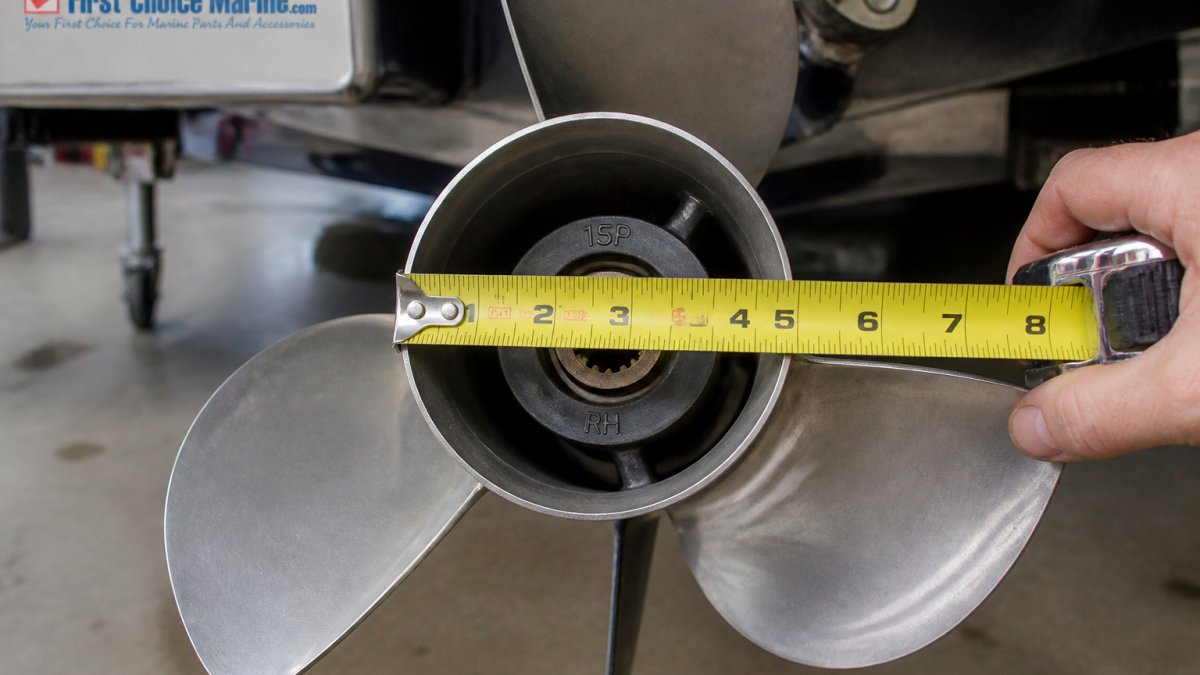
Start with diameter. Remove the propeller or measure it in place using a ruler or measuring tape.
Next, locate the pitch markings on the propeller hub (the center part that attaches to the shaft). Most propellers have pitch stamped or cast directly into the hub.
Finally, determine rotation. Stand behind the boat and look at the propeller. If the top of the blades move away from you as the propeller rotates forward, it's a right-hand (RH) propeller.
Record all three measurements along with your engine make and model, then cross-reference them with a propeller selection chart or consult with a marine retailer to confirm compatibility before purchasing.
Three-Blade vs Four-Blade Propellers: Which Is Right for You
The three-blade versus four-blade decision shapes your boat's entire performance character. Three-blade propellers are lighter, spin faster, and favor top-end speed with lower fuel consumption at cruise. They're the traditional choice for performance boats and open-water running where speed matters more than comfort.
Four-blade propellers deliver more blade area (roughly 33% more than a three-blade of the same diameter), which translates to better acceleration, smoother handling in rough water, and superior stern lift.
If your boat was originally equipped with a three-blade propeller and you're considering an upgrade, a four-blade of the same diameter and pitch will improve handling and acceleration noticeably. You may need to adjust pitch up slightly (add 1-2 inches) to keep engine RPM in the target range, since the extra blade area will load the engine more heavily.
Aluminum vs. Stainless Steel: Material Matters
Aluminum propellers cost less, are easier to repair, and are forgiving if you strike a rock or dock. They're the practical choice for recreational boaters who want a reliable, affordable option and don't mind occasional blade straightening or repair.
Stainless steel propellers are harder, hold their shape better under load, and deliver superior fuel economy and efficiency because their stiffer blades don't flex as much in the water. They're more expensive upfront but last longer and require less maintenance. Stainless steel is the choice for serious cruisers, offshore fishing, and any boat where fuel economy or performance consistency matters.
The key difference is blade stiffness. Aluminum blades flex slightly under load, which reduces efficiency but makes the material forgiving in shallow water or if you hit debris. Stainless blades stay rigid, which means better thrust transfer but less forgiveness if you strike something solid. For recreational boaters, aluminum is practical and budget-friendly.
First Choice Marine carries both aluminum and stainless steel propellers to match your boat's use and budget. The Turning Point Hustler Aluminum RH Propeller 13.5" x 15 4-Blade ($140.22) is an excellent upgrade for boats seeking better acceleration and handling without the stainless steel price tag. For those prioritizing efficiency and durability, the EMP IH Prop LX-3+ 3-Blade Stainless 19-Pitch ($377.99) delivers superior performance for larger offshore applications.


Boat Propeller Size Chart and Engine Compatibility
Your engine manufacturer specifies which propeller sizes work with your boat. This information appears in your owner's manual or on the engine's nameplate and includes diameter, pitch range, spline count, and shaft size.
Turning Point Hustler Aluminum RH Propeller 13.5" x 15 4-Blade #21431530 →
Matching these specifications is non-negotiable. Installing a propeller with the wrong spline count won't fit the shaft. Wrong shaft diameter means the hub won't seat properly. Mismatched gearcase size (measured in inches, typically 4.75" or 5" for recreational boats) can damage the transmission.
Most recreational boats run propellers in these ranges:
- Small boats (under 25 hp): 9-11" diameter, 8-13" pitch
- Mid-range (40-150 hp): 12-14" diameter, 13-19" pitch
- Large boats (200+ hp): 14-16" diameter, 17-23" pitch
Your engine's redline RPM (maximum safe operating speed, typically 4,500-6,000 RPM for most recreational engines) is your performance ceiling. At WOT with the right propeller, you should hit 75-85% of that redline. If you're overspeeding (exceeding the limit), pitch is too low. If you're underspeeding (falling short of the range), pitch is too high or blade area is insufficient for your boat's weight.
| Propeller Type | Diameter | Pitch Range | Best For | Material |
|---|---|---|---|---|
| Performance/Speed | 12-13" | 15-19" | Top-end speed, lighter boats | Aluminum or Stainless |
| Balanced | 13-14" | 17-21" | General cruising, mixed use | Aluminum or Stainless |
| Acceleration/Load | 14-15" | 13-17" | Heavy boats, towing, watersports | Aluminum or Stainless |
| Offshore/Efficiency | 15-16" | 19-23" | Large boats, fuel economy, cruise speed | Stainless Steel |
How to Choose the Right Boat Propeller for Your Specific Use
Choosing the right propeller means matching diameter, pitch, blade count, and material to your boat's actual use case, not just its engine specs. Start by defining your priority: Do you want maximum speed, better acceleration, smoother handling, or fuel economy?
For watersports and acceleration: Four-blade aluminum propellers in the 13-14" diameter range with 15-17" pitch. The Turning Point Hustler Aluminum RH Propeller 14.5 x 17 4-Blade ($160.19) is purpose-built for this, with tuned vents for fast hole shot and progressive pitch angles that balance acceleration with top-end capability.

For cruising and fuel economy: Three-blade stainless steel in the 15-16" diameter, 19-21" pitch range. The EMP IH Prop LX-3+ 3-Blade Stainless 19-Pitch ($377.99) excels here, offering balanced all-around performance with proven fuel economy at offshore cruise speeds.
For fishing and rough-water handling: Four-blade stainless in the 14-15" diameter, 17-19" pitch. The EMP IH Prop HR-4 4-Blade Stainless 19-Pitch ($435.99) delivers smooth, powerful thrust with high-rake cupped blades for stern lift and confident handling.
Propeller Maintenance and When to Replace
Propellers take a beating. Cavitation (tiny bubbles forming on the blade surface during high-speed rotation) erodes the blade over time. Ventilation (air being sucked down to the propeller) causes loss of thrust.
Check your propeller every 50 operating hours or at the start of each season. Look for blade erosion, cracks, or bending.
Aluminum propellers are repairable. A qualified shop can straighten bent blades, weld small cracks, and restore blade surfaces.
Replace your propeller when:
- Blades show deep cracks or structural damage
- Bending is severe enough to cause vibration
- Erosion has reduced blade thickness significantly
- Repairs would cost more than 60% of a new propeller
Between replacements, keep your propeller clean. Fresh water rinses remove salt deposits that accelerate corrosion. If your boat sits unused for extended periods, remove the propeller and store it indoors to prevent galvanic corrosion on the hub.
Selecting the right propeller is one of the highest-impact upgrades you can make to your boat's performance. The right combination of pitch, diameter, blade count, and material transforms how your boat accelerates, handles, and cruises.
Frequently Asked Questions
What does propeller pitch mean, and how does it affect my boat's performance?
Propeller pitch refers to the theoretical distance (in inches) the propeller would move forward in one complete rotation if there were no slip. Higher pitch means the propeller moves faster but requires more engine power, resulting in higher top speeds but slower acceleration. Lower pitch gives you quicker hole shot and better acceleration but lower top-end speed. Your engine RPM at wide open throttle (WOT) is the key indicator: if you're running below your target RPM, you need lower pitch; if you're exceeding it, you need higher pitch.
How do I know what propeller size is right for my boat?
Start by checking your engine manufacturer's specifications for the recommended propeller diameter and pitch range. Then consider your boat's typical use: fishing boats prioritize hole shot and handling (lower pitch), while cruising boats favor top-end speed (higher pitch). Measure your current propeller's markings (diameter x pitch x rotation) and verify engine compatibility. If your engine runs below its target WOT RPM, step down in pitch; if it runs above, step up. Always confirm your engine's spline count and hub type before purchasing.
Should I choose a three-blade or four-blade boat propeller?
Three-blade propellers offer better top-end speed and fuel economy due to less drag and blade area. Four-blade propellers provide superior acceleration, handling, stern lift, and smoother ride in rough water because they grip the water better. For watersports, fishing, or boats carrying heavy loads, four-blade is ideal. For cruising or maximum speed, three-blade works well. Your boat's weight, typical water conditions, and performance priorities should guide your choice.
What is propeller slip, and why does it matter when choosing a propeller?
Propeller slip is the difference between the theoretical distance the propeller should move (based on pitch) and the actual distance it moves through the water due to water pressure and resistance. Slip typically ranges from 5% to 15%. A propeller with excessive slip (over 15%) indicates poor efficiency or the wrong pitch selection. Monitoring your engine's RPM at WOT helps identify slip issues: if RPM is consistently below the manufacturer's target range, you may have too much pitch and excessive slip.
How do I measure my current propeller to find a replacement?
Most propeller markings are stamped on the hub (the center part that connects to the shaft). The markings show diameter x pitch x rotation (RH for right-hand, LH for left-hand). For example, '14.5 x 17' means 14.5-inch diameter and 17-inch pitch. If markings are worn, measure the diameter from blade tip to blade tip across the center, and count the blades. Write down your engine model, horsepower, and gearcase type. Check with your engine manufacturer or a propeller selection guide to confirm the correct hub kit you'll need for installation.
What's the difference between aluminum and stainless steel propellers?
Aluminum propellers cost less and are easier to repair after hitting debris, making them ideal for shallow or rocky waters. Stainless steel propellers offer superior durability, better fuel efficiency, and maintain performance longer, making them better for offshore or high-use applications. Stainless steel holds its blade shape under load, reducing flex and improving thrust efficiency. For recreational boaters in protected waters, aluminum works well; for serious cruising or fishing, stainless steel's longevity justifies the higher cost.
What information do I need before choosing a replacement boat propeller?
Gather your current propeller's diameter, pitch, and blade count (stamped on the hub). Note your engine brand, horsepower, and gearcase type. Check your engine manufacturer's recommended RPM range at wide open throttle. Identify your typical boating use (fishing, watersports, cruising, towing). Know your boat's hull type and typical load. Confirm your propeller shaft's spline count and diameter. If you're upgrading for performance, decide your priority: acceleration, top speed, fuel economy, or handling. Having this information ensures you select a propeller that matches your engine and delivers the performance you need.
