


Table of Contents
- What Drives the Cost to Replace a Boat Steering Helm
- Helm Price by Type: Rotary, Rack-and-Pinion, and Hydraulic
- Boat Steering Cable Replacement Cost and What Changes It
- Boat Steering Cable and Helm Replacement: Should You Do Both?
- Hydraulic Boat Steering Helm Replacement: When It Makes Sense
- Boat Steering Helm Replacement Time: DIY vs. Shop Labor
- Repair or Replace? Seal Kits, Stuck Cables, and Seized Parts
- Conclusion: Getting a Helm Estimate You Can Trust
- Frequently Asked Questions
Last Updated: October 12, 2026
What Drives the Cost to Replace a Boat Steering Helm
The cost to replace a boat steering helm depends on three things: the type of helm, the labor, and what else fails while you're in there.
A steering helm is the mechanical or hydraulic unit behind your wheel that converts turning motion into cable or fluid movement at the engine.
A mechanical rotary helm sits at the low end; a hydraulic helm at the high end, often several times higher.
Parts, Labor, and the Add-Ons That Show Up Later
Parts and labor split the bill roughly in half on a straightforward mechanical job. On hydraulic systems, parts take a bigger share because the pump and lines cost more.
The add-ons that appear later are predictable once you know them:
- A new steering cable, because the old one is usually worn when the helm fails
- A seal kit, if the hydraulic helm is leaking rather than broken
- New fittings and hardware, because old ones often strip or seize
A common mistake is ordering only the helm and discovering mid-job that the cable is seized inside its sheath. Then you're waiting on a second shipment with the boat half apart.
Helm Price by Type: Rotary, Rack-and-Pinion, and Hydraulic
Helm prices separate cleanly by steering technology: mechanical helms cost the least, rack-and-pinion sits in the middle, and hydraulic helms cost the most. Within each category, the model and its features move the number.
Here is how the three types compare on the factors that drive price:
| Helm Type | Typical Complexity | Key Cost Driver | Best For |
|---|---|---|---|
| Mechanical rotary | Low | Cable compatibility, turns lock-to-lock | Small outboards, simple setups |
| Rack-and-pinion | Moderate | Mounting style, dash modifications | Mid-size single-engine boats |
| Hydraulic | High | Pump capacity, seal quality, line routing | Larger boats, higher horsepower |
Mechanical Helms
Mechanical rotary helms are the budget option, and the Teleflex line shows how pricing scales with features. The Teleflex Safe-T II No-Feedback Helm #SH5150P lists at $184.47 and fits boats up to 24 feet with non-power-assisted outboards, replacing a standard Safe-T unit without dash modification at 3.0 turns lock to lock.

The Teleflex 4.2 No-Feedback Single Helm #SH4910P at $188.62 is a drop-in replacement for current-generation Safe-T systems with 4.2 turns lock to lock. Both meet A.B.Y.C. and N.M.M.A. standards and qualify for free shipping; the difference is steering feel and cable compatibility, not build quality.
Hydraulic Helms
Hydraulic helms jump in price because they replace cables with fluid lines and a pump. The Teleflex Baystar Front Mount Helm 1.1 #HH4311-4 and the Teleflex Baystar Helm 1.4 Front Mount ORB #HH4314-4 both list at $575.99.
For power-assisted setups, the Teleflex HPS Rotary Tilt Helm #SH91650P at $282.62 handles steering load even if power steering fails, using standard Safe-T mounting hardware and Quick Connect cables.
Boat Steering Cable Replacement Cost and What Changes It
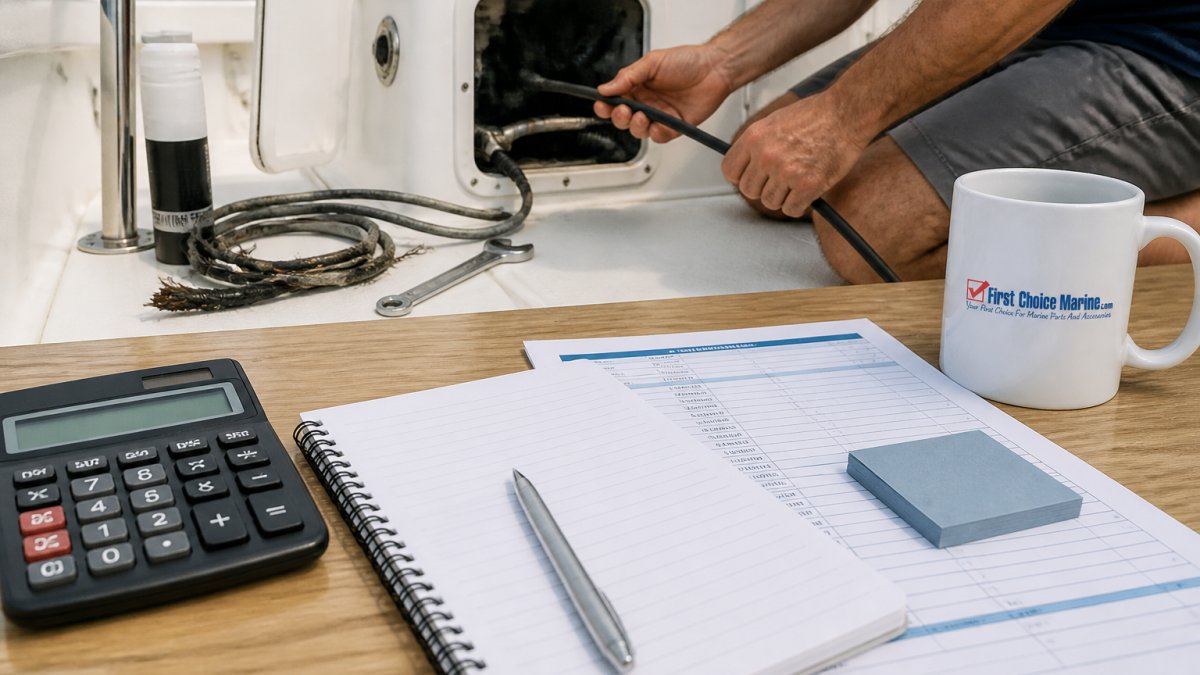
Boat steering cable replacement cost is usually lower than the helm itself, but it climbs fast when access is difficult. The cable is the long push-pull line from the helm to the engine, and it wears out from corrosion and flex.
What changes the price:
- Cable length. Longer boats need longer cables, and the price scales with length.
- Routing difficulty. A cable that runs through a clean, open path is quick to swap. One buried behind panels or under the floor adds hours.
- Condition of the old cable. A seized or corroded cable may need to be cut out, which takes longer than a clean pull.
- Helm compatibility. Some helms use Quick Connect cables, which speed up the job. Older systems may need adapters.
If the old cable is stiff, rusted at the ends, or has a frayed sheath, replace it while the helm is already off. Doing both at once saves the labor of opening the same access points twice.
Boat Steering Cable and Helm Replacement: Should You Do Both?
Replace both the cable and the helm together when either one is worn. The two parts wear as a system, and a new helm on an old cable often feels no better than the failed unit.
This is the itemized comparison most owners never get before they approve a quote:
| Scope of Work | What's Included | Why Owners Choose It |
|---|---|---|
| Helm only | New helm, reuse old cable | Cable is recent and in good condition |
| Cable only | New cable, reuse old helm | Helm is sound, cable is stiff or frayed |
| Helm and cable together | Both parts, one labor session | Both are worn, or access is difficult |
| Full system | Helm, cable, fittings, hardware | Corrosion throughout, older boat |
The math favors doing both when the boat is older or the access is tight. You pay for the same disassembly once instead of twice.
Hydraulic Boat Steering Helm Replacement: When It Makes Sense
Hydraulic boat steering helm replacement makes sense when the helm leaks, steering feels vague or spongy, or the boat has outgrown its mechanical system. Hydraulic steering removes cable stretch and gives more consistent response under load.
Signs it's time:
- Fluid weeping around the helm shaft or fittings
- Steering that feels loose, spongy, or slow to respond
- A helm that won't hold position under load
- A boat repowered above what the mechanical system was rated for
The Teleflex Baystar models are built for vessels up to 150 HP and feature enhanced check valves for durability against trailering stress.
Teleflex Baystar Front Mount Helm 1.1 #HH4311-4 →

Boat Steering Helm Replacement Time: DIY vs. Shop Labor
Marine technician labor rates in the U.S. commonly fall between $95 and $165 per hour, with mobile mechanics at the top and dealership service departments in the middle.
Here is how the time typically breaks down by job scope:
| Job Scope | Typical Hours | Typical Labor Range at $95-$165/hr |
|---|---|---|
| Mechanical helm only, open access | 1.5-2.5 | $145-$415 |
| Mechanical helm plus cable, open access | 3-5 | $285-$825 |
| Mechanical helm plus cable, buried routing | 5-8 | $475-$1,320 |
| Hydraulic helm only, accessible | 3-5 | $285-$825 |
| Hydraulic helm plus lines and bleeding | 6-10 | $570-$1,650 |
Those are labor-only figures; add the part cost from the sections above for an installed total.
DIY is realistic for a mechanically inclined owner on an accessible setup, but not for a hydraulic system with buried lines, a seized helm, or fittings you can't reach.
What separates a smooth DIY job from a nightmare:
- Photograph every connection before you take it apart
- Match the new helm to your existing cable type and mounting pattern
- Have the new cable and fittings on hand before you start
- Test steering effort by hand before you launch
If you're unsure whether you have the right part, ask before you order, discovering the wrong helm at the dock costs more than the part.
Repair or Replace? Seal Kits, Stuck Cables, and Seized Parts
A seal kit or cable repair is sometimes the right call instead of a full helm replacement. Hydraulic helms often leak at the seals rather than failing internally, and a seal kit costs a fraction of a new helm.
Here is the itemized comparison most owners never see before they approve a quote:
| Option | Typical Parts Cost | Typical Labor | When It Wins |
|---|---|---|---|
| Seal kit only | $25-$75 | 1-2 hrs | Helm holds pressure, leak is at the shaft or a fitting, housing is sound |
| Cable lubrication or freeing | $10-$30 in lubricant | 0.5-1 hr | Cable is stiff but moves, no fraying, no corrosion at the ends |
| Cable replacement only | $80-$250 depending on length | 2-5 hrs | Cable is seized or frayed, helm is sound |
| Helm replacement only | $185-$600+ | 1.5-5 hrs | Helm is worn internally, cable is recent and free |
| Helm and cable together | $265-$850+ | 3-8 hrs | Both are worn, or access is difficult |
| Full hydraulic system | $575-$1,500+ for helm, lines, fittings | 6-10 hrs | Corrosion throughout, older boat, or upgrading from mechanical |
When repair makes sense:
- The helm holds pressure and steers correctly apart from a slow leak
- The cable is stiff but not seized, and lubrication frees it
- The failure is isolated to one fitting or seal
- The housing and shaft show no play and no corrosion pitting
When replacement is the better call:
- The helm shaft has play or the internal mechanism is worn
- The cable is seized and won't free up with lubrication
- Corrosion has reached the housing or the fittings
- The system is older and parts are hard to source
A common mistake is chasing a leak with repeated seal kits when the housing itself is worn. If you've sealed it twice and it still weeps, the helm is done. Replace it.
Safety Checks After Any Steering Work
Steering is a safety-critical system. Before you launch after any helm, cable, or hydraulic work, run these checks:
- Turn the wheel lock to lock by hand and confirm smooth travel with no binding or grinding
- Check every fitting, nut, and connection for tightness and, on hydraulic systems, for weeping fluid
- Confirm the engine turns fully port and starboard with the wheel at the stops
- Bleed hydraulic systems completely and top off fluid to the correct level
Do not use the boat if the wheel binds, steering feels vague or spongy, fluid is actively leaking, or the engine does not reach full travel at the stops, the same signs that tell you a repair has failed.
American Boat & Yacht Council standards for steering systems
Conclusion: Getting a Helm Estimate You Can Trust
Steering that fails on the water is a safety problem, not just a cost problem. Get the diagnosis right before approving any work, and insist on an itemized quote that separates parts from labor.
First Choice Marine stocks the Teleflex helms covered here, including the Baystar hydraulic models and the Safe-T II and 4.2 rotary helms, all backed by our focus on repair and maintenance over unnecessary replacement.
Frequently Asked Questions
How much does it cost to replace the steering cable on a boat?
Cable costs vary by length and type. A no-feedback helm alone from First Choice Marine runs $184.47 to $188.62. Add labor if you hire a marine technician, typically several hours at shop rates. Cable length, routing difficulty, and whether you replace the helm at the same time all shift the total.
Can you replace a boat steering helm without replacing the cable?
Often yes, if the cable is in good condition and matches the new helm's connection type. Teleflex rotary helms use Quick Connect cables, so a helm swap can reuse the existing cable when it is compatible and not corroded. If the cable is stiff, frayed, or shows corrosion at the ends, replacing both at once saves you a second teardown later.
How long does it take to replace a boat steering helm?
A straightforward mechanical helm swap can take a DIY owner two to four hours. Hydraulic helm replacement takes longer because you must bleed the system and check for leaks, often half a day or more. Access matters: a helm behind a tight dash or a cable routed through foam or conduits adds time. A shop may quote one to three hours of labor for mechanical work.
Should I repair or replace a boat steering helm?
If the helm leaks at the shaft seal and the internals are sound, a seal kit can be far cheaper than a full replacement. But if the helm has play, grinding, or corrosion inside, replacement is the safer call. Have a marine technician inspect before deciding.
What affects the labor cost of replacing a boat steering helm?
Shop labor rates, access behind the dash, cable routing, and whether the job is mechanical or hydraulic all drive labor cost. Seized or corroded fittings add hours. Hydraulic systems need bleeding and testing, which adds time. Getting two or three written estimates that itemize parts and hours lets you compare quotes fairly instead of guessing.
