


Last Updated: October 30, 2026
Quick Summary
Marine grade wiring uses tinned copper strands and insulation rated for wet, oil, fuel and UV exposure, so it resists the corrosion that builds up in a boat's bilge and engine space. Automotive wire has bare copper and insulation built for dry, hot engine bays, so it can corrode, lose conductivity and fail sooner on a boat.
- Bare copper in a wet bilge forms green and white crust that raises resistance and generates heat.
- Ancor Red 14 AWG marine wire is rated 105°C dry and 75°C wet.
- Voltage drop under load often shows corrosion before a circuit fails outright.
- Use marine grade wire wherever moisture, heat, fuel or vibration can reach the conductor.
- Undersized wire is dangerous, because a fuse protects the wire, not the device.
Table of Contents
- Why Marine Grade Wiring Matters on a Boat
- How Automotive Wire Fails in a Marine Environment
- Tinned Copper Marine Wire vs Bare Copper Automotive Wire
- Insulation Ratings: Heat, Cold, Oil and Fuel Exposure
- Reading a Boat Wire Gauge Chart for Safe Current Loads
- Cost and Lifespan Tradeoffs: Which Wire to Buy
- Selecting Marine Wire and Connectors for Your Next Upgrade
- Frequently Asked Questions
Why Marine Grade Wiring Matters on a Boat
A boat's electrical system lives in one of the harshest environments any wire will ever see. Salt spray, bilge water, battery acid, engine heat and constant vibration all work against copper every day. That is why the wire you run in a boat is not a place to save a few dollars. At First Choice Marine, we see the same question come up again and again: can a standard automotive wire do the job on a boat? The short answer is that it can work for a while, but it rarely lasts.
Marine grade wiring is built for this environment. Our Ancor Red 250' 14 AWG Wire #104825, for example, uses tinned copper stranding and premium vinyl insulation rated for 105°C dry and 75°C wet conditions, and is described as resistant to salt water, battery acid, oil, gasoline and ultraviolet radiation.
How Automotive Wire Fails in a Marine Environment
Automotive wire is engineered for a dry, climate-controlled engine bay. Its conductors are usually bare copper, and its insulation is designed for heat and abrasion rather than constant moisture. On a boat, that design becomes a liability.
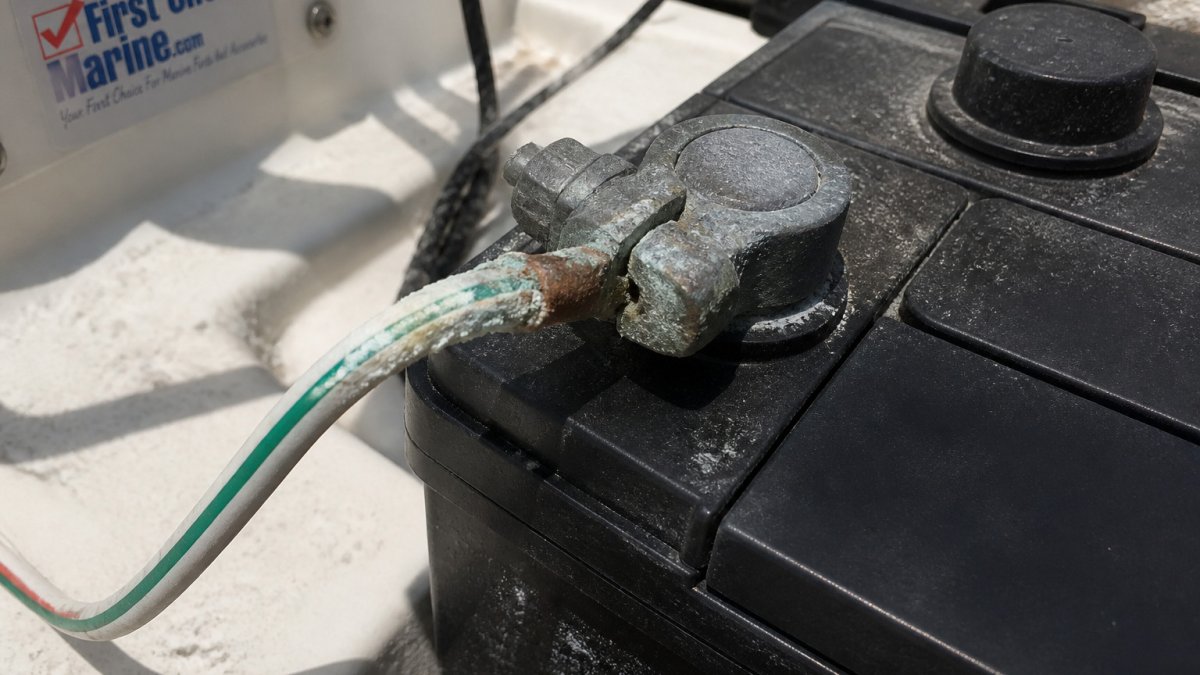
Moisture can reach bare copper at crimp points and wire ends, where corrosion may begin, sometimes hidden under the jacket. The green and white crust that forms increases resistance, which generates heat, which accelerates the damage. Eventually a circuit that tested fine last season starts dropping voltage or failing entirely.
Electrolysis adds another problem. Dissimilar metals in a wet bilge can drive current through corroded strands, speeding up deterioration.
Tinned Copper Marine Wire vs Bare Copper Automotive Wire
The core difference between these two wires is the conductor, but the reason that difference matters is a chain of chemistry and physics that plays out over months, not minutes.
Bare copper exposed to oxygen, moisture and salt forms copper oxides and chlorides, the green and white crust boat owners find under a jacket. Those compounds are poor conductors compared with clean copper. As the crust spreads strand to strand, the effective cross-section of the conductor shrinks, resistance climbs, and the voltage drop across the run grows.
Stranding matters as much as the coating. Marine wire is built with fine, numerous strands so the conductor stays flexible through vibration and thermal cycling. A stiff conductor work-hardens at bend points, and individual strands crack.
Here is how the two compare in practical terms:
| Feature | Tinned Copper Marine Wire | Bare Copper Automotive Wire |
|---|---|---|
| Conductor | Each strand tin-coated | Bare copper |
| Corrosion mechanism | Slow surface oxidation; oxide stays conductive | Copper oxide/chloride crust raises resistance |
| Flexibility over time | Fine stranding resists work-hardening | Coarser stranding can stiffen and crack |
| Electrolysis risk | Reduced at dissimilar-metal junctions | Higher near dissimilar metals in wet bilge |
| Insulation focus | Wet rating, fuel/oil, UV, cold flex | Heat and abrasion in dry conditions |
| Typical use | Bilge, engine, exposed runs | Dry, climate-controlled areas |
| Cost | Higher upfront | Lower upfront |
Electrolysis deserves its own note. When dissimilar metals sit in a wet, salty environment and a current path exists, the less noble metal gives up material. A bare copper conductor crimped to a plated terminal in a damp bilge is exactly that setup. The damage often starts at the crimp, hidden under heat-shrink, and works back up the strand bundle.
That circuit is exactly where you need the corrosion resistance most, because it sits in the wettest, most intermittent-duty location on the boat. The same logic applies to any run that passes through a damp locker, near a through-hull, or along a fuel line.
Tinned copper is not magic. It still needs proper crimping, adhesive-lined heat-shrink and strain relief, and it still fails if water is allowed to pool at a termination. But it gives you a far wider margin for error in a wet space, and that margin is what separates a circuit that lasts a decade from one that strands you at the dock.
Insulation Ratings: Heat, Cold, Oil and Fuel Exposure
Insulation matters as much as the conductor. A boat's wiring can run next to a hot engine, through a cold cabin or near fuel and oil lines. The insulation has to handle all of that.
Marine-rated insulation is typically rated for both dry and wet operating temperatures. The Ancor wires in our catalog, for example, are rated at 600 volts and 105°C dry and 75°C wet. They are also described as remaining flexible in extreme cold and resisting salt water, battery acid, oil, gasoline and ultraviolet radiation. When you compare labels, look for those specific ratings rather than a general "marine" claim. Beyond the insulation itself, proper marine cable protection remains essential for preventing physical damage in high-vibration environments where chafe tubing vs heat shrink for leaders offers a critical choice for long-term reliability.
Automotive insulation is often rated for heat but not designed for constant wet exposure or fuel contact. A wire that holds up under the hood of a car can harden or swell after months in a damp, fuel-scented bilge. Check the listing, confirm the temperature and chemical ratings, and match them to where the wire will actually run.
Ancor Red 250' 14 AWG Wire #104825 →
Reading a Boat Wire Gauge Chart for Safe Current Loads
Wire gauge determines how much current a conductor can carry safely. Smaller AWG numbers mean thicker wire. A thicker wire carries more current with less heat and voltage drop.
Our catalog includes several sizes you will see referenced on gauge charts. The Ancor Red 12 AWG Primary Wire 100' #106810 suits circuits that need more capacity than 14 AWG. For heavy feeds such as battery cables, the Ancor Black 25' 2/0 AWG Wire #117002 is the size you will see specified for high-current runs.
Before choosing a gauge, do three things:
- Add up the maximum current the circuit will draw.
- Measure the total run length, since longer runs lose more voltage.
- Check the chart against the circuit's protective fuse or breaker rating.
Watch out: undersized wire is one of the most common and dangerous mistakes. A fuse protects the wire, not the device, so the wire must be sized to carry the current the fuse allows.
Cost and Lifespan Tradeoffs: Which Wire to Buy
Marine wire costs more per foot than automotive wire. That is a real difference, and it is fair to ask whether it is worth it. The honest answer depends less on the price per foot than on where the run lives and what a failure costs you.
A dry, short run inside a cabin behind a panel sees little moisture and little vibration, and a quality automotive wire can serve there for years. A run that passes through a bilge, an engine space, a damp locker or an exposed deck fitting sees salt, heat and flex, and that is where marine grade earns its premium. Treating the boat as one decision either overpays in dry spaces or underpays in wet ones.
Lifespan expectations are where the two wire types diverge most, and it is the part most buying guides skip. The wire itself is rarely the line item that hurts; the labor to pull a failed run through a crowded boat, reterminate both ends and retest is what turns a cheap spool into an expensive repair.
Consider a bilge pump circuit. The same math applies to navigation lights, bilge blowers and any feed that runs aft through a wet compartment.
There is also a reliability angle that does not show up on a price tag. That transition is exactly where a mixed-wire system is most likely to be built wrong, because the splice or connector at the boundary is where bare copper meets moisture. If you do mix wire types, make the transition inside a dry, accessible location and seal it properly, so the wet side is entirely marine grade.
A simple rule works well: spend on marine grade wire wherever moisture, heat or fuel can reach the conductor, and use automotive wire only where those conditions do not exist. Then budget for the terminations, because that is where the money you saved or spent actually shows up.
Selecting Marine Wire and Connectors for Your Next Upgrade
The wire is only half the job. Connectors are where many failures begin. Use marine-rated terminals that match the wire gauge, and crimp them properly. Our Ancor 16-14 Male Snap Plug 25-pk #210718 and Ancor Butt Connector 22-18 Gauge Red 7-pk #230100 are examples of terminals designed for the marine environment, with nylon insulators and tinned copper barrels.
Before you buy, make a short list: the gauge each circuit needs, the length of each run, the insulation rating for the location, and the matching connectors. Our guide to buying marine wiring online walks through purchasing it safely and correctly. Our guide to marine grade electrical connectors is a useful reference when you are building that list. Our overview of marine electrical wiring standards can help you confirm which specifications apply to your vessel.
Want to start with the right wire? Browse our anchor words for 14 AWG marine wire, or see our anchor words for heavier 12 AWG runs. For higher-current feeds, our anchor words covers 2/0 AWG battery cable. If you are still sorting out terminations, read our anchor words before you order.


Frequently Asked Questions
Can you use automotive wire on a boat?
Automotive wire can be used in a few dry, protected spots on a boat, such as inside a dry cabin, but it is a poor choice for most marine circuits. Marine wire from First Choice Marine, such as the Ancor Red 12 AWG Primary Wire, uses tinned copper stranding and vinyl insulation designed for wet, harsh environments. For anything in the engine compartment, bilge, or exposed to weather, marine grade wire is the safer option.
What is the difference between marine-grade wire and automotive wire?
The main difference is the conductor and the insulation. Marine grade wire, like the Ancor 250' 14 AWG Wire #104825, uses tinned copper strands that resist corrosion and electrolysis, and it has ultra flexible Type 3 stranding that holds up to vibration. Its vinyl insulation is rated at 600V, 105°C dry and 75°C wet, and it resists salt water, battery acid, oil and gasoline. Automotive wire typically lacks these protections, so it corrodes faster in damp, salty conditions.
How do I choose the correct wire gauge for a boat?
Start with the current the circuit will carry and the length of the run, then check a boat wire gauge chart. Longer runs need a heavier gauge to limit voltage drop. Smaller gauge numbers mean thicker wire, so 2/0 AWG is far heavier than 14 AWG. For example, the Ancor Black 25' 2/0 AWG Wire #117002 is built for high-current battery cables, while the Ancor Red 14 AWG wire suits lighter circuits. Always match the gauge to the fuse or breaker rating for that circuit.
Why does tinned copper matter in a marine installation?
Tinned copper has a thin tin coating over each copper strand. The tin slows the oxidation and electrolysis that eat bare copper in salt water, and it keeps connections conductive for longer. Ancor marine wire uses tinned copper stranding for this reason, and its matching terminals, such as the Ancor Butt Connector 22-18 Gauge Red 7-pk #230100, also use tinned copper for low resistance and corrosion protection. Pairing tinned wire with tinned terminals gives the most reliable marine connections.

