


Table of Contents
- Common Signs of Steering Cable Failure
- Why Steering Cables Fail: Corrosion and Lack of Use
- How to Inspect for Visible Cable Damage
- Troubleshooting Stiff Steering: Cable vs. Gearbox vs. Rudder Issues
- How to Replace Stiff Boat Steering Cable
- Boat Steering Cable Replacement Cost and Options
- Lubricating Boat Steering Cable to Prevent Seizure
- When to Replace vs. Repair: Industry Standards
- Frequently Asked Questions
Last Updated: September 28, 2026
Common Signs of Steering Cable Failure
A failing boat steering cable creates immediate safety risks, you lose steering control entirely, often suddenly while underway.
Early warning signs appear weeks or months before failure, giving you time to replace the cable safely.
Stiff or Binding Steering
Stiff steering is often the first sign, the helm becomes harder to turn, requiring more effort than normal.
Binding differs from stiffness: the wheel gets stuck at certain points, then suddenly releases, caused by inner cable or conduit corrosion or swelling.
According to the 2026 Supra Owner's Manual, binding and stiffness in the steering system are primary indicators that a steering cable requires immediate replacement. Ignore these signs and you're risking total steering loss.
Play or Slop in the Steering Wheel
Play means the wheel moves without turning the boat, turn it one or two inches and nothing happens, then the boat suddenly responds.
Slop is looseness throughout the steering range, with excessive wheel movement before the rudder responds and steering feedback disappearing.
Both conditions indicate cable assembly wear. First Choice Marine's Teleflex No-Feedback Dual Rack Package uses precision dual cables to minimize lost motion and maintain tight steering control.

Jerky or Unresponsive Steering
Jerky steering happens in pulses, the rudder moves in fits and starts instead of a continuous arc.
Unresponsive steering is worse: the boat doesn't respond for several seconds, then suddenly corrects, creating dangerous situations in tight waters.
Both indicate internal cable damage from kinking or conduit collapse. Replacement is urgent.
Why Steering Cables Fail: Corrosion and Lack of Use
Corrosion attacks from inside and outside; saltwater is the worst culprit, but freshwater corrosion also occurs. Once water breaches the outer conduit's seal, rust spreads fast.
Lack of use is equally damaging, unused boats allow cables to seize as grease thickens and the inner cable sticks to the conduit.
Industry consensus suggests that cables reaching 10 years of age should be replaced regardless of apparent condition due to internal jacket swelling, according to iboats Forums marine maintenance discussions. Age combined with use creates the perfect storm for failure.
Saltwater vs. Freshwater Damage Cycles
Saltwater destroys cables faster than freshwater, salt crystals accelerate inner cable corrosion, requiring replacement every 8-10 years.
Freshwater damage is slower but serious, with cables lasting 10-12 years before failure becomes likely.
Unused boats face the worst damage, stagnant water promotes corrosion at triple the rate of actively used boats.
Saltwater boats need more frequent inspection and replacement; freshwater boats have slightly longer intervals but still require proactive replacement based on age.
How to Inspect for Visible Cable Damage
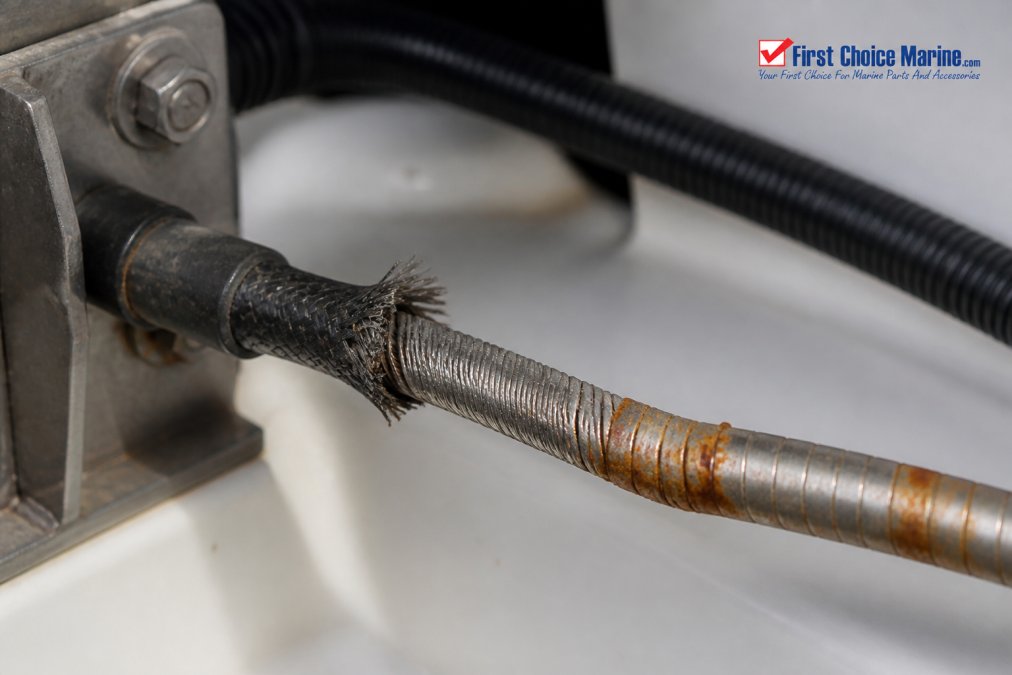
Start at the helm and follow the cable through the boat. Check transition points where the cable enters and exits, water breaches the seal most often here.
Look for discoloration: orange or brown stains indicate rust; white crusty deposits indicate saltwater corrosion. Any discoloration means internal corrosion is occurring.
Feel the cable by hand, hot cables indicate friction and binding; normal cables feel cool.
Visual Identification Guide: Fraying, Kinking, and Corrosion
Fraying appears as loose strands at the cable's end. The outer braid separates from the main cable. Fraying means the cable has been stressed or damaged. Replacement is necessary.
Kinking looks like a sharp bend or crimp in the cable. The cable may appear twisted or flattened in one section. Kinks prevent smooth movement and will worsen quickly. A kinked cable fails within weeks.
Corrosion shows as rust stains, white deposits, or pitting on the outer conduit. Advanced corrosion creates visible holes in the metal sheath. If you see holes, the cable is already compromised internally.
Check the cable's connection points. Where it attaches to the helm and the gearbox, look for loose fittings or corroded fasteners. Loose connections cause play in the steering. Corroded fasteners seize and prevent proper cable movement.
Troubleshooting Stiff Steering: Cable vs. Gearbox vs. Rudder Issues
Stiff steering doesn't always mean the cable is failing. Other components can cause similar symptoms. Proper diagnosis prevents unnecessary replacement.
A stiff cable feels the same throughout the steering range. You turn the wheel and it's hard everywhere, left, right, center. The resistance is constant.
A bad gearbox feels different. Stiffness may be worse in certain positions. The problem may be intermittent, stiff one day, normal the next. Gearbox issues often involve squeaking or grinding sounds.
A worn rudder bushing or damaged rudder box creates stiffness too. But this stiffness typically increases as you turn the wheel farther in one direction. Straight steering may feel normal, but hard turns are very stiff.
Teleflex No-Feedback Dual Rack Package →
Diagnostic Testing Procedures
Test 1: The Static Test
Turn off the engine. Try to move the steering wheel by hand. Does it move smoothly? If the wheel is hard to move with the engine off, the problem is likely the cable or helm unit, not the gearbox.
If the wheel moves freely with the engine off but becomes stiff when running, the gearbox or jet pump is the culprit.
Test 2: The Full Range Test
Turn the wheel fully left, then fully right. Does the stiffness occur throughout the entire range? Or only in certain positions?
Constant stiffness across the full range suggests a cable problem. Positional stiffness (worse in one direction) points to the rudder box or gearbox.
Test 3: The Feel Test
Feel the cable by hand while someone slowly turns the wheel. Does the cable move smoothly under the conduit? Or does it feel stuck or jerky?
Smooth movement with stiff steering at the helm means the gearbox is the problem. Jerky or stuck cable movement means the cable itself is failing.
Test 4: The Resistance Test
Turn the wheel and hold it in one position. Does the resistance ease slightly after 30 seconds? Or does it stay hard?
Resistance that eases suggests the cable is warming up and lubricant is flowing. Constant hard resistance indicates a structural cable problem.
How to Replace Stiff Boat Steering Cable
Replacement is straightforward on most boats. The cable is a sealed unit, it's not designed to be disassembled or repaired. Failure requires full replacement, according to BoatTEST steering cable maintenance guide.
Start by removing the old cable. Disconnect it at the helm and at the gearbox. Note how it's routed through the boat. Take photos before you start, you'll need to follow the same path with the new cable.
Measure the old cable's length. This determines the new cable's size. Cable lengths vary: 16 feet, 18 feet, 20 feet are common. Get the exact length right or the new cable won't reach.
Pull the new cable through the same conduit path. Don't force it. If the cable jams, stop and check the routing. A cable that's forced can kink inside the conduit.
Connect the new cable to the helm and gearbox. Tighten all fasteners firmly but don't overtighten, you can crack the fittings.
Test the steering before taking the boat out. Turn the wheel through its full range. It should move smoothly with light effort.
Tools Required for DIY Replacement
You need minimal tools for cable replacement:
- Adjustable wrench (to disconnect fittings)
- Socket set (for bolt removal)
- Flashlight (to see cable routing)
- Measuring tape (to measure cable length)
- Grease (marine-grade, for new cable lubrication)
- Teflon tape (to seal threaded connections)
Optional but helpful:
- Cable lubricant spray (helps new cable slide through conduit)
- Hose clamps (to secure cable in tight areas)
- Inspection mirror (to see hard-to-reach connection points)
Boat Steering Cable Replacement Cost and Options
Replacement cables range widely in price.
First Choice Marine offers several proven options. The Teleflex Xtreme No-Feedback Steering Kit 18' at $408.04 provides high-efficiency cable design with quick-connect installation and qualifies for free shipping. For larger boats, the Teleflex No-Feedback Dual Rack Package 16' at $789.78 offers dual cables that minimize lost motion and provide precision steering.

Lubricating Boat Steering Cable to Prevent Seizure
Lubrication prevents corrosion and keeps cables moving freely. Apply marine-grade grease to the cable connection points every season.
Maintenance Tips for Cable Longevity
Use the boat regularly. Boats that sit idle develop seized cables. Regular use keeps the cable moving and lubricant flowing.
When to Replace vs. Repair: Industry Standards
Steering cables are designed as sealed units and are not intended to be disassembled or repaired, according to industry guidance on steering maintenance. Failure requires full replacement.
- Stiff or binding steering
- Play or slop in the wheel
- Jerky or unresponsive steering
- Visible fraying, kinking, or corrosion
- Cable age over 10 years
Frequently Asked Questions
How long should a boat steering cable last?
Industry consensus recommends replacing steering cables at 10 years of age regardless of apparent condition, due to internal jacket swelling and degradation. Cables in saltwater environments may fail sooner. Regular inspection every season helps catch early signs of corrosion or binding before catastrophic failure occurs.
What are the symptoms of a seized boat steering cable?
A seized steering cable exhibits stiff, jerky steering that requires excessive force to turn the wheel. You may hear squeaking or grinding sounds from the cable assembly. The steering wheel may feel unresponsive or stuck in certain positions. Binding in the steering system is a primary indicator that immediate replacement is needed to restore safe boat control.
How much does it cost to replace a steering cable on a boat?
Steering cable replacement costs vary by system type and boat size. Complete mechanical steering systems from Teleflex range from approximately $290 to $790.
Can you lubricate a boat steering cable to fix stiff steering?
Lubrication can help prevent cable seizure and extend cable life, but it cannot restore a cable that is already failing or corroded internally. If stiffness persists after lubrication, the cable likely has internal damage and requires full replacement. Regular lubrication as preventive maintenance is far more effective than attempting to repair an already compromised cable assembly.
