


Boat engines work hard, usually harder than most people realize. They push against water all day, deal with steady heat, and take on salt, sand, silt, and weeds every time you go out, pretty much on every trip. Most boat owners know they should flush the engine after a run. It feels like the right thing to do, and that’s probably why it’s so common. You hook up the hose, rinse out the salt, and call it done. For many people, that’s where it ends, and they head back to the dock thinking the job is finished.
The problem is that a flush only handles a small part of what’s really happening. Engines often fail for reasons that have nothing to do with skipping a flush, which surprises a lot of owners. The real issues usually sit deeper in the cooling system, completely out of sight. Scale builds up inside, impellers slowly wear down, heat exchangers clog, and hidden corrosion keeps spreading. Over time, these problems add up until the engine overheats or shuts down, often with little warning. In most cases, there are no clear signs beforehand.
This article explains it in plain language. It looks at the difference between a basic engine flush and a full engine cooling system service, starting with where the gap really shows. You’ll learn what each one actually does, what it leaves behind, and when a simple flush stops being enough. No fluff. Whether it’s a small outboard or a hard‑working commercial motor, understanding this difference matters, especially before trouble starts.
What an Engine Flush Really Does
An engine flush is pretty much what it sounds like. Fresh water is sent through the raw-water side of the cooling system, usually entering at the flush port and exiting through the exhaust. That one pass helps wash out salt, loose sand, and light surface debris. It’s straightforward, and that’s often the appeal. For boat motors that run in saltwater often, this step can matter more than many owners think, especially when the boat is used regularly.
Over time, flushing can help slow corrosion. By keeping salt from drying into hard crystals inside hoses and narrow cooling passages, spots where problems often go unnoticed, it lowers small risks that can quietly stack up. Many owners flush after every trip once the boat is back on the trailer. It’s a small habit, but in my view, it can help stop damage before it starts getting worse.
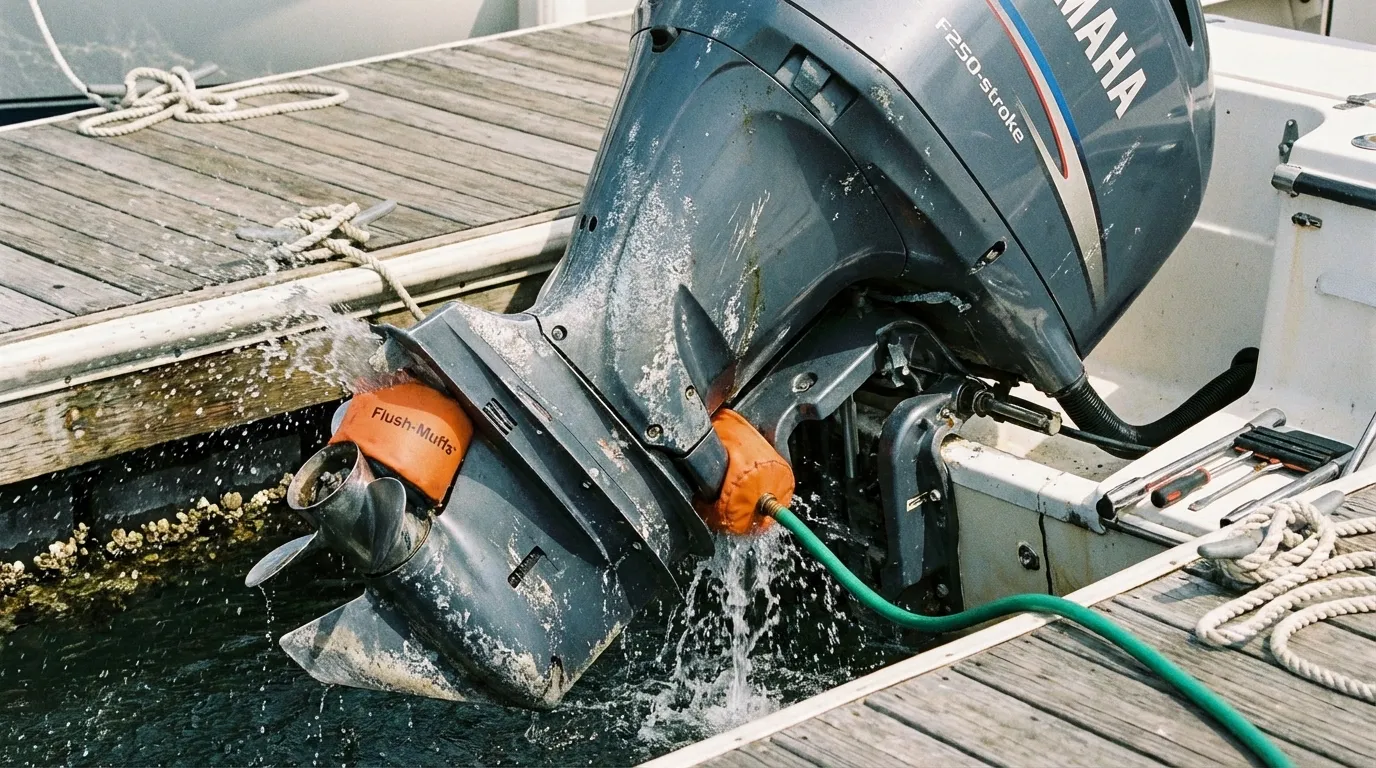
That said, flushing has real limits. Water usually takes the easiest path through the system, not always the areas that need the most help. It doesn’t clean metal surfaces, break down hard scale, or inspect parts for wear. If a passage is already blocked or badly corroded, water may never reach it at all.
Marine incident data helps explain why this matters. In 2024, engineering system failures rose by more than 16 percent compared to the year before. Nearly half of propulsion failures involved main engines or gearing, where cooling performance often has a quiet but serious effect.
| Failure Type | Incidents | Year |
|---|---|---|
| Engineering system failures | 759 | 2024 |
| Power and propulsion failures | 141 | 2024 |
| Recreational machinery failures | 289 | 2024 |
For more details on diagnosing overheating issues during idle or cruise, see Engine Cooling Systems: Diagnosing Overheating at Idle or Cruise.
Inside the Engine Cooling System
To understand why flushing sometimes isn’t enough, it helps to look at what’s really happening inside an engine cooling system. It’s usually more packed than most people expect. Many boat engines use raw water pulled straight from the lake or ocean to control heat. The idea is simple, but the route isn’t. That water moves through an impeller, a web of hoses, thermostats, and often a heat exchanger before it exits near the exhaust.
Over time, minerals and salt start to build up, along with marine growth that sticks to metal surfaces, especially in warm water. Because this happens slowly, most owners don’t notice at first. That buildup slowly narrows internal passages and makes it harder for heat to leave the engine block and move into the cooling water. Even a thin layer can cause real problems, which often surprises people.
Marine fouling and organisms scaling on surfaces of heat exchangers impair effectiveness by as high as 30%.
A 30 percent drop in cooling efficiency is a big deal, I think. It usually leads to higher engine temps, more stress on seals and gaskets, and a shorter lifespan for key parts. A standard engine flush won’t remove buildup that’s basically baked onto internal surfaces.
Most boat owners don’t catch this early, and that’s normal. Problems often show up only when alarms go off or performance starts to feel wrong. Engines that overheat at idle or during a normal cruise are often dealing with hidden restrictions inside the system.
Engine Flush vs Full Cooling System Service
The interesting part isn’t just that these two services are different, it’s how far apart they usually are in real life. An engine flush and a full cooling system service go to very different depths. Short answer: one stays near the surface, the other goes much deeper, and there’s nothing confusing about that.
An engine flush counts as basic upkeep. A full service, in my view, works more like preventive care for the whole system. It follows the entire cooling path, not just the easy-to-reach areas, and that difference becomes more noticeable as engines rack up hours.
Instead of only running clean water through the engine, a full cooling system service usually gets hands-on. Parts are often taken apart, chemicals are used to remove mineral buildup, components are checked closely, and worn pieces are replaced when needed, this is where patience really pays off. Small details matter, because this is often when hidden issues show up and actually get fixed, not just washed away.
| Service Type | What It Covers | What It Misses |
|---|---|---|
| Engine flush | Rinses salt and loose debris | Scale, corrosion, worn parts |
| Full cooling service | Inspection, descaling, part checks | Higher cost and labor |
Putting off a full service for years is a common mistake, especially among DIY boaters who flush often and assume that’s enough. Regular flushing doesn’t catch everything. For a quick refresher on good flushing habits, that Engine Flush Guide: Prevent Salt, Silt & Cooling Damage explains it clearly.
When a Simple Flush Is Not Enough
The hard part is that the signs are usually easy to spot when a basic flush isn’t cutting it anymore. Problems tend to show up after those warnings are brushed off and the boat is back in the water, which is often when issues show themselves anyway. That’s just how it usually happens.
Repeated overheating is one of the clearest red flags. It’s quick, annoying, and stressful. If an engine still runs hot after a flush, it often points to a blockage somewhere inside. You might notice weak water flow from the telltale, or flow that starts and stops, which never feels good. That pattern often matches a worn impeller along with internal passages that have slowly picked up debris over time. Not ideal.
Exhaust parts can give hints too. Manifolds and risers usually last three to seven years, depending on use and water conditions. Corrosion often builds up inside without much showing on the outside. Waiting too long raises the risk of water reaching the engine, which can get expensive fast.
Adhering to these schedules is essential for ensuring reliable performance and extending the engine’s operational life.
Real-world shop work backs this up. Engines often get flushed on schedule, but impeller swaps are skipped and heat exchangers are left alone. The damage usually builds slowly and quietly, with little warning.
Service Intervals That Actually Protect Boat Motors
Knowing when deeper service should happen makes planning easier and usually avoids last‑minute stress, which most people would rather skip. Every engine has its own quirks, and that’s hard to avoid. Still, common industry ranges give most boats a useful starting point, and I see them as a dependable baseline when there’s no service history to rely on.
Raw water impellers are usually replaced once a year or after about 100 to 200 hours. It’s a small part, but it handles constant load and often fails quietly. Heat exchangers and closed cooling systems run on longer schedules. Exchanger service often falls in the five‑ to seven‑year range, while coolant changes are more often needed every two to three years.
At first, these intervals can feel aggressive, and that reaction is normal. They’re based on how issues show up in real use, especially when small problems slowly stack up. Cooling jacket issues often come from old coolant and gradual buildup. A full service also lets technicians check zincs, hoses, and clamps, small details that are easy to miss but costly later.
How This Fits Into Smarter Boat Maintenance
More boat owners are shifting toward planned maintenance instead of rushing to fix things during a breakdown, and that usually feels like a positive change. Less stress, more planning, which is honestly a relief. Predictive schedules and seasonal inspections are now common even on recreational boats, and for most people this approach just makes sense. You’ll often notice that checking parts before they fail, rather than after, becomes a normal habit.
What many people find interesting is how engine care connects to everything else onboard. Systems don’t work alone. Cooling problems can strain electrical parts, and sensors and alarms often feel the effects too. When looking over a full maintenance plan, it helps to see where systems connect. This topic comes up in the Marine Electrical System Maintenance: 2025 Boater Guide.
From a cost point of view, flushing still matters and is usually affordable. Full cooling service costs more at first, but it often prevents failures that can shorten a season. That’s why many boaters plan deeper service during winterization or offseason storage, saving time later with an easier start.
Questions People Commonly Ask
I usually recommend flushing the engine after every saltwater trip, yes, every time. It’s also needed after running through dirty or silty water. Freshwater-only boats can likely flush less often, but it’s still a smart habit.
Can an engine flush fix overheating issues?
Recurring overheating usually points to an internal issue. An engine flush can help if salt or debris is loose and recent, which does happen. But a full engine cooling system service is still needed, so a flush won’t fix every problem.
What parts are checked during a full cooling system service?
Full services usually check the raw water impeller (often the key part), along with thermostats, heat exchanger, hoses, zincs, and coolant condition. Some shops also include chemical descaling, which is optional.
Some jobs are DIY, like impeller swaps, and they’re usually quick wins, I think, in my experience. Heat exchanger work or chemical cleaning is often best left to experienced technicians.
Not really, in most cases. Freshwater often cuts salt corrosion, which helps, but minerals can still build up and biological growth can show up. Full service is still needed, just less often.
The Bottom Line for Long-Lasting Engine Care
For saltwater boaters, an engine flush is usually a smart habit and rarely something to skip (it’s often non‑negotiable). Flushing after each outing removes salt and loose debris, which helps in the short term, but it doesn’t clean deep inside the motor. That’s usually where internal scale and corrosion build up, often out of sight (annoying, I know). Over time, this hidden buildup can slowly cut cooling efficiency until the engine starts to suffer.
That’s where a full engine cooling system service fits in. It’s simple, but it matters. By cleaning internal passages and getting coolant flowing the way it should, it often helps the engine last longer. When heat can move through the system easily, the chance of sudden failure drops, often during long runs or on especially hot days. The key is knowing when a basic flush is enough and when a full service makes sense.
For more reliable motors and safer trips, both steps belong in a regular maintenance plan. Stick with it, and the engine that works hard for you gets some well‑earned backup.
If you’re curious about how preventive care is evolving across the marine industry, read the Engine Flush Market Growth 2026: Preventive Care Surge.
