


A dependable electrical system makes every trip safer and a lot less stressful. Proper marine electrical system maintenance powers your starting system, navigation lights, bilge pumps, electronics, trolling motors, and charging gear. Ignore it, and small problems can turn into dead batteries, dim lights, blown fuses, or equipment that quits right when you need it.
Electrical maintenance matters whether you’re a weekend boater or part of a working crew. Boats deal with vibration, moisture, salt, and long stretches in storage, and all of that slowly wears down wires, terminals, switches, and batteries over time. The good news is that most electrical problems come from a few common issues, and they’re easy to catch early.
This guide covers practical steps to help keep your boat reliable all season. It looks at inspections, battery care, wiring standards, corrosion control, voltage drop, and smart tools that make maintenance easier. It also points out common mistakes and useful steps to take before the season starts and throughout the rest of the year. For a broader overview, this guide also pairs well with Understanding Your Boat’s Electrical System: Maintenance and Troubleshooting.
Start With the Basics of Marine Electrical System Maintenance
Keep a marine electrical system clean, dry, protected, and easy to inspect. Secured wires shouldn’t rub. Tight connections help the whole system stay dependable over time, especially when the boat deals with vibration, moisture, and the kind of wear that shows up fast on the water. Circuit protection should match the wire size. Batteries need proper mounting and regular checks. According to ABYC guidance summarized in industry sources, marine systems should use marine-grade parts because the boating environment is much harsher than a car or garage setup.
ABYC (American Boat and Yacht Council) is a leading organization dedicated to establishing, maintaining, and advancing standards for the design, construction, maintenance, and repair of recreational boats.
Marine electronics keep getting more advanced, and as more gear is added, maintenance increases with it. That’s no surprise.
| Metric | Value | Timeframe |
|---|---|---|
| Global marine electronics market | USD 6.66 billion | 2024 |
| Projected marine electronics market | USD 9.73 billion | 2030 |
| Marine electronics CAGR | 6.7% | 2025-2030 |
| Global marine maintenance service market | USD 12.5 billion | 2023 |
| Projected maintenance service market | USD 23.7 billion | 2032 |
More boats now carry fish finders, chartplotters, boat lighting, battery chargers, pumps, and connected accessories. Each added device increases the need for proper maintenance. Even a simple yearly check of visible wiring and connections can catch many issues early, before they start affecting safety or performance.
Build a Simple Marine Electrical System Maintenance Routine
The best marine electrical system maintenance plan is the one you’ll actually follow. Keep it simple and repeatable, because a few quick checks on a regular schedule do far more than one big repair after something fails.
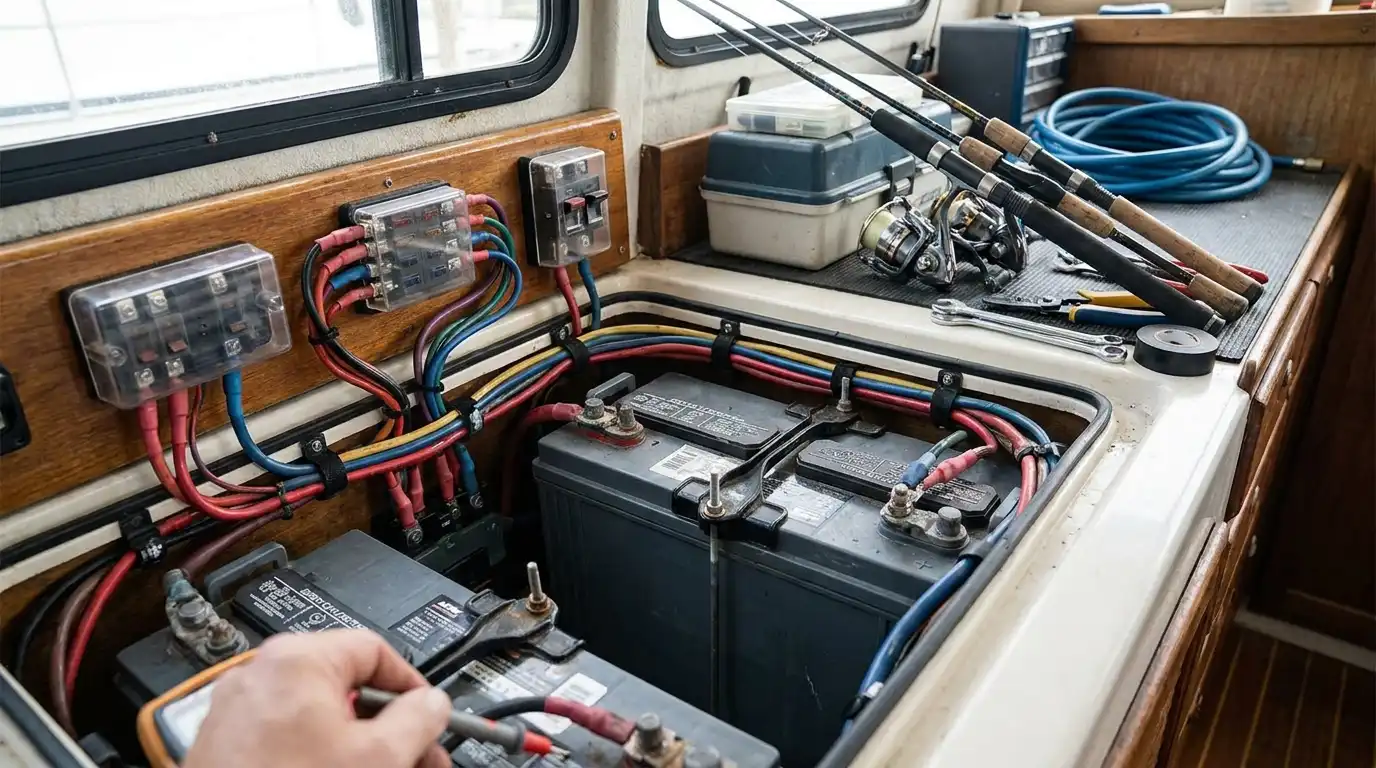
At least once a year, check visible wiring and connections. Look for cracked insulation, loose clamps, chafe marks, melted spots, green or white corrosion, and signs of water intrusion. Then check the batteries. Industry guidance suggests checking battery voltage every month and load-testing batteries at the start of each season.
Use an easy routine:
Monthly
- Check the battery voltage.
- Look for corrosion on the terminals.
- Make sure the battery hold-downs are tight.
- Test the navigation lights, pumps, and electronics.
Start of the season
- Test batteries under load
- Check fuse panels and breakers
- Clean and protect terminals
- Confirm charging system output
After storage or a long layup
- Reinspect all visible wiring
- Look for rodent damage or moisture
- Test every major electrical function before launch
A written checklist really helps, especially for commercial operators or owners with several accessories to keep track of. If problems are already showing up, the companion read can help narrow them down: Marine Electrical Systems Troubleshooting Guide.
Consistency matters most. Most failures don’t come out of nowhere. They tend to leave clues first.
Protect Batteries, Charging Systems, and High-Use Circuits in Marine Electrical System Maintenance
Electrical problems can start with the batteries, and they’re also one of the simplest places to improve reliability. On a boat, batteries need good ventilation, secure mounting, clean terminals, and the right charging setup. They also need to match the job. Starting batteries, deep-cycle batteries, and dual-purpose batteries are each made for different kinds of work.
For boaters using trolling motors, fish finders, livewell pumps, or heavy boat lighting, battery condition affects more than engine starts. Low voltage can make electronics glitch and pumps run slower. It can also reduce motor efficiency, which helps explain why battery monitoring has become more common over the past few years.
Battery care best practices
- Use marine batteries made to handle vibration and resist corrosion
- Keep terminals clean and tight
- Use disconnect switches when they make sense
- Make sure your charger matches your battery type
- Be careful with lithium upgrades, and check charging compatibility first
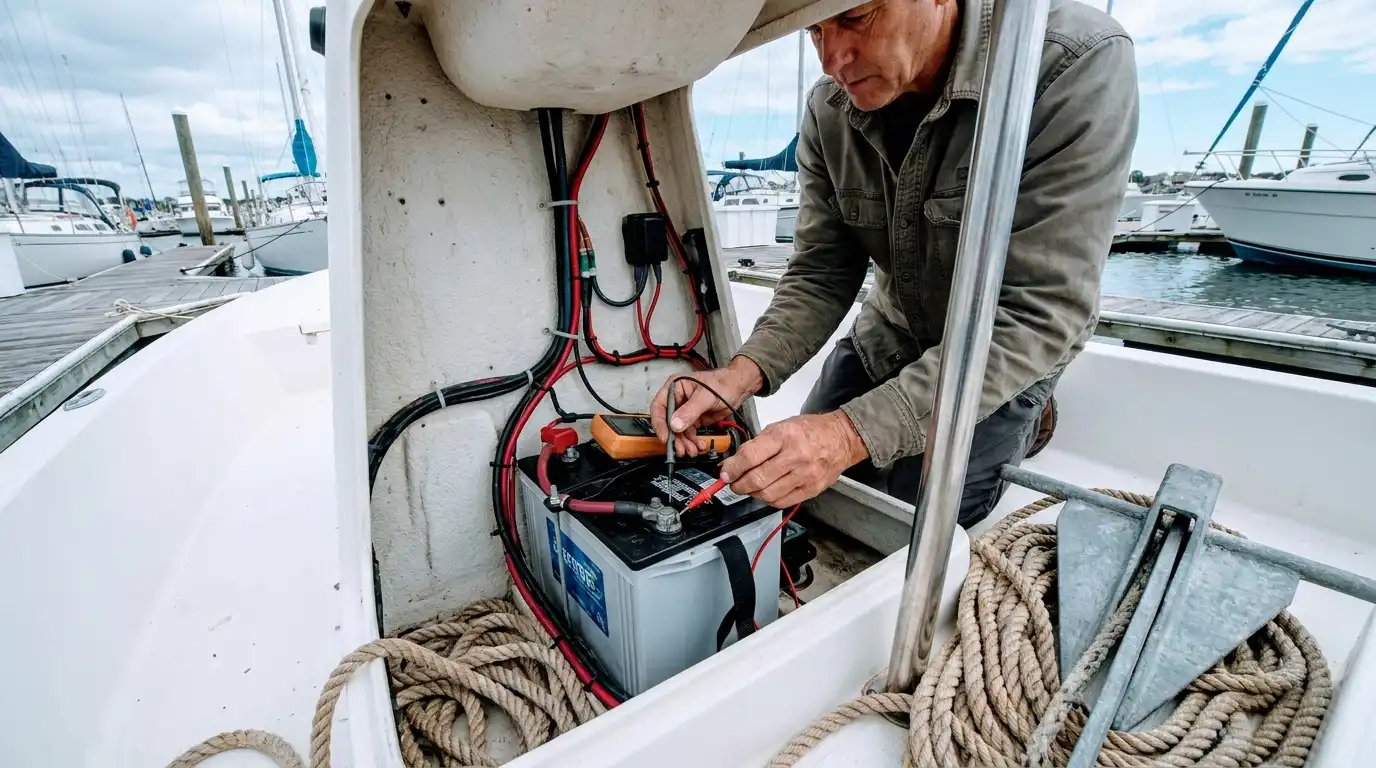
If your boat has older wiring or lots of accessories added over time, test for voltage loss. A drop of more than 0.5V across a cable run can point to extra resistance, usually from a weak connection, wire that’s too small, corrosion, or a damaged cable.
Out on the water, a fishing boat might start fine at the dock, then lose sonar performance by midday. The fish finder may not be the issue, because low voltage from a corroded connection or poor charging between trips may be the real cause. Good battery care helps spot the real problem, so people don’t replace parts that still work.
Use Marine-Grade Wiring and Watch Voltage Drop Closely
Not all wire is the same. One of the most common mistakes boat owners make is grabbing automotive or household parts to save a little time or money. On a boat, electrical systems have to handle much more. Salt, moisture, vibration, and constant movement wear cheap components down fast.
ABYC-aligned guidance points to marine-grade tinned copper wire, proper overcurrent protection, sealed terminals, and solid wire support to stop chafe before it starts. That’s not just about keeping things neat. These steps reduce resistance, limit heat, slow corrosion, and help prevent failures you really do not want to deal with later.
| Electrical guideline | Best-practice value | Why it matters |
|---|---|---|
| Critical circuit voltage drop | 3% | Supports reliable performance for safety-related loads |
| Non-critical circuit voltage drop | 10% | Helps general accessories work within acceptable limits |
| Excessive resistance warning | >0.5V drop | Can signal a bad cable, poor connection, or wrong wire size |
| Battery standard scope | 50 volts DC or less | Useful reference point for common onboard DC systems |
Critical circuits are the ones you do not want failing at the worst possible moment, like bilge pumps, navigation lights, and engine-related electrical loads. Non-critical circuits are convenience items that matter less from a safety point of view. Different risk. Different priority.
Common mistakes to avoid:
- Mixing wire sizes without checking load requirements
- Adding accessories to a circuit that is already at capacity
- Leaving wire runs unsupported so they rub on fiberglass or metal
- Using open, unsealed connectors in wet spaces
- Replacing a blown fuse with a larger one before finding the cause
When a circuit keeps acting up, do not just start swapping parts. Follow the wire path, inspect terminal condition, confirm breaker size, and measure actual voltage under load before guessing. Simple checks can reveal the real problem faster. Owners who want more detail on protection devices can also review Marine Electrical Protection Guide 2026: Fuses & Breakers.
Fight Corrosion Before It Spreads
Corrosion can do serious damage to a boat electrical system. It may start small. Just a little white or green buildup on a terminal can slowly raise resistance, reduce charging, create heat and make equipment act in odd ways.
Saltwater boats face the most risk, but freshwater boats can still run into corrosion too. Damp bilges, poor ventilation and long storage periods can all lead to trouble, so prevention and a fast response are the real fix.
Corrosion control tips
- Check terminals for green or white buildup
- Clean connections and tighten them the right way
- Use adhesive-lined heat shrink or waterproof connectors
- Keep electrical spaces as dry and well-ventilated as possible
- Check bonding continuity and sacrificial anodes
- Protect exposed terminals where needed
Corrosion can be more than a hassle. A corroded cable on a bilge pump or boat lighting circuit can turn into a real safety issue, and it can happen faster than many people expect.
It can also spread to expensive gear like fish finders and charging systems. When owners buy maintenance supplies from First Choice Marine, they can get better results by using marine-rated electrical parts instead of general-use substitutes, especially for connectors, wiring, and battery care products.
Smarter Maintenance Tools and Seasonal Planning
Today’s tools make marine electrical system maintenance a lot easier than it used to be. Owners don’t need a shop full of equipment to catch problems early, either. Just a few basics can help spot issues sooner and protect that investment before a small problem turns into a bigger one.
Useful tools include:
- Digital multimeter
- Clamp meter for current readings
- Battery monitor, including Bluetooth models
- Heat gun for marine heat shrink
- Thermal imaging tool for hotspot checks
- Label maker or simple tags for circuit ID
Thermal scanning and battery monitoring are becoming more common for a reason. They help owners find hot breakers, weak charging and battery decline early, before a hard failure cuts a trip short or leaves a system down at the worst time. That matters even more on boats with larger electronics packages or upgraded house banks.
Seasonal planning matters too. Before winter storage, owners should disconnect and maintain batteries properly, check chargers and keep compartments dry so moisture doesn’t cause extra problems while the boat sits. Before spring launch, they should test all major circuits under real load. Many boaters also pair electrical checks with fuel and engine care. That’s why they review Marine Fuel System Maintenance Strategies for 2025 as part of a full preseason routine.
Frequently Asked Questions
How often should I inspect my boat’s electrical system?
A good baseline is an annual inspection of visible wiring, terminals, fuse panels, and major connections. Battery voltage should be checked monthly, and batteries should be load tested at the start of each season. If the boat sat unused for months, inspect again before launch.
What is the most common cause of marine electrical problems?
Corrosion and poor connections are near the top of the list. Moisture, salt, vibration, and loose terminals can all increase resistance and cause weak performance or total failure. Many problems that look like bad equipment actually start with wiring or battery issues.
Can I use automotive wire on my boat?
It is not a good idea. Marine-grade tinned copper wire and sealed connectors are built to handle the wet, vibrating marine environment better than automotive parts. Using the right materials helps prevent corrosion, chafe, and voltage loss.
What voltage drop is acceptable on a boat?
Best-practice guidance says critical circuits should stay within 3% voltage drop, while non-critical circuits can be within 10%. If you measure more than 0.5V drop across a run, that can point to excessive resistance. It is a sign to inspect cable size, terminals, and connection quality.
What products should I keep on hand for marine electrical system maintenance?
Basic supplies include a multimeter, terminal cleaner, dielectric protection where appropriate, marine heat shrink, spare fuses, cable ties, and waterproof connectors. Many boat owners also keep battery care items and replacement boat lighting parts ready, and First Choice Marine is one example of a marine-focused source for those kinds of maintenance items.
Is a lithium battery upgrade worth it on a boat?
It can be, but only if the system is designed for it. Lithium batteries offer benefits like lower weight and usable capacity, but charging compatibility, protection, and installation quality matter more than ever. If you are unsure, check the full charging and wiring setup before making the switch.
Keep Your System Reliable All Season
A marine electrical system maintenance plan doesn’t need to be complicated. Check the system regularly. Keep batteries in good shape. Use marine-grade wire and sealed connections. Watch for voltage drop. Catch corrosion early. Test everything before each season and again after long storage. These simple habits help you avoid bigger repairs, protect onboard electronics, and make things safer when you’re out on the water.
If one idea stands out from this guide, keep it simple: electrical reliability starts with routine attention, not last-minute fixes. You don’t need to be a full-time mechanic. Loose terminals, dirty battery posts, chafed wire, or weak voltage are all things a careful owner can spot with a checklist and a meter before they turn into real trouble.
Start with your battery bank, your key circuits, and the wiring you can already see this week. Then make a schedule you can actually stick to. Over time, that steady attention helps pumps, lights, motors, and electronics work when you need them. That matters for safety and performance, and it makes every trip from the dock feel a little more dependable.
