


Picking the right trolling motor mount sounds simple at first. Then the comparisons begin: bow mounts, transom mounts, quick-release brackets, backing plates, shaft length, even deck angles. Before long, one small hardware choice can feel like a much bigger boating decision than expected.
Trolling motor mounts do a lot more than just hold the motor. The right setup affects steering, tracking, safety, noise, and how smoothly the motor goes in and out of the water. It can also affect how well modern GPS features work once you’re out on the water. When the fit is off, problems usually show up fast: flex, rough control, extra vibration, or a motor that keeps hitting rails and hatches every time it’s used, which gets annoying fast.
This guide explains it in plain language. It covers how to match trolling motor mounts to different boat styles, how to check deck shape and strength, and what placement often works best on the bow or transom before any holes get drilled. It also looks at trends in electric trolling motors and quick-release systems, plus setup details like bracket style, mount position, and support hardware. The goal is a better long-term choice for the boat.
Start With the Trolling Motor Mounts That Fit Your Boat
The best trolling motor mounts depend first on where the motor will go and how the boat is really used. For many fishing boats, a bow mount is often the best choice because it gives better control from the front when working shorelines, staying on structure, or moving slowly in the wind, which comes up a lot. That kind of control can make a real difference on the water.
That also helps explain why the bow-mount segment makes up 42.5% of the trolling motor market, based on recent market data. The overall market is growing too, with the global trolling motor market estimated at $1.2 billion in 2025, which is a pretty big number.
| Market Metric | Value | What It Means |
|---|---|---|
| Global trolling motor market | $1.2 billion in 2025 | Demand for motors and mounts keeps growing |
| Bow-mount segment share | 42.5% | Bow mounts remain the most common style |
| North America revenue share | 38.2% | Strong boating and fishing demand in this region |
For buyers, that growth matters. More options can definitely be helpful, but they also make it easier to pick a mount that seems right at first and still does not fit the hull, deck, or fishing style very well. In most cases, that leads to extra hassle and a setup that is less enjoyable to use.
Common trolling motor mounts styles
- Bow mounts: A good choice if strong control and more exact positioning at the bow matter, which usually helps a lot when working in specific areas.
- Transom mounts: Often easier to install, and they’re commonly found at the stern on smaller boats.
- Quick-release mounts: Very useful if the motor comes off for storage, security, or just easier access.
- Specialized kayak mounts: Made for lighter craft and tighter spaces, where standard mounts often do not fit very well.
For a bass boat, bay boat, or another fishing setup where precision matters while holding position or moving along structure, bow-mounted trolling motor mounts are often worth the extra planning. Help comparing motor styles before buying is covered in Choosing the Right Trolling Motor: Essential Considerations for Boat Owners.
Check Placement, Deck Angle, and Clearance for Trolling Motor Mounts
A mount can be well made and still be the wrong fit for a boat, so fit usually matters more here than brand or price. Garmin installation guidance says a bow-mounted trolling motor should sit as close to the boat’s centerline as possible, meaning near the middle of the bow. That setup helps with tracking and steering, which is a small detail that can make a real difference.
BoatUS also says the mounting pad should stay horizontal to the water. This is especially relevant on boats with angled bow decks, which are pretty common. If the pad is not level, the motor can sit at the wrong angle. That may affect deploy and stow movement when raising or lowering it, and it can also put extra strain on the bracket.
Some boats need a wedge plate or a fabricated mounting plate to correct the deck angle. Before buying, it usually helps to check the bow shape and mounting surface first.
A simple fit check before drilling
- Put the motor where you plan to mount it.
- Start by looking to see if the base sits level with the water.
- Open nearby hatches too and check whether there’s enough clearance by the rail.
- Make sure the shaft clears the rub rail when it deploys.
- Check whether the motor head will hit the bow when it’s stowed.
- Also make sure the mount doesn’t block cleats, lights, anchor gear, or anything else you need at the bow.
BoatUS says some installs need custom changes. In some cases, even a short section of rail may need to be changed so the shaft has enough room to clear. That’s usually why a dry fit matters so much here. It helps you catch those problems before drilling holes, which is really the whole point.
Shaft length matters too. A common rule says the center of the motor section should stay at least 12 inches below the waterline. One practical sizing guide suggests adding 16 inches for a bow-to-waterline distance of 0 to 10 inches, 20 inches for 11 to 20 inches, and 22 inches for 21 to 30 inches. If the shaft is too short, you can end up with poor control and more cavitation, and that often shows up pretty fast.
Make Sure Trolling Motor Mounts Can Handle Real-World Loads
A lot of boat owners focus on motor weight, but that’s only one part of what the mount has to handle. Trolling motor mounts also take force from waves, turning, trailering, repeated deploy cycles, and sudden shock in rough water. A mount can feel solid at the dock and still bend or flex badly out on the lake, especially once the boat starts bouncing and turning.
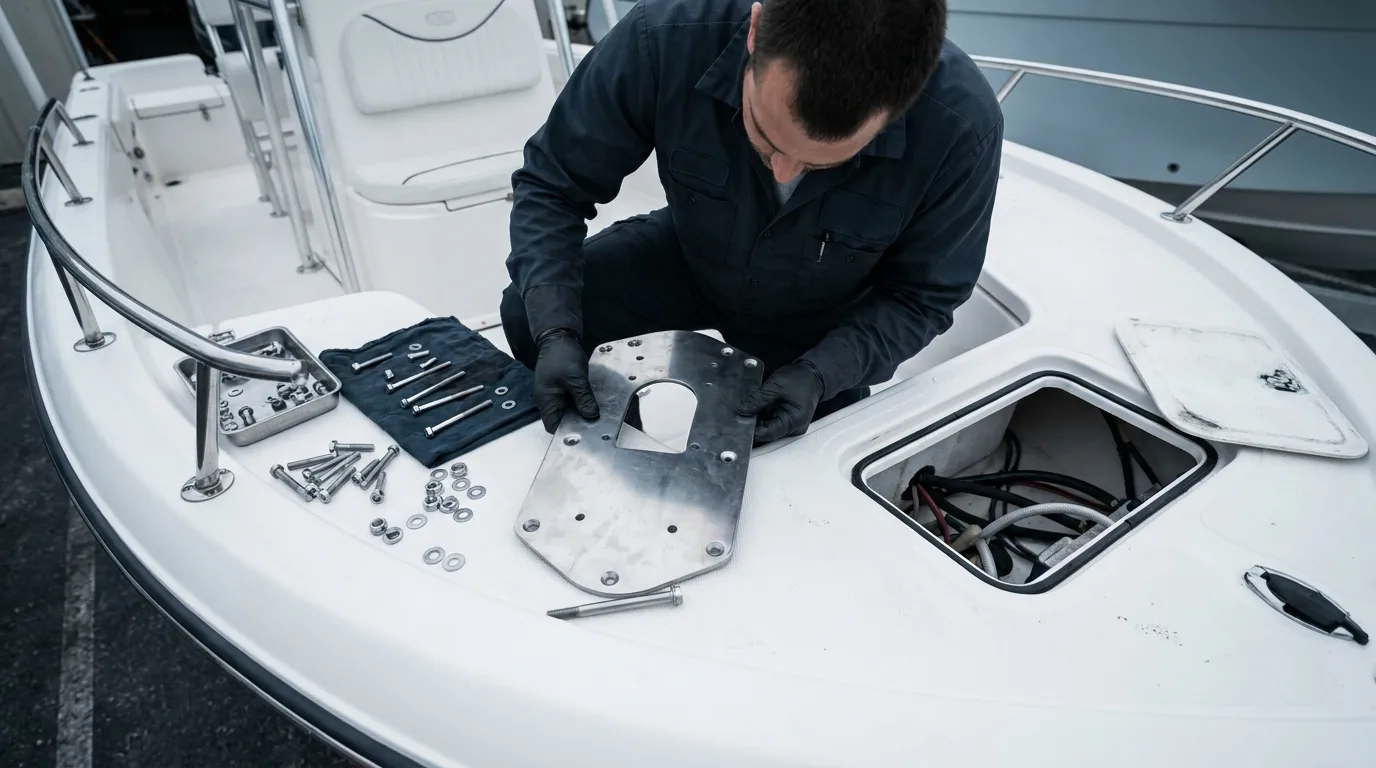
Garmin tells installers to make sure the deck structure can handle both the motor load and the forces that come up during use. In simple terms, that means looking past the top surface of the deck, not just what is easy to see. Thin fiberglass, weak aluminum panels, or older decks may need reinforcement with a backing plate before installation.
Signs you may need extra support
- The deck flexes when you lean on it.
- Existing hardware shows stress cracks.
- The motor is high thrust, or it has an extra-long shaft.
- You fish rough water often.
- The mount sits near the edge of the bow (not farther back on the deck).
A simple rule for motor sizing is 5 pounds of thrust for every 200 pounds of total boat weight. As motors get stronger, a stable trolling motor mount usually matters even more, especially at the bow where the load tends to focus.
That advice is about electrical connections, but it also fits the bigger setup. Small maintenance steps often help protect the whole system. Mount hardware, wiring, and connectors work together, so the full setup matters. If you’re putting together a more complete system, that’s covered in Essential Trolling Motor Accessories Every Boater Needs, which in most cases includes mounting parts, wiring basics, and connectors.
One common mistake is skipping the backing plate because the deck “feels strong enough.” Another is using hardware that handles static load well enough, but does not hold up to repeated vibration over time. That part gets missed a lot. For commercial users and serious anglers, going a little stronger on the install now will often save time and money later, especially for boats that are used in rough water often.
Choose Features That Match How You Actually Use the Boat
Not every boater needs the same kind of mount. Some fish every week and leave the motor installed all season. Others tow the boat long distances, remove gear between trips, or need the bow area clear for commercial work. That is when mount features start to matter, often earlier than people expect. The best choice usually depends on how the boat is actually used, not just which mount looks the strongest.
Quick-release trolling motor mounts have become more popular because they make storage easier and service work simpler. They can also help when dock theft is a concern, or when the motor gets in the way of a cover or garage clearance. In many setups, that means the motor can come off before towing, before covering the boat, or before parking in a low garage. For kayak users and owners of smaller craft, specialized mounts are also showing up more often as electric fishing setups become more common. It is a practical shift and, in this case, probably a little overdue.
Modern motors do more than move the boat. GPS features, route control, and virtual anchoring all depend on stable alignment to work properly. Garmin notes that large metal objects nearby can interfere with compass-based functions. Because of that, mount placement affects both smart features and physical fit. That helps explain why many boat owners now pay more attention to installation details than they used to. You usually cannot just bolt a motor anywhere and expect the technology to work well.
We covered this here: 2026 Trends in Smart Trolling Motors: What You Need to Know. It gives a clear look at newer technology and what it means for boat setup choices.
Smart trolling motor features and setup choices
A good example is a guide boat operator who trailers often and works in changing weather. A fixed mount may be sturdy enough, but a quick-release system can make maintenance faster and reduce wear during transport. Meanwhile, a bass angler who wants the cleanest deck profile may prefer a lower, more permanent base with reinforced support near the bow. In situations like those, that practical fit is often more useful than overthinking it.
Think About Installation and Future Service
The best trolling motor mounts should be easy to install, but they also need to be simple to inspect, remove, clean, or upgrade later, and that really matters. It’s something a lot of people honestly miss.
Batteries change, motors get replaced, and smart electronics get added too, often sooner than expected. A mount without room for service can become a real headache over time, especially when routine checks or updates are needed.
Before the final install, consider these practical points:
Smart planning tips
- Choose corrosion-resistant hardware made for marine use.
- Make sure you can reach nuts, backing plates, wiring paths, and other service points, since that usually makes later work a lot easier.
- Leave enough room to remove the motor later if it needs service.
- Think about battery location and cable runs early in the setup.
- Why not test deploy and stow a few times before final tightening? It’s often worth checking twice.
The main point is simple: leave yourself service access whenever you can. That usually helps later. Clean electrical paths, protected connectors, and removable parts make off-season care much easier, especially when checking wiring, cleaning connections, or swapping parts in most cases.
A trusted parts source can help with that too. Many boat owners use First Choice Marine to compare trolling motor equipment, accessories, and maintenance items in one place, especially when planning a full system instead of only buying a bracket. Some owners also review Bow Mount Trolling Motors: Installation, Performance Tuning & Maintenance before starting a more involved install.
Avoid the Most Common Buying Mistakes
Most trolling motor mount problems usually start before installation even begins. People often buy a mount too early, before measuring the boat, or they wait too long and end up with a poor fit because their motor choice has already narrowed their options. A little planning helps more than many people think. It really does make a difference here.
These are the mistakes that show up most often:
- Choosing by brand name alone instead of picking the option that actually fits the deck.
- Overlooking centerline placement on bow setups.
- Not checking whether the pad sits level to the water.
- Forgetting about hatch, rail, and light clearance.
- Skipping reinforcement on a thin deck.
- Mismatching shaft length and mount position.
- Not planning ahead for storage, trailering, future removal, or later changes.
A good mount should fit the boat now and still work later if electronics change, a stronger motor is added, or the setup shifts to a smarter electric system. That kind of flexibility often matters, especially for owners who keep the boat for a long time, because those upgrades happen fairly often. The electric trolling motor market is also expected to grow from $618.9 million in 2025 to $641.2 million in 2026, so more boat owners will likely face these upgrade choices soon. That is worth keeping in mind.
For buyers comparing newer systems, Breaking Down the Best Electric Trolling Motors of 2026 can also help explain how changing motor technology affects mounting and installation decisions.
Frequently Asked Questions
What is the best type of trolling motor mount for a fishing boat?
For many fishing boats, bow mounts are the best choice because they give better control and precise boat positioning. They are especially useful for casting around structure, shorelines, and windy areas. Transom mounts can still work well on smaller boats where simple installation matters most.
How do I know if my deck is strong enough for trolling motor mounts?
Look for deck flex, thin material, or old stress cracks around hardware. If the area feels weak or the motor has high thrust, add a backing plate or reinforcement. A stable deck is important not only for strength but also for better motor performance.
Do I need a quick-release mount?
You may want one if you trailer often, store the motor indoors, need better bow access, or want easier service. Quick-release mounts also help with security and off-season removal. If the motor stays on the boat full time, a fixed mount may be enough.
How important is centerline placement on a bow mount?
It is very important. Mounting near the boat’s centerline usually improves tracking and steering response. It also helps many modern GPS-guided motors perform more accurately during spot-lock or route control functions.
Where can I compare trolling motor mounts and related gear?
A marine parts retailer with a strong focus on trolling motor systems can save time because you can compare mounts, hardware, wiring supplies, and accessories together. For many boat owners, First Choice Marine is one practical place to review these kinds of products while planning a complete setup.
Can a retailer help me find parts beyond just the mount?
Yes. A good marine supplier can help you think through the full system, including connectors, maintenance items, accessories, and replacement hardware. That is useful when you want your trolling motor mount, motor, and onboard setup to work well together, which is one reason some buyers browse First Choice Marine when building or updating a trolling motor system.
Put the Right Mount to Work
Choosing the right trolling motor mount usually comes down to a few practical checks. Start with your boat style and how you really use it, because that often matters more than you might think. Measure the deck and make sure the pad sits level, then check centerline placement so the motor lines up properly with the bow. Before drilling, test every clearance point, especially near hatches or rails. It also helps to think ahead about real-world loads, future service access, and whether a quick-release system could make things easier over time, which it often does.
The good news is that this choice does not need to feel more complicated than it really is. A solid mount choice usually comes from matching the setup to the boat, not from chasing the most expensive option. There is a reason bow mounts are still so popular. In this case, the best choice is still the one that fits your deck, your motor, and the way you use the boat day after day.
Planning an upgrade? Make a short checklist before shopping: boat weight, thrust needs, shaft depth, deck angle, reinforcement, and storage needs. It is a small step, but it can help you avoid costly mistakes and lead to a trolling motor setup that feels safer and smoother, with less hassle every time you head out.
