


Last Updated: October 23, 2026
Quick Summary
A deep cycle marine battery lasts roughly two to ten years depending on chemistry and use. Flooded lead-acid runs two to five years, AGM three to six, gel four to six, and lithium iron phosphate eight to ten or more, assuming reasonable charging and storage.
- Flooded lead-acid batteries need consistent watering, equalizing charges, and ventilation for hydrogen gas.
- AGM batteries are spill-proof and vibration-resistant, making them ideal for rough water and trailers.
- LiFePO4 batteries tolerate 80-90% depth of discharge and deliver roughly 80Ah usable from a 100Ah battery versus about 50Ah from lead-acid.
- Heat and long idle storage are the two silent killers that shorten battery life regardless of chemistry.
- Charge lead-acid batteries every 4 to 6 weeks during off-season storage to prevent sulfation.
Table of Contents
- Deep Cycle Marine Battery Lifespan by Chemistry
- Factors That Affect Deep Cycle Battery Life Expectancy
- How to Tell If a Marine Battery Is Bad
- Marine Battery Replacement Signs and When to Upgrade
- How to Extend Marine Battery Life
- Warranty Life Versus Expected Service Life
- Frequently Asked Questions
Deep Cycle Marine Battery Lifespan by Chemistry
A deep cycle marine battery lasts roughly two to ten years, depending on chemistry and use. Flooded lead-acid runs two to five years, AGM three to six, gel four to six, and lithium iron phosphate (LiFePO4) eight to ten or more, assuming reasonable charging and storage. Abuse can cut any of them in half.

The table below compares the two numbers that predict replacement timing: expected years of service and rated cycle life at a stated depth of discharge (DOD).
| Chemistry | Typical service life (years) | Rated cycle life (at stated DOD) | Usable capacity per cycle | Best fit |
|---|---|---|---|---|
| Flooded lead-acid | 2-5 | ~300-500 cycles at 50% DOD | ~50% | Occasional use, tight budget, willing to maintain water levels |
| AGM | 3-6 | ~500-800 cycles at 50% DOD | ~50-60% | Rough water, vibration, low-maintenance owners |
| Gel | 4-6 | ~500-1,000 cycles at 50% DOD | ~50% | Deep, slow discharges; not for high-output charging |
| LiFePO4 (lithium) | 8-10+ | ~3,000-5,000 cycles at 80% DOD | ~80-90% | Frequent use, high draw, long-term value |
Cycle-life figures are manufacturer ratings, not guarantees.
Flooded lead-acid handles repeated discharge and recharge but needs consistent watering, equalizing charges, and ventilation for hydrogen gas.
AGM absorbs the electrolyte in a glass mat, making it spill-proof and vibration-resistant, a real advantage in rough water and on trailers.
LiFePO4 delivers the longest service life and the most usable capacity per rated amp-hour because it tolerates 80-90% depth of discharge without lead-acid's wear.
Factors That Affect Deep Cycle Battery Life Expectancy
Four factors decide whether your battery lands at the low or high end of its chemistry's range: discharge depth, cycles per season, charging, and storage between trips.
Estimating Lifespan From Your Actual Use
Turn cycle ratings into a replacement timeline with three numbers: usable capacity, average depth of discharge per trip, and trips per season.
Next, estimate daily draw: add up the amp-hours your electronics, fridge, lights, and stereo consume in a typical day.
Then divide. Drawing 40Ah per trip from a 100Ah flooded battery with 50Ah usable discharges to about 80% state of charge, a shallow, easy cycle.
Finally, convert cycles to years.
Depth of Discharge and Cycle Life
Depth of discharge is how much capacity you use before recharging; one cycle is a full discharge and recharge. Lead-acid tolerates shallow discharge far better than deep. Routinely draining a flooded or AGM battery below 50% capacity shortens its life significantly, which is why most lead-acid deep cycle banks are sized so a normal trip uses no more than half the capacity.
Lithium tolerates deeper discharge. A LiFePO4 battery rated for 3,000-5,000 cycles at 80% DOD can be run down to 20% state of charge regularly without the accelerated wear lead-acid suffers.
Charging Practices and Frequency
Overcharging damages every chemistry.
Undercharging is just as harmful to lead-acid. Sulfate crystals build up on the plates during partial states of charge and permanently reduce capacity (Effect of sucrose-based carbon foams as negative electrode additive on the performance of...).
Frequent shallow cycles extend life more than occasional deep cycles. A battery recharged daily at 30% DOD lasts longer than one recharged weekly at 80% DOD, even when the total energy moved is the same.
Temperature and Environmental Conditions
Heat accelerates the chemical reactions inside a battery. One in a hot engine compartment ages faster than one in a cooler, ventilated spot; life roughly halves for every 18°F (10°C) above about 77°F.
Salt spray and humidity corrode terminals and connectors, so marine installations face constant corrosion risk; corrosion-resistant terminals and a light coat of dielectric grease help. Vibration from the engine and rough water can loosen internal connections in lead-acid batteries; sealed AGM and lithium packs resist it better.
How to Tell If a Marine Battery Is Bad
Recognizing battery failure early prevents being stranded on the water. Watch for these warning signs.
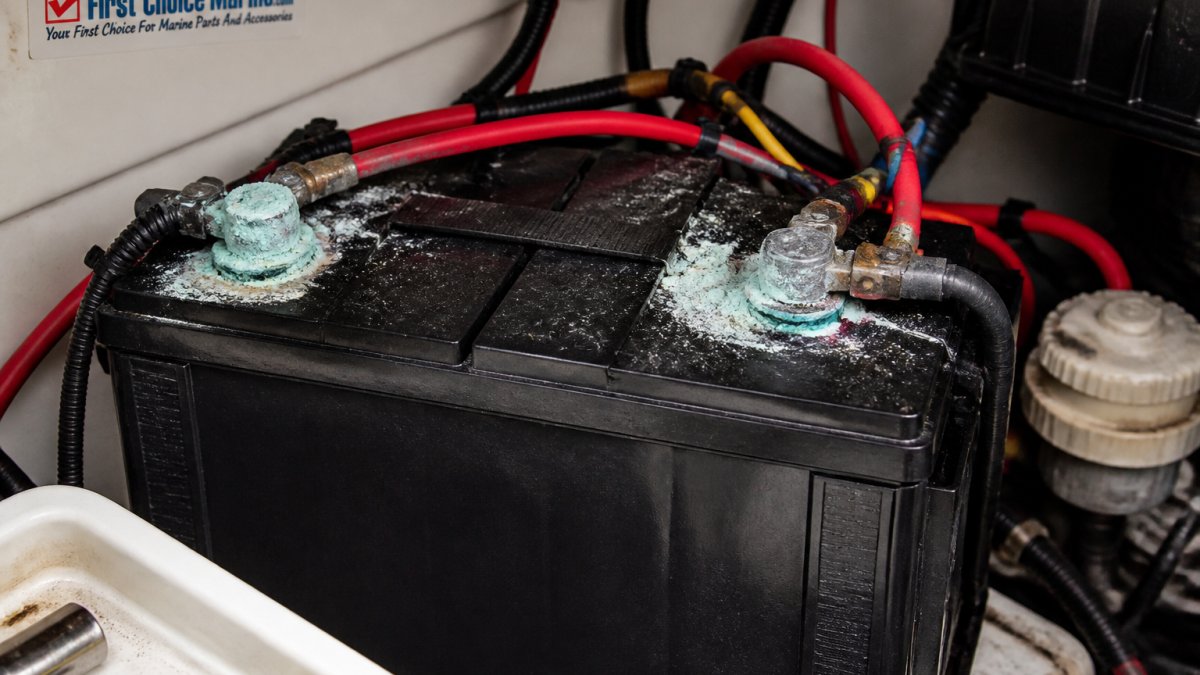
Common Signs of Battery Failure
Slow engine cranking is often the first sign.
Swollen or bulging case indicates internal pressure buildup, usually from overcharging or a manufacturing defect. A swollen battery should be replaced immediately.
Corrosion on terminals appears as white, blue, or green crusty deposits.
Rotten egg smell near the battery indicates hydrogen gas release from overcharging or internal failure. This smell is a safety hazard and requires immediate attention.
Battery won't hold charge after sitting overnight. A healthy battery maintains voltage for weeks.
Cracked case allows electrolyte to leak. Once the case cracks, the battery cannot be repaired and must be replaced.
Testing Battery Health and Voltage
A simple voltage test reveals whether your battery is healthy.
A fully charged 12-volt battery should read 12.6 to 12.8 volts with no load (engine off, no accessories). Below 12.4 volts after sitting overnight means it isn't holding charge properly.
Under load (engine running), a healthy battery should maintain 13.5 to 14.5 volts. If voltage drops below 13 volts while running, the alternator isn't charging properly or the battery is failing.
A multimeter is the simplest tool: set it to DC voltage, touch the red probe to the positive terminal and the black probe to the negative, and read the display.
Pro-Guide Signature 12v 100ah Group 24 Lithium Battery #24M100 →
For deeper diagnostics, a load tester applies a heavy electrical load and measures the response; many marine service shops offer load testing.
Never ignore slow cranking or corrosion. These signs indicate your battery is failing and may leave you stranded. Test voltage before your next boating trip to avoid surprises.
Marine Battery Replacement Signs and When to Upgrade
Knowing when to replace a battery prevents frustration and safety risks on the water.
Replace your battery immediately if:
- The engine won't crank at all
- Voltage drops below 12 volts with the engine off
- The case is cracked or leaking
- Corrosion is so heavy that cleaning doesn't restore power
- The battery is older than its expected lifespan for its chemistry
Consider upgrading to a higher-capacity battery if:
- You've added new electronics that demand more power
- You're running electronics longer than the current battery supports
- You want longer intervals between charging
- You're upgrading from lead-acid to lithium for reliability
An upgrade might mean moving from a 50Ah lead-acid battery to a 100Ah lithium battery, letting you run more equipment longer without draining the battery completely.
Replacement cost varies by chemistry. Lead-acid costs less upfront but needs replacing more often; lithium costs more initially but delivers better long-term value through longer lifespan and better performance.
How to Extend Marine Battery Life
Several practical steps keep your battery healthy and extend its service life well beyond the minimum.
Proper Storage and Off-Season Care
Batteries lose charge sitting idle. During off-season storage, charge every 4 to 6 weeks to prevent sulfation in lead-acid batteries and keep lithium in good condition.
Store the battery in a cool, dry location, 50°F to 80°F is ideal. Avoid hot engine compartments or exposed areas where temperature swings are extreme.
Disconnect the negative terminal if the boat will sit unused for months to prevent parasitic drain from bilge pumps, alarms, and other equipment.
Cover the battery to protect it from salt spray and corrosion. A simple plastic cover or battery box keeps terminals clean and extends life.
Battery Maintenance and Corrosion Prevention
Clean corroded terminals regularly: mix baking soda with water into a paste, scrub the terminals and connectors with an old toothbrush, and rinse with fresh water.
Apply a thin coat of dielectric grease to terminals after cleaning. This prevents moisture and salt from causing new corrosion.
Check water levels in flooded lead-acid batteries every month during boating season. Top up with distilled water only if the level drops below the plates. Tap water contains minerals that shorten battery life.
Tighten cable connections quarterly; engine vibration loosens them over time, increasing resistance and reducing power delivery.
Monitoring Battery Health with Smart Solutions
Digital monitoring systems track battery voltage, current, and capacity in real time. The Digital Yacht BM100 Battery Monitoring Solution provides accurate DC voltage and current measurements, letting you catch problems before they leave you stranded, and calculates state of charge and time to depletion.

The Vetus CANNS500 Digital Battery Monitoring Shunt offers Wi-Fi-connected monitoring through your smartphone. You can check battery status from the cabin without visiting the engine compartment.
Smart monitoring prevents the common mistake of over-discharging. Many boaters don't realize how low their battery voltage has dropped until the engine won't start. Monitoring systems eliminate this guesswork.
Warranty Life Versus Expected Service Life
Warranty and actual service life aren't the same thing; understanding the difference helps you plan replacements.
A warranty covers manufacturing defects for a set period.
Warranty claims are strict. You must prove the battery failed due to a defect, not misuse.
Expected service life is how long the battery actually lasts under normal use.
The gap exists because warranties protect against manufacturing defects, not normal wear, a battery can fail from age and use without being defective.
When choosing a replacement, focus on expected service life and your boating frequency rather than warranty length.
Frequently Asked Questions
How many years does a deep cycle marine battery last?
A deep cycle marine battery's lifespan depends on its chemistry. Lead-acid batteries typically last 2-5 years, AGM batteries 4-7 years, and lithium batteries 8-10 years or longer with proper use. Actual lifespan varies based on charging practices, depth of discharge, temperature, and how frequently the battery cycles.
What affects the lifespan of a deep cycle battery?
Several factors influence how long your deep cycle battery lasts: depth of discharge (shallower discharges extend life), charging frequency and method, storage temperature (heat reduces lifespan), corrosion on terminals, overcharging or undercharging, and electrical load demands. Keeping your battery at moderate temperatures and avoiding full discharges whenever possible significantly extends service life.
How can I tell if my marine battery is failing?
Signs of battery failure include slow engine cranking, dim or flickering lights, corrosion around terminals, swollen or cracked casing, and a rotten-egg smell (for flooded lead-acid batteries). You can also measure voltage with a multimeter: a fully charged 12V battery should read 12.6V or higher. If it drops below 12V when rested, the battery is weakening and may need replacement soon.
How can I extend my boat battery's lifespan?
Extend battery life by using a quality charger suited to your battery chemistry, avoiding complete discharges, storing the battery in a cool, dry place during off-season, keeping terminals clean and corrosion-free, and monitoring state of charge regularly. Installing a battery monitoring system like the Digital Yacht BM100 or Vetus CANNS500 helps track health and catch problems early, preventing premature failure.
Choosing the right deep cycle marine battery and maintaining it properly keeps your boat running reliably for years. First Choice Marine stocks trusted battery options including the Pro-Guide Signature Lithium Battery and Battle Born Batteries 100Ah, plus monitoring solutions like the Digital Yacht BM100 to track battery health in real time. These products help you avoid costly replacements and enjoy more time on the water with confidence in your electrical system.

