


Last Updated: October 25, 2026
Quick Summary
To measure boat propeller pitch, remove the propeller, identify the 75% blade radius point, use a straightedge and protractor to measure the blade angle at that point, then calculate pitch using the formula: Diameter × π × tan(blade angle). Compare your calculated pitch to the stamped pitch on the propeller; they should match within 1-2 inches.
- Propeller pitch is the theoretical distance a propeller travels forward in one complete revolution, measured in inches.
- The 75% radius point is the industry standard for measuring pitch because it captures effective pitch that actually moves your boat.
- Blade pitch isn't uniform along its length; the angle is steeper near the hub and flatter near the tip.
- Check at least two blades to spot problems; blades should measure within 1-2 inches of each other.
- Within 1-2 inches of the marked pitch is normal due to manufacturing tolerances and blade wear.
Table of Contents
- What Propeller Pitch Means and Why It Matters
- Propeller Diameter vs. Pitch: Understanding the Difference
- How to Read Boat Propeller Numbers on Marked Propellers
- Tools and Preparation for Measuring Pitch Accurately
- Step-by-Step: How to Measure Boat Propeller Pitch
- How to Measure Unmarked Propeller Pitch Without Markings
- Using a Boat Propeller Pitch Gauge for Precision
- How Prop Pitch Affects RPM and Speed
- Getting the Right Propeller for Your Boat
- Frequently Asked Questions
What Propeller Pitch Means and Why It Matters
Propeller pitch is the theoretical distance a propeller travels forward in one complete revolution, measured in inches.
Pitch directly affects performance. Too low a pitch limits top speed; too high a pitch prevents the engine from reaching full RPM, leaving power on the table.
That's why learning to measure boat propeller pitch is practical knowledge every boat owner should have.
Propeller Diameter vs. Pitch: Understanding the Difference
Two numbers define every propeller: diameter and pitch. They control different aspects of performance.
Propeller diameter is the width of the circle the blades sweep out.
Propeller pitch is the distance the propeller theoretically advances in one revolution. A 19-inch pitch propeller moves forward 19 inches per turn.
The key difference: diameter controls how much water moves, while pitch controls how far the boat moves per revolution.
How to Read Boat Propeller Numbers on Marked Propellers
Most propellers have numbers stamped on the hub or blade, telling you exactly what you're working with.
The format is always diameter x pitch. A marking that reads "14 x 19" means a 14-inch diameter and 19-inch pitch.
Additional stamps may include the manufacturer name, part number, material type, and a hub kit number indicating shaft size and spline configuration.
The stamped number is the nominal pitch, the theoretical design pitch. Measuring the blade angle may reveal a slightly different effective pitch, normal variation from blade flex, water slip, and manufacturing tolerances. See real propeller examples with marked pitch specifications to understand how these numbers appear on actual products.
Tools and Preparation for Measuring Pitch Accurately
You don't need expensive equipment to measure pitch; basic shop tools work fine.
Essential tools:
- Straightedge (a metal ruler or machinist's straight edge, at least 12 inches long)
- Ruler or measuring tape (marked in inches)
- Protractor or angle gauge (a simple plastic protractor from a school supply store works)
Optional tools that improve accuracy:
- Propeller pitch gauge
- Caliper for precise measurements
- Level to ensure your measuring surface is truly flat
Preparation steps:
Clean the propeller thoroughly. Salt, algae, and corrosion make accurate measurements harder. Use fresh water and a soft brush.
Place the propeller on a flat, stable work surface with the blade you're measuring horizontal and parallel to it.
Mark a reference line on your work surface so you can track measuring points consistently across multiple blades or repeat checks.
Step-by-Step: How to Measure Boat Propeller Pitch
Step 1: Remove and Secure the Propeller
Start by removing the propeller from your boat's shaft. Consult your engine manual, since the procedure varies by engine type.
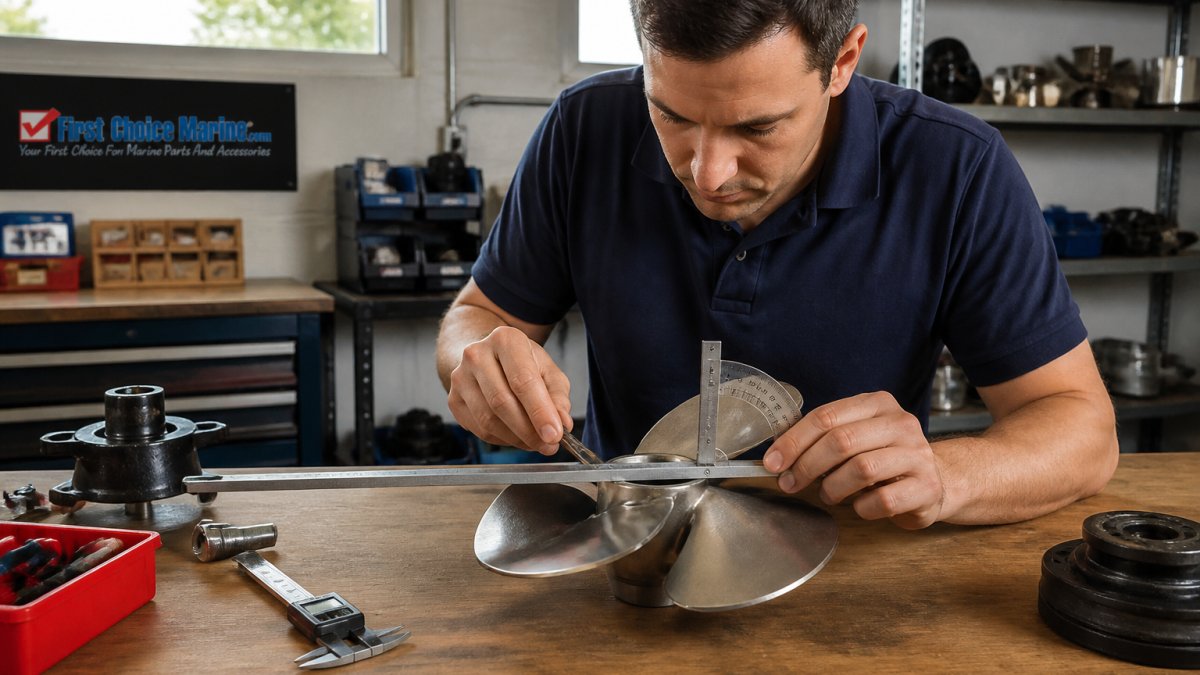
Inspect the propeller for damage. Cracks, bent blades, or hub damage affect measurements; if it's damaged, replacement is safer than measuring it.
Secure the propeller firmly so it won't move during measurement.
Make sure the hub sits level and the blade extends horizontally away from you; any movement throws off your angle reading.
Step 2: Identify the 75% Blade Radius Point
The 75% radius point is the industry standard for measuring pitch: far enough from the hub to show true pitch, but not so far out that blade flex distorts the reading.
To calculate it, measure from hub center to blade tip. If that's 7 inches, multiply 7 × 0.75 = 5.25 inches; the 75% point is 5.25 inches from hub center.
Mark this point on the blade with a pencil.
Why 75%? Blade pitch isn't uniform along its length: the angle is steeper near the hub and flatter near the tip.
Step 3: Mark and Measure the Blade Angle
Position your straightedge flat against the blade's face at the 75% point you marked, laying flush with no gaps.
Place your protractor to measure the angle between the straightedge and a horizontal reference line (your work surface or the line you drew earlier).
Read the angle. This is the blade angle at the 75% radius point.
Write it down for the pitch calculation.
Take the measurement twice; small variations are normal, but if readings differ by more than 2 degrees, reposition the straightedge and try again.
Step 4: Calculate Pitch from Blade Geometry
Convert the blade angle to pitch with this formula:
Pitch = Diameter × π × tan(blade angle)
Breaking this down:
Turning Point Hustler Aluminum RH Propeller 14.5 x 17 4-Blade #21501730 →
- Diameter = your propeller diameter (14 inches for a 14 x 19 prop)
- π = 3.14159
- tan(blade angle) = the tangent of your measured angle
Example: You measured a 14-inch diameter propeller with a blade angle of 18 degrees at the 75% radius point.
Pitch = 14 × 3.14159 × tan(18°) Pitch = 14 × 3.14159 × 0.3249 Pitch = 14.3 inches
Your calculated pitch is approximately 14 inches.
Don't worry about being exact to the decimal point. Within 1-2 inches of the marked pitch is normal.
Step 5: Check Multiple Blades and Points
A propeller has multiple blades, and each may have slightly different pitch. Check at least two blades to spot problems.
Rotate the propeller so the next blade points up. Repeat steps 2-4 for this blade.
Compare your results. Blades should measure within 1-2 inches of each other. If one blade reads 5+ inches off, the propeller may be damaged or bent.
For better accuracy, measure at two points on the same blade: the 50% and 75% radius points. The 75% point is standard, but checking the 50% point (halfway between hub and tip) shows how pitch varies along the blade. This variation is normal, but large differences suggest blade damage.
Document all your measurements. Write down:
- Propeller diameter and marked pitch
- Blade angle at 75% radius
- Calculated pitch
- Results from each blade
Step 6: Compare Results and Document Findings
Compare your calculated pitch to the stamped pitch on the propeller. They should match within 1-2 inches.
If all blades measure consistently close to the marked pitch, your propeller is in good condition.
Keep your measurements for reference. If you're shopping for a replacement, your pitch measurement helps you find the right match.
Follow these six steps in order to accurately measure your boat propeller pitch.
| Step | What to Do | Key Point |
|---|---|---|
| 1 | Remove and secure the propeller | Clamp firmly with soft jaws, one blade pointing up |
| 2 | Identify the 75% blade radius point | Multiply hub-to-tip distance by 0.75, mark with pencil |
| 3 | Mark and measure the blade angle | Use straightedge and protractor at 75% point |
| 4 | Calculate pitch from blade geometry | Use formula: Diameter × π × tan(blade angle) |
| 5 | Check multiple blades and points | Measure at least two blades; results should match within 1-2 inches |
| 6 | Compare results and document findings | Match calculated pitch to stamped pitch; record all measurements |
How to Measure Unmarked Propeller Pitch Without Markings
Some older or damaged props have worn or illegible markings. You can still measure pitch using the same blade-angle method.
Without markings, you need to know or estimate the propeller diameter.
The challenge with unmarked propellers is confirming diameter. If you're unsure, measure the hub bore (the hole that fits on the shaft).
If diameter remains uncertain, measure the blade angle and calculate pitch for a range of likely diameters.
Using a Boat Propeller Pitch Gauge for Precision
A pitch gauge is a specialized tool designed specifically for this job.
A pitch gauge is essentially a protractor with a blade holder.
For boat owners who measure propellers regularly or need high precision, a pitch gauge is worth the investment.
Using a pitch gauge:
- Position the gauge's blade against your propeller blade at the 75% radius point
- Align the gauge's reference surface with a horizontal line
- Read the pitch value directly from the gauge scale
- Record the reading
Pitch gauges reduce measurement error and are faster than the manual method.
For best results with any method, take multiple readings. Consistency across readings tells you your measurement is accurate.
How Prop Pitch Affects RPM and Speed
Pitch directly controls how hard your engine works and how fast your boat goes.
Lower pitch props (like 17 or 18 inches) let your engine reach maximum RPM more easily.
Higher pitch props (like 21 or 23 inches) make the engine work harder to turn.
Your engine has an optimal RPM range, typically 4,500 to 6,000 RPM at wide-open throttle.
Understanding how pitch affects performance helps you choose the right prop for your boating style.
Getting the Right Propeller for Your Boat
Measuring your current propeller pitch is the first step toward optimizing your boat's performance.
Your engine manual lists the recommended RPM range at wide-open throttle. If you're consistently running below or above that range, a different pitch might be the answer.
When shopping for a replacement propeller, knowing your current pitch measurement gives you a starting point. If your boat feels sluggish, try a lower pitch.
First Choice Marine carries a wide selection of propellers in different sizes and pitches. The Turning Point Hustler Aluminum RH Propeller 14.5 x 17 4-Blade delivers performance-tuned pitch angles designed to optimize hole shot and top speed.

Frequently Asked Questions
How is propeller pitch measured?
Propeller pitch is measured by determining the blade angle at the 75% radius point (three-quarters of the distance from hub to blade tip). A straightedge is placed flat against the blade at this point, and the angle between the blade surface and a horizontal reference is measured. This angle converts to pitch using the formula: pitch equals the blade angle multiplied by the blade radius in inches, then divided by 12. The 75% radius point is standard because it represents where blade efficiency peaks and pitch variation is minimal across the blade.
What tools do you need to measure boat propeller pitch?
Basic tools include a straightedge or ruler, a protractor or angle gauge, a measuring tape or ruler, and a stable flat work surface. For more accurate measurements, a pitch gauge (a specialized tool that measures blade angle directly) eliminates the need for manual angle calculation. A pencil helps mark reference points on the blade. A calculator is useful for converting blade angle to pitch inches. Some boat owners use a digital angle finder for greater precision, though traditional tools work well for DIY measurement.
Can you tell a propeller's pitch from its markings?
Yes. Most propellers display markings stamped or cast into the hub or blade that show diameter and pitch as two numbers, for example, 14 x 19 means 14-inch diameter and 19-inch pitch. These markings are the fastest way to identify pitch without measurement. However, markings can wear, corrode, or become illegible on older propellers. If markings are absent or unclear, physical measurement using a straightedge and angle gauge is necessary. Marked pitch represents nominal (theoretical) pitch; actual measured pitch may vary slightly due to blade wear or manufacturing tolerance.
How does propeller pitch affect boat speed and engine RPM?
Higher pitch propellers cause the engine to turn at lower RPM for the same throttle position, reducing top speed but improving fuel efficiency at cruise. Lower pitch propellers allow higher RPM and faster acceleration, but may limit top speed. Pitch directly affects the theoretical distance the boat travels per propeller revolution: a 19-pitch prop moves the boat approximately 19 inches per revolution at 100% efficiency. Matching pitch to your engine's optimal RPM range is essential for performance. If your engine runs below recommended RPM at full throttle, a lower-pitch prop is needed; if it exceeds maximum RPM, a higher-pitch prop is required.
Measure your boat propeller pitch accurately, and you'll make smarter decisions about your boat's setup. Start with the straightedge and protractor method, it's simple, reliable, and costs almost nothing. Your measurements give you concrete data to troubleshoot performance issues or shop for the right replacement prop.

