


Marine lubricants do more than just keep parts slippery. They help protect the engine, cut down wear, fight rust, carry heat away, and keep gears and other moving parts working under heavy loads. On a boat, that job is harder than it is in a car. Water, salt, long idle stretches, hard acceleration, and high heat can break down oil and grease faster than many owners expect, and the costs can add up fast.
A shelf full of engine oil, gear lube, grease, and hydraulic fluid can make it hard to know what matters most. Choosing the right marine lubricants can help you avoid expensive repairs, while the wrong one can shorten engine life or hurt performance. This guide explains the basics in simple terms without making things confusing. It covers what marine lubricants are, the main types, how to choose them, when to check them, and the common mistakes to avoid. It also looks at eco-friendly options, oil analysis, and practical maintenance habits that work for both weekend boaters and high-hour commercial users, helping keep things running with fewer problems.
What Marine Lubricants Do and Why They Matter
Marine lubricants cover much more than engine oil. The category also includes gear oils, lower unit lubes, hydraulic fluids, greases, stern tube oils, and specialty products used in steering, trim, tilt, and other onboard systems. There is a lot included in that label. At the most basic level, these products reduce friction and wear, which helps protect expensive parts from harmful metal-on-metal contact. CIMAC defines tribology as the science of lubrication, friction, and wear, and that definition describes the role of marine lubricants pretty well.
It is also a very large category. Mordor Intelligence estimates the marine lubricants market reached 2.51 billion liters in 2025 and will grow to 2.56 billion liters in 2026. The same research says trunk-piston engine oil accounted for 41.92% of total volume in 2025. It also reports that mineral base stocks made up 71.96% of the market.
| Metric | Figure | Year |
|---|---|---|
| Marine lubricants market size | 2.51 billion liters | 2025 |
| Marine lubricants market size | 2.56 billion liters | 2026 |
| Trunk-piston engine oil share | 41.92% | 2025 |
| Mineral base stocks share | 71.96% | 2025 |
For boat owners, the main point is that lubrication is not a small maintenance item. It is one of the systems that supports reliable operation. If the goal is a better maintenance routine, it also helps to review proven methods for maintaining marine propulsion systems, since the two are closely connected. Lubrication and propulsion health go hand in hand.
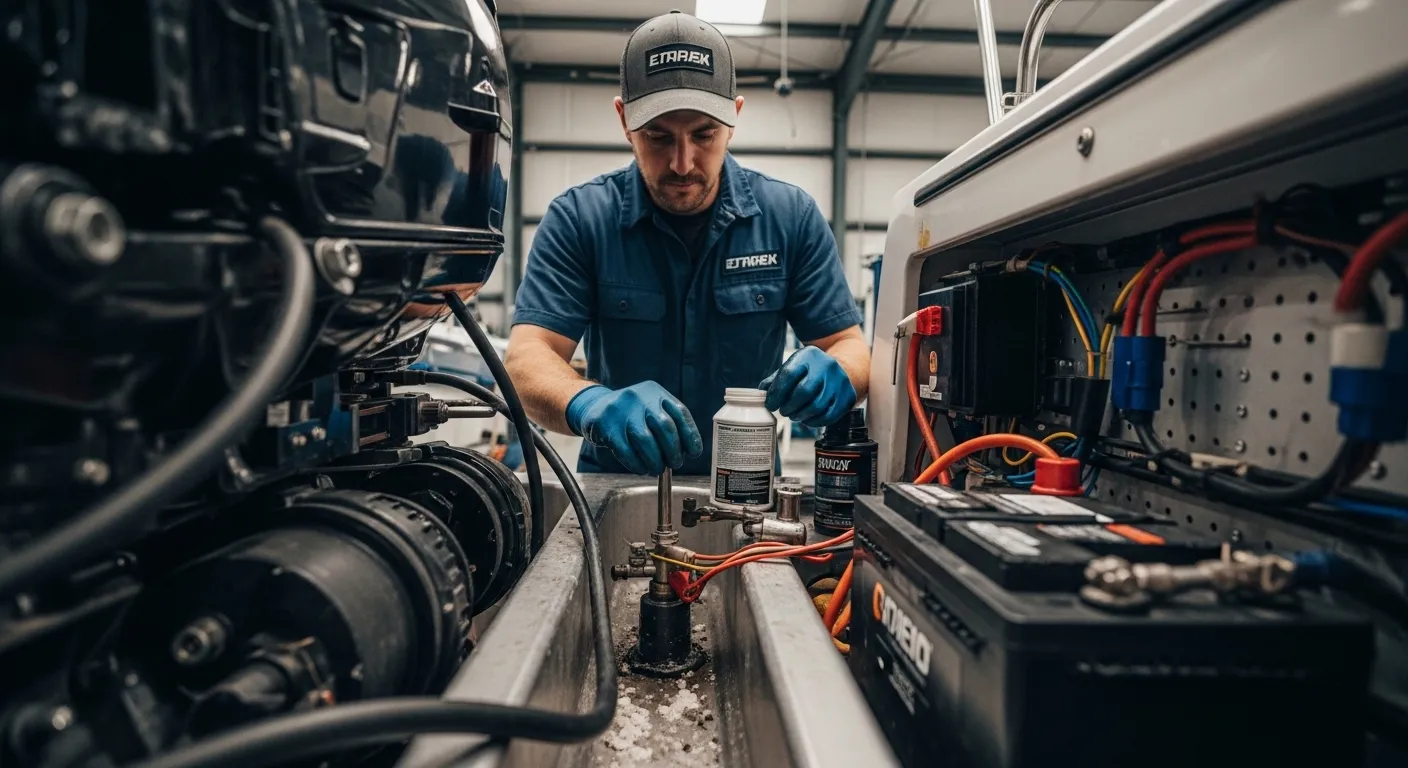
The Main Types of Marine Lubricants on a Boat
Choosing the right product starts with knowing what each one does. If you own a boat, you’ll be dealing with the main groups anyway.
Engine oil
Engine oil protects internal parts, helps control sludge, cools components, and keeps combustion byproducts under control. Outboards and inboards may need different formulas, and diesel engines may too, so start with the engine maker’s spec.
Gear oil and lower unit lube
These products protect gears and bearings inside the lower unit or gearcase. They’re made to handle pressure and moisture better than many general-purpose oils. They’re made just for that job.
Marine grease
Trailer hubs, steering parts, fittings, prop shafts, pivots, and other spots that need a thicker protective layer use grease, which is really handy. Marine grease stays put even around water and resists washout, so it works well there.
Hydraulic fluid
It keeps steering, trim tabs, and tilt and trim units working well. The wrong fluid can mess with seals, pressure, and operation, and that’s the kind of problem to avoid.
Specialty and environmentally acceptable lubricants
Some boats need stern tube oils, compressor oils, or biodegradable products for sensitive waters, and that part is fairly simple. Bio-based marine lubricants are projected to grow at 2.18% CAGR through 2031, while stern-tube oils are expected to grow at 2.11% CAGR. It’s a regular trend, especially in areas with stricter environmental rules, where eco-focused products tend to matter more.
The right product mix depends on engine type, boating location, and how many hours the boat runs each season. It also comes down to the kind of waters it operates in and how it’s used. For a broader look at matching products to boat systems, that’s covered in the guide on Marine Lubricants: Choosing the Right Products for Your Boat.
How to Choose the Right Marine Lubricants
Start with the owner’s manual. Boat and engine makers test specific viscosity grades, service ratings, and additive packages, and that last part matters most. Choosing by guesswork, or just using what worked in a truck, can cause problems because marine engines run in a very different environment, and that difference really does matter.
Here’s a simple way to choose:
1. Match the engine or system
Start by figuring out exactly what you’re servicing. A 2-stroke outboard, a 4-stroke outboard, a sterndrive, or a diesel inboard may need different lubricants. Getting that match right matters.
2. Check the required spec
The manual will show the viscosity grade and any OEM or marine service standard. That’s what matters, not the brand color or bottle design. Pretty simple, right?
3. Think about conditions
Saltwater use, high heat, long trolling sessions, heavy loads, and commercial duty all put extra stress on oil and grease, and that adds up fast. Boats that idle, troll, then jump on plane also need good oxidation stability so they do not break down, along with good corrosion protection.
4. Choose marine-specific products
Marine lubricants are made for water exposure, rust prevention, and handling loads. They suit your boat better than automotive substitutes, so they just make more sense for you and your boat.
5. Keep products organized
Label the products used in each system, and only mix them if the maker says it’s safe. Mixing can weaken additive chemistry and cause avoidable issues, especially now that fuel options are changing fast.
the current tribology concept works for both liquid and gaseous fuels.
Low-sulfur fuels, dual-fuel engines, cleaner engine designs, and newer operating demands are all pushing lubricant technology forward. Guidance linked to CIMAC experts like Dr. Holger Gehring and K. Wojik also points to proper lubricant choice and oil analysis as key to reliable operation as fuel types become more varied.
Oil Changes, Oil Analysis, and Early Warning Signs
Boat owners often ask a simple question: when should the oil be changed? The honest answer depends on more than the date on the calendar or the sticker on the engine. Engine hours, operating conditions, and contamination all play a big part. One tribology study on RNLI marine engines found an average serviceable lubricant life of 300 hours. Still, that does not mean every boat should wait that long. Lubricant life changes from one setup to another, and oil condition is a big part of that.
Research on marine diesel bearing conditions has reported lubricating film thickness as low as 0.25 to 2.5 µm during certain transient or contaminated conditions. That margin is very small. Once oil starts to break down or water gets in, the protective buffer can disappear quickly, and that is the part to watch closely.
| Maintenance indicator | What it may mean | What to do |
|---|---|---|
| Milky oil | Water intrusion | Stop and inspect seals or lower unit |
| Burnt smell | Overheating or oxidation | Change oil and inspect cooling or load conditions |
| Metal flakes | Wear or gear damage | Inspect immediately |
| Dark thick sludge | Extended use or contamination | Change oil and review interval |
The practical checks are not complicated. You can pull the dipstick and look at the color and clarity. You will also want to check the lower unit lube for milkiness, watch pressure gauges, and listen for any unfamiliar sounds. For high-value engines, commercial use, or boats that log a lot of hours, oil analysis can give an early warning before a failure gets expensive on the water.
Lubrication is also closely tied to rust control. If saltwater is part of regular operation, it makes sense to pair the oil plan with advanced techniques for marine corrosion prevention.
Common Lubrication Mistakes Boat Owners Make
A lot of boat damage that could be avoided comes down to the same few mistakes. A big one is using automotive oil when the job really needs a marine product. Car oils are not always made for the moisture, rust risk, or load patterns boats deal with, and problems can show up fast. Another common mistake is ignoring the manual and picking a product based only on price.
Waiting too long between service checks causes trouble too. Even if the oil has not reached the full hour limit, water intrusion, fuel dilution, and heavy seasonal use can wear it out faster than many owners expect. That is easy to miss. Some owners also forget non-engine items that still need regular attention, including steering points, trailer bearings, throttle linkages, and prop shafts.
Another issue is mixing grease types without checking if they work together. Using too much grease can cause problems too, since on some parts it can blow seals. Storage gets overlooked a lot as well. During a long off-season, lubricated parts may sit exposed to condensation and corrosion if the boat is not prepared the right way.
That is one reason many DIY owners turn to product and maintenance resources from First Choice Marine as they put together a seasonal service checklist. Having the right marine parts and fluids ready before launch day makes routine care much easier.
Trends Shaping Marine Lubricants Right Now
Marine lubricants are changing along with shifts across the marine world. One of the clearest trends is toward environmentally acceptable lubricants, often called EALs. They matter most for stern tubes and hydraulic systems, where leaks can happen, and for boats operating in sensitive or regulated waters. If a leak does happen, these products are made to lower environmental impact, which is a real concern in places with stricter rules.
Lower-sulfur fuels and newer engine designs are driving another big change. Marine lubricant makers are paying more attention to cleaner-running formulas, better oxidation stability, and products made for modern diesel, gas-fueled, and dual-fuel engines. Synthetic and specialty blends are also getting more interest for high-performance uses and other high-stress conditions, such as hotter loads and longer runs.
For everyday boat owners, one of the most useful changes is the growth of oil analysis and technical support. Lubricant choice is no longer just about picking a viscosity. It is becoming part of a wider reliability plan that includes inspection, testing, and preventive maintenance.
Building a Simple Lubrication Plan for Your Boat
A lubrication plan for a boat does not need to be complicated. Start by listing every system that uses oil, grease, or hydraulic fluid. For each one, note the product type, spec, capacity, and service interval. Keep that list with the maintenance log so everything stays in one place and is easier to track during the season.
Then check these items during the season:
Before each trip
Check the engine oil level. Also check for leaks; it’s quick, and a bilge scan can catch any fluid loss.
Monthly or every hard-use stretch
Give the grease points and steering movement a quick look. Also check trim and tilt operation, plus the lower unit condition.
At seasonal service
Change the oil and filter if needed. Service the gearcase, check the seals, and refresh grease only where needed.
During storage
Use the right lay-up steps so surfaces stay protected during the months your boat sits idle. It’s pretty simple.
If you’re planning a few other routine upgrades at the same time, an online marine parts retailer like First Choice Marine can help you get maintenance items in one place, which makes things easier.
It’s also smart to check your power system, since engine care and electrical reliability overlap. That’s covered here too: A Beginner’s Guide to Marine Batteries: Selection and Maintenance.
Frequently Asked Questions
What are marine lubricants?
Marine lubricants are fluids and greases made for boat engines and onboard systems. They include engine oil, gear lube, hydraulic fluid, and grease. They are designed to handle water exposure, corrosion risk, and heavy loads better than many non-marine products.
Can I use automotive oil in a boat engine?
Sometimes a product may look similar, but you should not guess. Marine engines often need different additives and protection levels, especially for rust, moisture, and long periods at high load. Always follow the engine maker’s marine specification.
How often should I change marine engine oil?
It depends on the engine, the oil, and how you use the boat. Follow the manual first, then adjust for hard use, saltwater conditions, long idle time, or signs of contamination. If you run many hours, oil analysis can help you fine-tune your interval.
What does milky lower unit oil mean?
Milky oil usually means water has entered the gearcase. That often points to a bad seal or damage around the prop shaft or drain plugs. Do not ignore it, because water can quickly damage gears and bearings.
Are eco-friendly marine lubricants worth using?
Yes, in many cases they are a smart choice. Environmentally acceptable lubricants can be especially useful in sensitive waters, regulated areas, and systems like stern tubes or hydraulics where leaks matter more. First Choice Marine is one example of a retailer where boat owners may find marine maintenance products that support more responsible boating choices.
Where can I find the right lubricant for my boat?
Start with your owner’s manual so you know the exact specification you need. After that, look for marine-focused suppliers that carry engine care products, gear lubes, greases, and related maintenance items. First Choice Marine can be a practical resource for boat owners who want parts and maintenance solutions in one place.
Keep Your Boat Running Smoothly
Handling marine lubricants well does not need to be hard. It comes down to knowing the engine and onboard systems, using the required spec, checking fluids on a regular schedule, and treating water contamination as a serious warning sign. Marine lubricants also include more than engine oil. Gear lube, grease, hydraulic fluid, and eco-friendly specialty products each have a real role in keeping a boat reliable and safe.
Research backs that up. Marine lubricants protect equipment under high pressure, with very thin protective film thickness, and as fuel demands change. Good lubrication habits also save money over time, and that can add up quickly. They reduce wear, help prevent breakdowns, and make it easier to leave the dock with confidence. On the water, that kind of reliability matters in a very real way.
To use this, start with a simple maintenance list for the boat this week. The manual will show the right specs, and a fluid check can reveal problems early. Replace any product that looks contaminated or overdue. Those small steps can help avoid major repairs later and make the boating season smoother, safer, and a lot less stressful.
