


Anchoring should feel reliable and safe, not like one more thing to stress about. But many boaters learn the hard way that the wrong anchor winch can cause real problems. If the unit is too small, it may struggle when there’s load on it. Bad wiring can cause voltage drop, heat buildup, and weak performance. And if the rode or chain does not match the right way, the gypsy can jam at the worst moment, right when it needs to work. That’s why choosing the right anchor winches system matters from the start.
Anchoring is also connected to everyday boating safety. In 2024, the U.S. Coast Guard reported 3,887 total reportable boating incidents, 2,170 injuries, and 556 fatalities. Good seamanship still comes first, but reliable gear also helps lower risk when conditions change fast.
This guide explains anchor winches in simple terms. It covers how to size a winch and how wiring connects to the full marine electrical system. It also looks at which chain and rode details really matter, plus how related onboard equipment like steering systems can affect safe anchoring in tight spaces. Along the way, it covers common mistakes, 2026 trends, and practical buying tips, so you can choose a setup that fits your boat and how you actually use it, not just what looks right on paper.
Why proper sizing of anchor winches matters more than boat length
A lot of buyers start with boat length alone. It’s a quick shortcut, but it misses too much. Sizing anchor winches based on the total load from the anchor, chain, rope, and hardware works better, especially since that last part often gets missed. Conditions matter too. A boat used on calm lakes will need something different from one anchoring in tidal inlets or coastal fishing grounds.
Lippert gives a simple formula: (Anchor Weight + Rode Weight) x 1.5 = working load. Other guidance suggests choosing a windlass rated at 3 to 4 times the working load. West Marine recommends a minimum rated pulling power of 4 times the total weight of the anchor, chain, rope, and hardware, which gives you a practical baseline and is easy to remember.
| Sizing Factor | Guideline | Why It Matters |
|---|---|---|
| Working load | Anchor + rode weight x 1.5 | Estimates the real retrieval load |
| Rated pull | 3x to 4x working load | Adds needed safety margin |
| Alternative rule | Ground tackle weight x 3 | Useful quick check for buyers |
Guessing from hull length sounds convenient, but load-based sizing is usually much more accurate. Yachting Monthly gives a useful example: in 10 m water depth, with a 25 kg anchor and 30 m of chain out, the load is about 40 kg. That number surprises a lot of owners. Chain weight adds up quickly, even before wind, current, or mud suction start putting more strain on the system.
The basic minimum load that the windlass should handle will be the weight of chain and anchor, with the boat directly above the anchor.
For a wider electrical safety background before installing a high-draw winch, there’s also Demystifying Marine Electrical Systems: Maintenance and Troubleshooting, and it’s a good idea to read it first.
How to size anchor winches step by step
Sizing gets much easier when you break the job into a few clear parts. Start by listing your ground tackle exactly as it sits on the boat, and yes, that means all of it. Include the anchor, every foot of chain, the rope rode, shackles, swivel, and any connector hardware. Don’t guess here. Either weigh each piece or get the numbers from the manufacturer specs.
Then figure out the load the winch needs to handle. Say the anchor weighs 35 pounds and the chain, rope, and hardware add another 45 pounds. That brings the full tackle weight to 80 pounds. Using the 3x method, you’d want at least 240 pounds of pull. If a little extra margin feels smarter, the 4x guideline puts you closer to 320 pounds, which gives a safer buffer.
After that, check the chain spec closely, because this is where a lot of installs run into trouble. Two chains can both be marked 1/4 inch, but link shape and pitch may still differ enough to cause real feeding problems.
It is essential that you use what is termed calibrated chain with an electric windlass.
The locker layout deserves a careful look too. Defender Marine suggests about 12 inches of rode fall for horizontal windlasses and 18 inches for vertical windlasses. Without enough drop, the chain may stack up under the unit and jam.
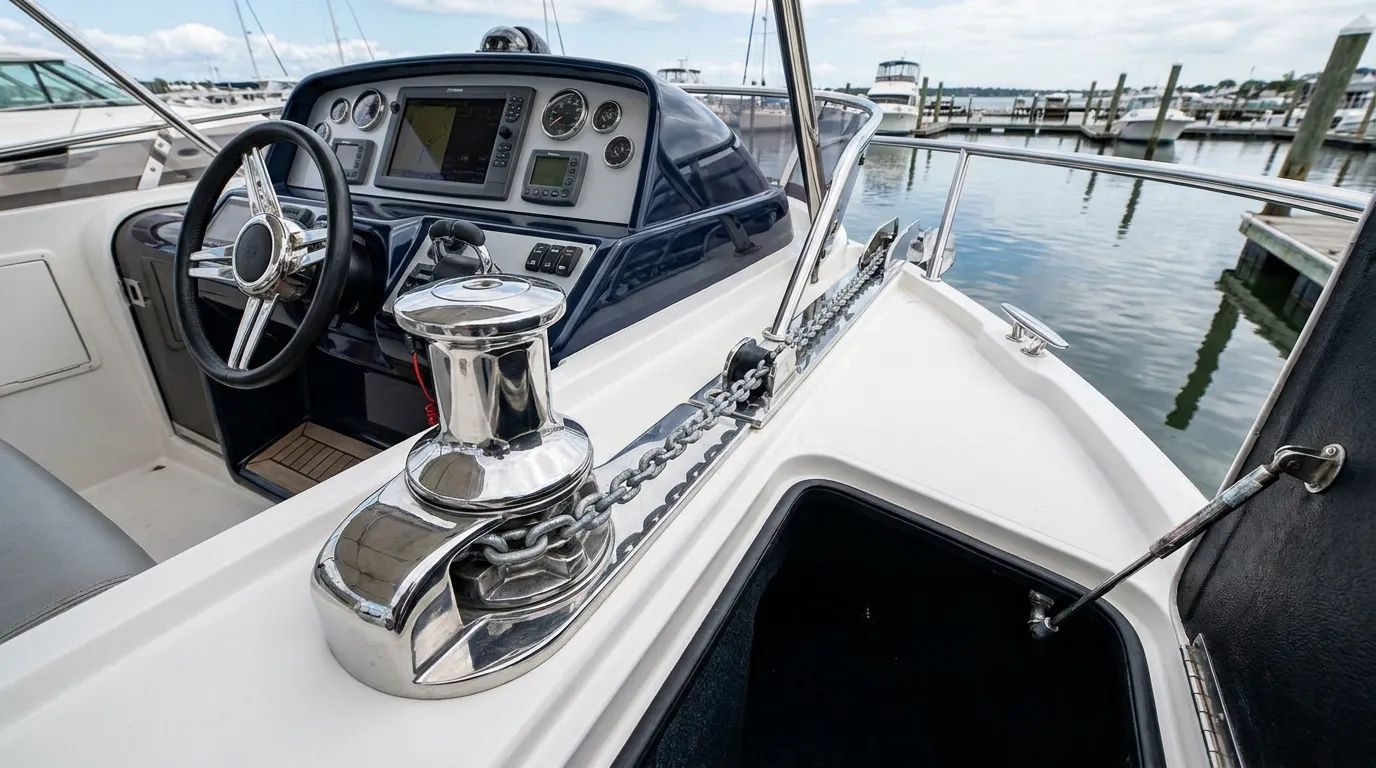
For most recreational boats, electric systems are still the standard option. They’re quicker, less physical to use, and they make more sense if anchoring happens often. In 2026, that stands out even more as more owners add modern batteries, electronics, and integrated controls, which make the whole setup run more smoothly.
Wiring your anchor winches the right way inside the marine electrical system
Poor wiring can make even a great anchor winch work badly. It’s not just about power, either. Safety matters too. A windlass pulls high current, so wire size, breaker protection, battery condition, and the total circuit length all need to be taken into account.
Yachting Monthly gives two solid examples. If a motor draws 140 A over as much as 20 m of cable, it should have at least 35 mm2 cable. A motor drawing 80 A should have at least 25 mm2 cable. As current goes up, cable size increases quickly, often more than people expect.
Voltage drop also needs attention. ABYC E-11 recommends a 3% max voltage drop for critical circuits, although up to 10% is accepted for windlasses because of their heavy power draw. In simple terms, undersized cable can leave the winch weak, slow, or running hot, which is the last thing you want when you need it most.
Here’s a practical wiring checklist:
Start with the battery bank
Make sure the battery can handle the winch load. It’s easy to blame the winch, and people often do. But if the battery is weak, the real problem is low voltage under load.
Size the cables for distance and amperage
Always measure the full cable run, not just the straight-line distance. If the run is longer, you need larger wire, that’s the main part.
Use the right breaker and solenoid
A dedicated breaker protects the circuit, and that part is pretty easy. The control relay or solenoid should match the winch maker’s specs, so you don’t have to guess.
Protect all terminals from corrosion
Heat shrink and sealed lugs really help. Clean connections also keep your whole marine electrical system working well out on the water.
Test under real load
A dockside spin test isn’t enough. In safe conditions, pull up the anchor and watch for voltage sag, heat, or slow operation. You’ll notice problems in real use, so that’s the test that really shows how well it works.
Choosing the right type of anchor winch system for your boat and use
The best setup depends on how the boat is really used. How often it anchors, how heavy the ground tackle is, how much room there is on the bow, and the conditions it fishes or works in all matter, especially in rougher conditions.
Horizontal windlasses are easier to reach and suit boats with enough deck space. Vertical models usually manage chain more neatly and give better fall below deck, but they need proper locker depth to work well. A shallow anchor locker can turn even a good winch into a constant hassle.
Operation matters too. Foot switches are still common on the bow, while helm controls make day-to-day use easier. Some boaters also prefer integrated control layouts that sit neatly alongside modern electronics, which can leave the dash looking much tidier. That usually matters more on larger boats, where the helm operator may also be dealing with drift, current, nearby traffic, and other boat movement at the same time.
steering systems matter here as well. If steering feels stiff, delayed, or vague, anchoring in a busy area gets harder. Lining the boat up over the anchor for retrieval can become a struggle, and that extra effort puts more load on the winch. Reliable steering and anchoring gear usually work best together. If the controls feel sloppy, that was covered in this guide on Boat Steering Systems Compared: Mechanical vs Hydraulic for Real-World Boating.
One final point: never use the winch to pull the boat forward.
The anchor windlass is intended to retrieve the anchor and ground tackle, not to pull or drag the boat.
That mistake leads to overload, breaker trips, and damage more often than many owners expect, and it can turn into an expensive lesson.
Common mistakes that lead to jams, overload, and short service life
Most anchor winch failures begin with setup mistakes, not the motor. One common issue is gypsy mismatch. The chain may look right at first, but if it is not the exact calibrated type the winch was made for, it can slip or jump, and trouble can start almost right away.
Another common issue appears after the boat is anchored. If the winch is left to hold the full anchoring load, wear adds up fast. A snubber or chain stopper should carry that load instead, which gives the gearbox and deck hardware better protection from heavy shock loads.
Poor locker design also causes problems over and over. If the chain does not fall freely, it can stack up and feed back into the winch. Add some mud or weed, and the system may stop fully. Many owners also pick a unit that only has enough pull on paper. Out on the water, mud, current, and poor alignment change things, so extra margin makes a clear difference.
As a practical buying step, many boaters compare parts through suppliers like First Choice Marine. It helps to look at winches alongside related electrical items and rigging gear instead of buying the winch as if it works by itself.
What is changing in 2026
The anchors and marine winches market is still growing, and the increase is not small. Market Research Future estimates the global boat anchor market at USD 3.585 billion in 2024, rising to USD 3.759 billion in 2025. Zion Market Research puts the global marine winches market at USD 1.84 billion in 2024 and expects it to reach USD 2.85 billion by 2034.
| Market | Recent Size | Outlook |
|---|---|---|
| Boat anchor market | USD 3.585B in 2024 | USD 3.759B in 2025 |
| Marine winches market | USD 1.84B in 2024 | USD 2.85B by 2034 |
| U.S. registered recreational vessels | 11,674,073 in 2024 | Strong ongoing demand for equipment |
For boat owners, the main change in 2026 is electrical integration. New ABYC standards work is still focused on AC and DC safety, along with lithium battery systems. Because of that, anchor winches should be planned as part of the full marine electrical system, not treated like a separate add-on, especially on boats that also use trolling motors, inverters, sonar, and chargers. On the commercial side, new IMO safety rules for some anchor handling winches took effect on January 1, 2026. Across the industry, there is also more focus on safety and documentation, with clearer records and more regular checks.
Frequently Asked Questions
How do I know if my anchor winch is too small?
If it struggles to retrieve the anchor in normal conditions, trips breakers often, or slows badly under load, it may be undersized. Compare its rated pull against the full weight of your anchor, chain, rope, and hardware, then add a healthy safety margin.
Can I install an anchor winch on a 12V boat?
Yes. Many recreational boats use 12V anchor winches successfully. The key is using the correct wire size, breaker, battery capacity, and chain match so the system performs well under real load.
Do I need calibrated chain for electric anchor winches?
Yes, in most cases. The gypsy is built for a specific chain size and link pattern, so non-calibrated or mismatched chain can slip, jam, or wear the system faster.
Should the winch hold the boat at anchor?
No. The winch is for deploying and retrieving the ground tackle, not for taking the full anchoring load over time. Use a snubber or chain stopper to protect the winch and reduce shock loads.
Where can I compare anchor winches with related wiring and deck hardware?
It helps to compare the winch with breakers, switches, wiring, and anchoring accessories at the same time. A marine parts retailer such as First Choice Marine can be useful for that because it lets you look at the full install, not just the winch by itself.
What should I check before buying a replacement winch?
Check the total ground tackle weight, chain calibration, locker depth, voltage, current draw, and deck layout. If you are shopping for parts, First Choice Marine is one example of a place where boaters often compare related components for a more complete replacement plan.
Make your anchoring system safer and easier to trust
A good anchor winch does more than save effort. It makes anchoring easier, reduces strain on the crew, and helps with safer boat handling when wind, current, or bottom conditions get tough (and sometimes they do). The right choice starts with the actual load, not a rough estimate. From there, match the chain carefully, make sure the rode fall is right, and wire the system as part of the full marine electrical system.
Size it for the anchor and rode weight, and leave enough pull capacity with some extra margin. Use calibrated chain, and protect the circuit with proper cable and breaker sizing. The winch should not be used to drag the boat. It also helps to think about related gear like steering systems, since precise boat control makes anchor retrieval safer and easier, especially in tight spots.
If you’re planning an upgrade in 2026, spend a few extra minutes mapping out the full setup before buying. That can help you avoid jams, overload, or costly rewiring later. A well-matched system is easier to use, easier to maintain, and much easier to trust when conditions are less than ideal.
For more technical insight, check Marine Electrical Systems 2026: Adopting Next-Gen Power Innovations for Small Boats for upcoming electrical integration trends that complement modern anchor winches setups.
