


Last Updated: November 4, 2026
Quick Summary
To find boat parts near me, first identify the exact replacement part using its part number and your engine's make, model and year. Then check local stock by phoning a dedicated marine counter with that number. Compare total cost, shipping time and return policy before choosing online ordering.
- Search by the part number on the old component, not a generic term, to cut out mismatched results.
- Call ahead and ask whether the part is on the shelf now, how many are in stock, and whether it can be held.
- Convert handling time plus transit time into a calendar date and compare it to when you need the part.
- Compare total cost including shipping, sales tax and oversize fees, since bulky parts often lose their online savings.
- Favor OEM or established aftermarket parts with a written warranty for steering, fuel and high-current electrical items.
Table of Contents
- Finding Boat Parts Near Me: A Practical Starting Point
- Identify the Exact Replacement Part Before You Search
- Marine Parts Near Me: Checking Local Stock Efficiently
- Used Boat Parts Near Me: When Secondhand Makes Sense
- Mercury Boat Parts Near Me: Matching Outboard Components
- Replacement Boat Parts Online: Shipping Times, Costs, and Urgency
- Pick Your Next Parts Order With Confidence
- Frequently Asked Questions
Finding Boat Parts Near Me: A Practical Starting Point
Finding boat parts near me starts with knowing what you actually need. An owner often searches for a part, finds a dozen listings, and still isn't sure which one fits their engine. The fastest route is a clear part identification followed by a deliberate choice between local stock and online ordering.
The marine parts and accessories market was valued at USD 17.7 billion in 2025 and is expected to reach USD 18.9 billion in 2026 (Stratview Research, 2025 Recreational Boat Parts and Accessories Market Report). That volume of supply is why searches for boat parts near me return so many options, and why narrowing them down matters.
This guide covers how to identify the right part, check local stock efficiently, weigh used against new, match outboard components, compare shipping and urgency, and place an order with confidence. Boat dealers and repair shops are a large, steady industry, with revenue growing at an annualized 1.6% over the five years to 2026 to an estimated $39.5 billion (IBISWorld, Boat Sales & Repair in the US Industry Analysis).
Identify the Exact Replacement Part Before You Search
Start with the part number printed on the old component, then the make, model and year of your engine or boat. Search results for a generic term like "water pump" will mix parts for different horsepower ranges and model years. Searching by part number removes most of that noise.
Compare the part you pulled off the boat with the listing photo and dimensions before you buy. A safe way to buy online walks through the checks to make before paying.
If you are unsure, ask the seller to confirm fitment against your engine's serial or model number before you pay.
Marine Parts Near Me: Checking Local Stock Efficiently
A local store lets you see the part, compare it to the old one, and leave with it the same day. The drawback is that a shop's shelves rarely cover every engine brand or older model. The difference between a wasted afternoon and a same-day repair is usually how you verify stock before you drive.
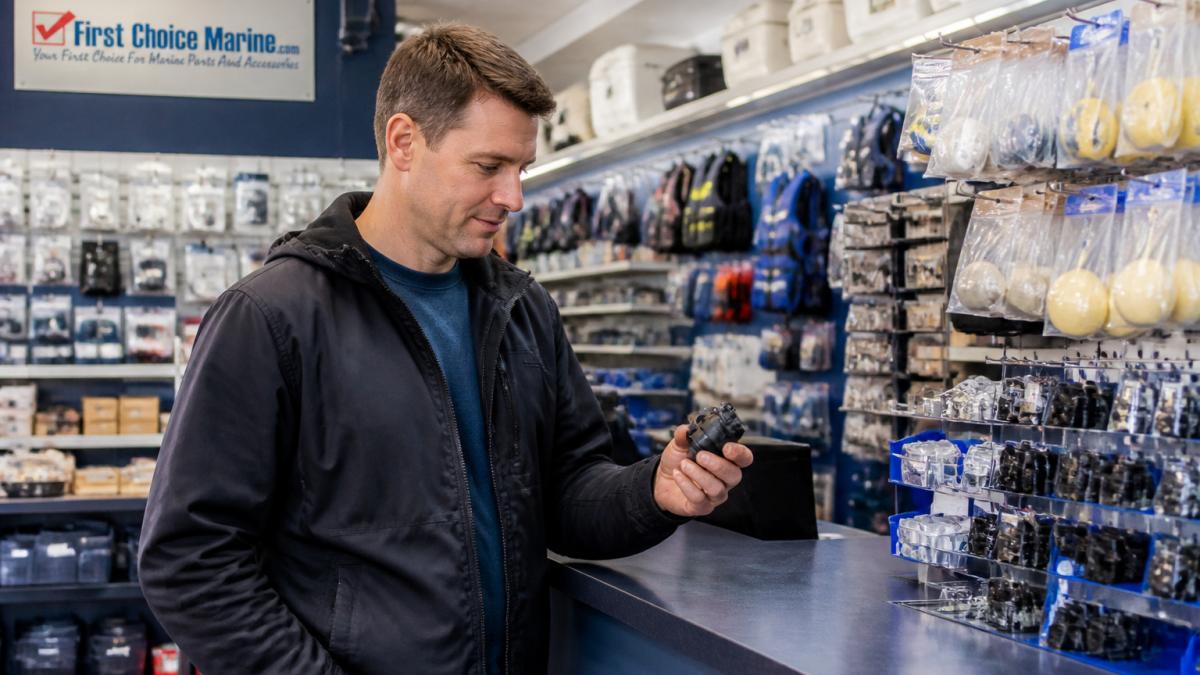
Build a shortlist of nearby sellers
Search by your ZIP code rather than by city name, then filter the results into three buckets: dedicated marine parts counters, general auto-parts stores that carry a marine aisle, and dealership service departments that sell parts over the counter. Each bucket behaves differently. A dedicated counter is most likely to stock engine-specific components; a general store is most reliable for fasteners, hose clamps, and universal consumables; a dealership is the best bet for current-model OEM parts but may require the part to be ordered.
Map the distance from your slip or storage yard, not from home. A store 20 minutes from your house but 90 minutes from the boat is not local in any useful sense on launch day.
Verify stock with a part-number call
Call ahead with the part number, your engine's make, model, year, and serial number. Ask three specific questions: Is the item physically on the shelf right now? How many are in stock? Can you hold it for pickup today?
Ask the counter to read the part number back to you and confirm it matches. Counter staff work from catalogs that occasionally supersede part numbers, and a superseded number may fit even when the printed one does not appear in the system.
Watch out: a store that says "we can order it" is not local stock, confirm the lead time in business days and whether the order is returnable before you commit.
Confirm pickup, hours, and counter policies
Before traveling, confirm the parts counter hours, which are often shorter than the store's retail hours, and whether the counter closes for lunch. Ask whether the part can be paid for over the phone and held at will-call, and what identification or order number you need at pickup. If you are sending someone else, ask whether the counter requires the purchaser's name on the order.
Know what local shelves actually cover
If your part falls in the second group, treat the local call as a confirmation step rather than a sourcing plan.
Have a fallback before you leave
If the local counter cannot help, ask two questions before hanging up: Can you transfer from another store in your network, and what is the transfer time? A regional chain with a nearby warehouse can often move a part overnight, which keeps you local for pickup while beating standard shipping. If neither works, move to online ordering with the shipping and urgency checks in the next section.
Used Boat Parts Near Me: When Secondhand Makes Sense
Used parts can make sense for some cosmetic pieces and hardware. They are a poor choice for safety-critical items such as steering components, fuel system parts and electrical connections that carry a load. Even for less critical hardware, checking part compatibility before buying helps avoid a poor fit and keeps the installation straightforward.
Inspect any used part for cracks, corrosion, wear and missing fasteners. Ask the seller about its history, and where possible, test it before you install it. Buying used saves money only when the part is sound.
EMP Lower Gearcase Seal Kit #26-00146 →
Mercury Boat Parts Near Me: Matching Outboard Components
Mercury outboards use specific part numbers across model years, so matching the exact number matters. For example, the EMP Lower Gearcase Seal Kit #26-00146 is listed for Mercury/Mariner 4-cyl, 75-80 HP, 6-cyl, 90-115 HP and V6, 150-200 HP outboards from 1978 to 1988 (see the EMP Lower Gearcase Seal Kit #26-00146). Confirm your engine's model year before ordering.

For cooling system work, the BRP Water Pump Repair Kit #5008972 is listed as an Evinrude/Johnson water pump kit that includes the listed parts. You can view the exact kit and its number to confirm it matches your outboard. Check the fitment range on the listing against your engine before you buy (see the BRP Water Pump Repair Kit #5008972).
Replacement Boat Parts Online: Shipping Times, Costs, and Urgency
Online ordering often gives you wider selection and easier price comparison, but the listed price is only one line in the real cost. A part that arrives after your trip, or that you cannot return because you ordered the wrong fitment, costs more than a local part at a higher sticker price.
Compare total cost, not sticker price
Build a simple side-by-side for each option: unit price, shipping charge, sales tax, and any handling or oversize fee. Oversize charges matter for items like lower units, propellers, fuel tanks, and long steering cables, which frequently ship by freight rather than parcel. Read the guide to avoiding hidden costs in marine parts before committing to a bulky order.
A common pattern is that small, light parts favor online ordering on price, while bulky or heavy parts often erase the online savings once freight is included.
Read the shipping window as a date, not a range
Convert the stated handling time plus transit time into a calendar date and compare it to the day you need the part in hand, not the day you plan to install it. Note whether the seller ships same-day and what the order cutoff time is. For urgent needs, confirm whether expedited shipping is available and whether the seller guarantees the delivery date or only estimates it.
Watch out: a listing that shows a fast transit time but a multi-day handling time can still arrive after your trip, check both numbers separately.
Check the return policy before you buy
Confirm the return window, whether returns are accepted for electrical parts, and who pays return shipping. Electrical components, fuel-system parts, and special-order items are commonly excluded from returns, so a wrong guess on those is a total loss. Ask whether the seller will confirm fitment against your engine serial number before shipping; a seller who will check is worth a small price premium.
Decide OEM versus aftermarket deliberately
OEM parts are built to the manufacturer's specification and typically carry the strongest fitment guarantee, but they cost more and may be backordered. For safety-critical systems, steering, fuel delivery, and high-current electrical, favor OEM or a well-established aftermarket brand with a written warranty. For cosmetic and low-stress hardware, aftermarket is usually a reasonable value.
Handle urgent and stranded situations
If the boat is stranded or a part is needed before a weekend trip, work the problem in order: call the nearest dedicated marine counter first, ask about network transfers second, and check whether a mobile marine mechanic carries the part on a service truck third.
If local stock is unavailable, ask the online seller whether overnight or two-day shipping is available to your ZIP code and whether the part can ship the same day if you order before the cutoff. Confirm the delivery address is one where someone can receive the package, since signature requirements on high-value parts can add a day.
Keep a record for the next order
Save the part numbers, seller, order date, and fitment notes for every order. The next time you search for boat parts near me, that record turns a fresh search into a quick reorder and reduces the chance of buying an incompatible part twice.
The table below summarises the online ordering checks covered in this section.
| Check | What to confirm | Why it matters |
|---|---|---|
| Total cost | Unit price, shipping, tax, oversize fees | Sticker price can hide freight charges |
| Shipping window | Handling time plus transit time as a date | Part must arrive before your trip |
| Return policy | Window, electrical exclusions, return shipping cost | Wrong guesses on electrical or special-order items are a total loss |
| Part type | OEM for safety-critical, aftermarket for cosmetic | Matches the level of risk to the price paid |
| Saved record | Part numbers, seller, order date, fitment notes | Makes reorders quick and avoids repeat mistakes |
Pick Your Next Parts Order With Confidence
Match the part number, confirm fitment, and compare local and online options on availability, total cost and timing. Once you have chosen a part, the DIY boat maintenance support guides cover the rest of the repair.
Frequently Asked Questions
Can I buy used boat parts near me?
Yes. Used marine parts are often sold by local marinas, boat yards, salvage yards, and online marketplaces that serve nearby buyers. Inspect used items closely for cracks, corrosion, worn seals, and wear marks, and confirm the exact part number before paying. Used parts make the most sense for non-critical components and cosmetic or hardware pieces. For safety-critical items such as fuel system components, steering parts, and certain electrical fittings, buying new from a known supplier is usually the safer choice, and you should always verify that the part matches your engine's model year and serial details.
Where can I find parts for my boat?
Start with a dedicated marine parts retailer, which typically stocks engine, electrical, plumbing, and hardware components. Local boat dealers and service shops can often source parts for your specific make and model, and some will check inventory for you by phone. Big-box and auto parts stores rarely carry marine-specific items, so they are best used only for general hardware.
How do I find the right replacement part for my boat?
Gather your boat's make, model, year, and engine horsepower, and locate the engine serial number and the original part number printed on the old component. Compare that number against the manufacturer's cross-reference or the part's stated replacement numbers. A Mercury or BRP water pump kit, for example, may list several superseded part numbers, so matching only the year is not enough. If the number is worn off, photograph the component from several angles and bring it to the counter before buying.
Need a part you can't find locally? First Choice Marine carries marine hardware, electronics and maintenance supplies for recreational and commercial boaters. Sign in to your account to track your orders and check availability.

