


Quick Summary
Neither blade count wins everywhere. A 4 blade prop usually gives better hole shot, grip and ride smoothness, while a 3 blade prop usually gives more top-end speed and efficiency at cruising throttle. Match the choice to what your boat does most of the time, then check pitch and diameter against your engine.
- A 4 blade prop adds blade area, which improves grip and helps the boat climb onto plane.
- The extra blade area adds drag, which usually takes some speed off the top end.
- A 3 blade prop usually suits boats that run mostly at high speed in calm water.
- Pitch matters as much as blade count, so a mismatched 4 blade can underperform a 3 blade.
- Check your engine's rated WOT RPM range in the manual before choosing a prop.
Table of Contents
- Is a 4 Blade Prop Better Than 3? The Short Answer
- 3 Blade vs 4 Blade Propeller: Side-by-Side Comparison
- Acceleration, Hole Shot and Time to Plane
- Top Speed, Cruising and Fuel Efficiency
- 3 Blade vs 4 Blade Prop on a Pontoon Boat
- Matching Pitch and Using a 3 Blade to 4 Blade Prop Calculator
- Choosing the Right Prop for Your Setup and Ordering Your Replacement
- Frequently Asked Questions
3 Blade vs 4 Blade Prop: Which Is Better for Your Boat?
Last Updated: November 3, 2026
Is a 4 Blade Prop Better Than 3? The Short Answer
Neither blade count wins everywhere. A 4 blade prop usually gives better hole shot, grip and ride smoothness, while a 3 blade prop usually gives more top-end speed and efficiency at cruising throttle. The choice usually comes down to what your boat does most of the time. Start there, then match the pitch and diameter to your engine.
Check your own engine's operating range before choosing between blade counts.
A 4 blade prop adds blade area in the water. That extra area improves grip, which helps the boat climb onto plane. The cost is drag, which takes some speed off the top end.
3 Blade vs 4 Blade Propeller: Side-by-Side Comparison
The table below summarizes how each blade count usually performs. Use it as a guide, not a rule.
| Factor | 3 Blade Prop | 4 Blade Prop |
|---|---|---|
| Top speed | Usually higher | Usually lower |
| Hole shot and acceleration | Good | Usually stronger |
| Time to plane | Good | Often quicker |
| Vibration and smoothness | Good | Usually smoother |
| Grip in the water | Good | Usually better |
| Fuel use at cruise | Often more efficient | Can be less efficient |
Four-blade props are a common upgrade for boats that struggle to get on plane, or that carry heavy loads. Three-blade props suit boats that run mostly at high speed in calm water. Both designs depend heavily on pitch, so a 4 blade prop at the wrong pitch can underperform a well-matched 3 blade.
The EMP IH Prop 4-Blade Group D Aluminum 17-Pitch (P9413-1300-17) lists at $114.99 and has a 13-inch diameter and 17-inch pitch. For a higher-pitch 4 blade that suits boats already getting on plane well, the EMP IH Prop 4-Blade Group E Aluminum 21-Pitch (P9513-1400-21) lists at $129.99.
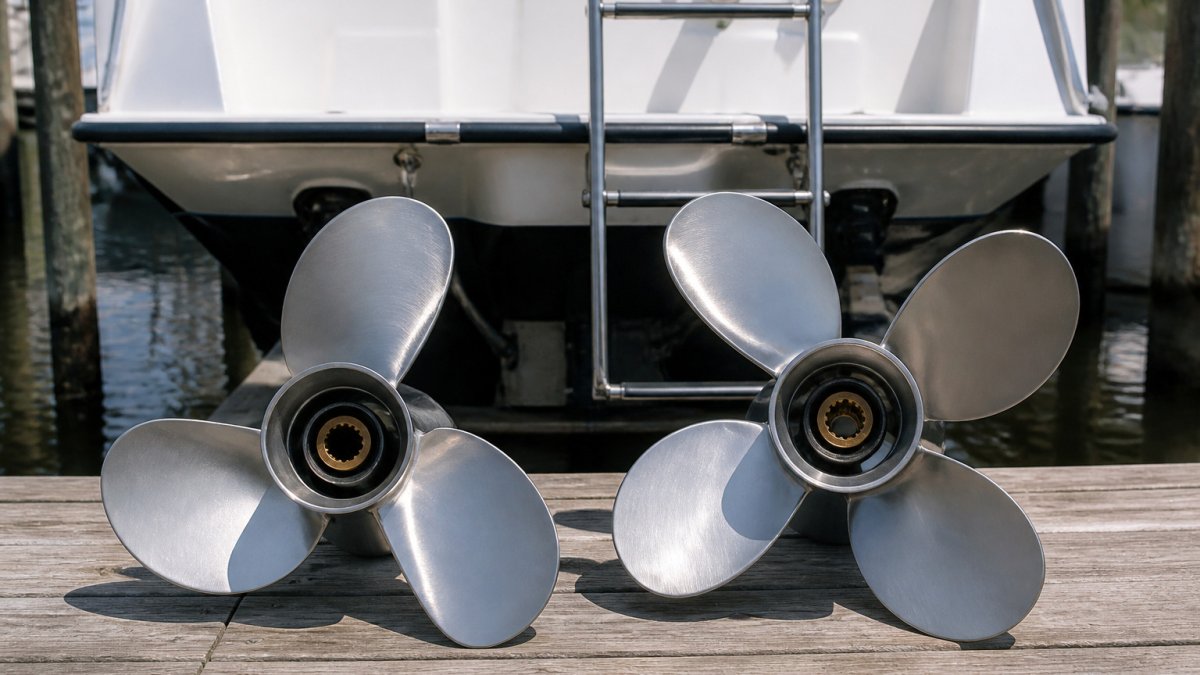
Acceleration, Hole Shot and Time to Plane
Hole shot is the moment a boat moves from a standstill toward planing. A 4 blade prop typically gives more grip at that stage, so the bow lifts sooner.
The effect is most noticeable on heavy boats, boats with a full load of passengers, or boats running high-pitch props. If your boat is slow to get up, check your pitch before you buy a new blade count. A lower pitch often fixes the problem for less money.
The EMP Prop Aluminum Prop RH 3-Blade Group C 10-Pitch (P5211-0988-10, $75.99) has a 10-inch pitch and is listed for maximum hole shot on smaller outboards.
Top Speed, Cruising and Fuel Efficiency
Top speed is where a 3 blade prop usually earns its place. Fewer blades create less drag, so the engine can reach a higher RPM and a higher speed.
Cruising efficiency depends on the engine's load. Many owners find a 3 blade prop burns less fuel at a steady cruise, but results vary with hull shape, weight and sea state. Test your own boat rather than relying on general claims.
The EMP IH Prop 4-Blade Group E Aluminum 21-Pitch lists a higher pitch at $129.99.
For a stainless option, the EMP Prop Stainless Steel Prop RH 3-Blade Group C 11-Pitch (P5221-1000-11, $224.10) is made of stainless steel.
3 Blade vs 4 Blade Prop on a Pontoon Boat
A 4 blade prop adds blade area, which can help a boat climb onto plane and hold the water in turns.
The trade-off is real. A pontoon with a 4 blade prop may lose a little top speed compared with a 3 blade, so decide what matters more on your water, a quicker, more confident climb onto plane, or a higher top end you may rarely use.
Match the prop to the pontoon setup, not just the blade count. A few variables change the answer:
- Two-log versus tritoon. A tritoon with more buoyancy and a larger engine can often turn a higher pitch and may benefit from a 4 blade for grip in turns. A two-log pontoon with a smaller outboard usually needs lower pitch and may be better served by a 3 blade that lets the engine reach its RPM range.
- Engine size and RPM range. Confirm the outboard's rated WOT RPM range in the manual. A 4 blade that drops RPM below the range will feel sluggish and lug the engine; a lower-pitch 4 blade may be the better match.
- Typical load. Pontoons often run heavy with family, coolers, and gear. If you regularly carry a full load, the 4 blade's grip advantage shows up most.
- Use. Cruising and tubing favor grip and mid-range pull; flat-out running favors the 3 blade.
A practical starting point. If your pontoon struggles to plane with a normal load, or feels loose in turns, a 4 blade at a moderate pitch is worth testing. If it already planes easily and you want maximum top speed, a 3 blade at the correct pitch may suit you better. Either way, test with your normal load and record RPM and time to plane so you can compare fairly.
Solas Prop 4-Blade Aluminum 14.75 x 15 A S Rubex 4 #9514-148-15 →
Watch out: a 4 blade prop that is pitched too high for a heavily loaded pontoon can actually feel worse than the 3 blade it replaced, because the engine cannot reach its operating range. Check pitch before you assume blade count is the problem.
Confirm the hub kit fits your engine before you order the EMP IH Prop 4-Blade Group D Aluminum 17-Pitch (P9413-1300-17).
Matching Pitch and Using a 3 Blade to 4 Blade Prop Calculator
Blade count alone does not determine performance. Pitch, diameter, engine operating range, and your boat's current setup all interact, and a 4 blade prop at the wrong pitch can underperform a well-matched 3 blade. Treat any calculator as a starting estimate, not an answer. Once pitch and diameter are matched to the engine’s operating range, improving engine performance also means protecting the setup from avoidable strain.
Why pitch matters more than blade count. Pitch is the theoretical distance the prop would travel forward in one revolution. A higher pitch loads the engine harder and lowers wide-open-throttle (WOT) RPM; a lower pitch raises RPM and improves acceleration. When you add a blade, you add blade area and drag, so the engine typically loses RPM at the same pitch.
Verify against the manufacturer's operating range. Every outboard and sterndrive has a recommended WOT RPM range in its owner's manual, which you must confirm for your specific model. If a prop change pushes WOT RPM above the top of that range, you are under-propped and risking over-revving; if it falls below the bottom, you are over-propped and lugging the engine. Both conditions can shorten engine life. Never guess, read the manual and use a tachometer you trust.
A repeatable testing process. Compare props under the same conditions so the numbers mean something:
- Record the engine's rated WOT RPM range from the manual.
- Note your current prop's diameter and pitch, usually stamped on the hub or barrel.
- Load the boat the way you normally run it, same passengers, gear, and fuel level.
- Run at WOT on calm water with the drive trimmed to a normal setting, and record RPM and GPS speed.
- Note time to plane from a standing start.
- Change one variable at a time, pitch or blade count, not both, and repeat the same run.
- Compare RPM, top speed, time to plane, and how the boat feels in turns and chop.
Watch out: testing on a windy day, with a different load, or with the trim in a different position will give you numbers you cannot compare. Keep the conditions as close to identical as you can.
What calculators can and cannot do. Online 3 blade to 4 blade prop calculators estimate pitch equivalence from blade count and current pitch. They cannot account for your hull shape, weight distribution, engine health, or the prop's blade geometry, which varies by manufacturer. Use the calculator to pick a starting pitch, then confirm with a test run before you commit.
Cavitation, ventilation, and slip. If the prop loses grip, the engine revs without the boat accelerating, you may be seeing ventilation (air pulled into the blades, often from mounting height or trim) or cavitation (low-pressure bubbles forming on the blade). Mounting height and trim still matter. Prop slip, the difference between theoretical and actual speed, rises with load and poor setup, so a prop that performs well light may slip when loaded.
Choosing the Right Prop for Your Setup and Ordering Your Replacement
Before you buy, answer three questions. What does the boat do most of the time: tow, cruise, fish or run fast? How many people and how much gear do you usually carry? What is your engine's rated RPM range?
Once you have those answers, match the prop to the job:
- Want a 4 blade prop at a moderate pitch: Consider the EMP IH Prop 4-Blade Group D Aluminum 17-Pitch.
- Want a higher-pitch 4 blade: Consider the EMP IH Prop 4-Blade Group E Aluminum 21-Pitch.
- Want a lower-pitch 3 blade for a smaller outboard: Consider the EMP Prop Aluminum Prop RH 3-Blade Group C 10-Pitch.
- Want a stainless steel 3 blade: Consider the EMP Prop Stainless Steel Prop RH 3-Blade Group C 11-Pitch.
- Want a 4 blade with a larger diameter at a different price point: Consider the Solas Prop 4-Blade Aluminum 14.75 x 15 A S Rubex 4 (9514-148-15), which lists at $140.46 and requires an interchangeable hub kit sold separately.
Before ordering, check the hub type and cross-reference numbers against your old prop. A matching hub matters as much as the blade count.
If you are replacing a prop and planning other work at the same time, our steering helm replacement price guide can help you budget. If you are still working out the pitch on your current prop, our guide to measuring boat propeller pitch walks through the steps.
Once you have settled on a size and blade count, you can browse the matching 3 and 4 blade props and compare 4 blade stainless and aluminum options in one place.
Frequently Asked Questions
Should I get a 3 or 4 blade prop?
Choose a 3 blade prop if top speed and fuel economy matter most, and a 4 blade prop if you want better hole shot, stern lift and smoother handling. Your engine's wide-open-throttle RPM range should guide the final pick, so check the manufacturer's operating limits before you buy.
Will a 4 blade prop go faster than a 3 blade?
Not usually at top speed. A three blade prop of the same diameter and pitch typically reaches a higher top end because it has less blade area creating drag. If you need maximum top-end speed, a three blade is usually the better choice.
What is the difference between a 3 blade and 4 blade prop with the same pitch?
With the same diameter and pitch, a four blade prop has more surface area in the water, which improves grip, acceleration and smoothness but adds drag. The three blade prop will usually run at a higher RPM and top speed. The four blade will typically sit lower in RPM under load. Because blade count changes load on the engine, confirm your wide-open-throttle RPM stays within the manufacturer's range after switching.
Do you lose speed with a 4 blade prop?
If your boat already gets on plane quickly and you rarely run at full throttle, the speed trade-off may not matter. For fishing or loaded pontoon use, the four blade's grip often outweighs the top-speed loss.

