


Last Updated: November 4, 2026
Quick Summary
For heavy loads, choose a lower-pitch propeller so your engine can reach its recommended wide open throttle RPM range while towing or carrying gear. Lower pitch takes a smaller bite of water per revolution, which helps the engine avoid lugging. Confirm your engine's WOT range and test RPM with your typical load before buying.
- Lower pitch lets the engine spin faster under the same load, helping it reach its WOT range.
- Check RPM at full throttle with your normal load, not an empty boat.
- A reading consistently under the engine's published range points to a pitch reduction.
- Four-blade props give more blade area, better hole shot and stronger grip under load.
- Higher elevation reduces engine performance, so a lower pitch may help restore RPM.
Table of Contents
- Why Heavy Loads Change Your Propeller Pitch Needs
- How to Read Pitch and Diameter Before You Buy
- Low-Pitch vs. High-Pitch Boat Propeller: Which Wins Under Load
- Boat Engine Recommended RPM Range and What It Means for Pitch
- The 7 Best Propeller Pitches for Heavy Loads
- Prop Pitch Calculator: Adjusting for Altitude and Load
- Choosing Your Heavy-Load Prop: Next Steps for Your Boat
- Frequently Asked Questions
Why Heavy Loads Change Your Propeller Pitch Needs
Carrying extra weight changes how your engine reaches its operating range, and the propeller is the part that decides whether it does.
Here is the core problem. A propeller with too much pitch takes a bigger bite of water per revolution, so the engine has to work harder to spin it. Under heavy load, the engine labors and the RPMs drop.
Reducing pitch addresses this directly. Lower pitch lets the engine spin faster under the same load, which helps it reach its WOT range.
How to Read Pitch and Diameter Before You Buy
Pitch is the theoretical distance a propeller would travel forward in one full revolution, measured in inches. Diameter is the width of the circle the blades sweep.
For heavy loads, focus on pitch first and keep diameter matched to your engine's specification. Increasing diameter adds blade area and low-end thrust, but it also raises the risk of clearance problems at the gearcase and can push the prop toward cavitation at higher RPM.
Rake is the angle of the blades relative to the hub. Standard outboard and stern drive propellers have a set blade rake angle that differs from high-performance designs.
Material matters more than most guides admit
Most heavy-load guides stop at pitch and blade count. The material choice is just as important under sustained torque. Aluminum and stainless steel differ in stiffness and cost, and the right material depends on how often the boat tows or carries gear. For a boat that tows or carries gear every weekend, the stiffness advantage of stainless is real; for occasional heavy loads on a 9-20HP engine, a well-pitched aluminum four-blade is usually the practical choice. The pitch still has to be right either way, material does not fix an over-pitched prop.
Blade count and heavy loads
Three-blade props are the general-purpose default: efficient, fast, and light. Four-blade props trade a little top speed for more blade area, better hole shot, and stronger grip under load, which is why heavy-load and sail-drive lines tend to run four blades. If you tow, run a loaded boat, or fight a strong current, a four-blade in the correct pitch usually beats a three-blade in the same pitch for acceleration and mid-range thrust.
Reading the numbers in practice
A prop stamped 10 x 7 is 10 inches in diameter and 7 inches of pitch. A 10 x 5 is the same diameter with two inches less pitch, meaning it will spin faster at WOT under the same load. That two-inch gap is often the difference between an engine that lugs below its range and one that sits inside it. When you compare listings, hold diameter constant and compare pitch, because that is the variable that changes your RPM.
Low-Pitch vs. High-Pitch Boat Propeller: Which Wins Under Load
Lower pitch wins when you are carrying weight, towing or running at altitude. The engine can reach its RPM range, and you get better hole shot and acceleration.
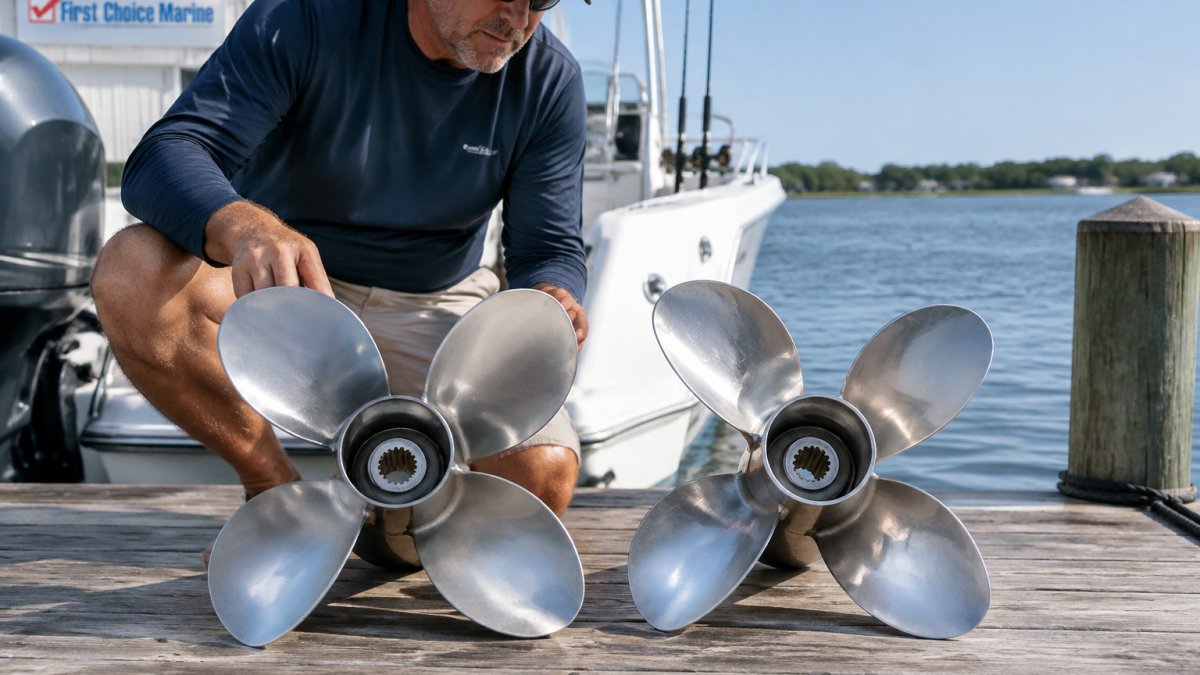
High pitch wins when the boat is light and the water is calm. It delivers higher top speed, but under heavy load it can keep the engine from reaching WOT, which means it runs below its efficient range.
For most heavy-load owners, a useful approach is to choose the lowest pitch that still lets your engine hit its recommended RPM range at full throttle.
Watch out: if you tow or carry gear regularly and keep a high-pitch prop, you may not notice the lugging until you check RPM at WOT. Once you’ve confirmed the prop keeps the engine in its proper RPM range under load, check that any replacement parts you fit are compliant marine hardware.
Boat Engine Recommended RPM Range and What It Means for Pitch
Every outboard has a recommended WOT RPM range set by its manufacturer. That range is the target, and pitch is how you hit it. If your engine runs below the range at full throttle, the prop is too high in pitch for your load. If it runs above the range, the prop is too low, and you may be overspinning the engine.
To check, run the boat at full throttle with your typical load, read the tachometer, and compare the number to your engine's published range. A reading consistently under range points to a pitch reduction. A reading over range suggests going up in pitch.
Before you change props, confirm your engine is mounted and aligned correctly, since a misaligned shaft can mimic pitch problems. Follow these steps to check propeller shaft alignment at home. Once the RPM check is done, you can estimate how much efficiency you are losing to slip, which is the gap between the prop's theoretical travel and its actual travel through the water. Learn how to calculate boat propeller slip step by step.
The 7 Best Propeller Pitches for Heavy Loads
The Solas Amita HT line is built for heavy load and sail drive use, with a four-blade aluminum design and a rubber hub. Compare which Solas prop suits your boat before you choose a model. The models below cover the 9-20HP Tohatsu, Nissan and Mercury range and differ mainly in pitch. All are sold through First Choice Marine. Use the table as a starting point, then confirm your engine's WOT range before you order.
Solas Prop Amita HT Toh/Niss/Merc Al 9-20HP 7 High Thrust #5113-100-07 →
| Model | Pitch | Diameter | Blades | Material | Best use |
|---|---|---|---|---|---|
| Solas Amita HT 5113-100-05 | 5 in | 10 in | 4 | Aluminum | Heaviest loads, towing, altitude |
| Solas Amita HT 5113-100-07 | 7 in | 10 in | 4 | Aluminum | Moderate loads, balance of grip and speed |
| Solas Amita HT 5113-100-09 | 9 in | 10 in | 4 | Aluminum | Light-to-moderate loads, better top speed |
| Solas Amita HT 5113-100-11 | 11 in | 10 in | 4 | Aluminum | Light boats, calm water, speed priority |
| Solas Amita HT 5113-100-13 | 13 in | 10 in | 4 | Aluminum | Light boats only; will lug under load |
| Solas Amita 3-blade (heavy-load pitch) | Varies | 10 in | 3 | Aluminum | Budget general use, light loads |
| Stainless 4-blade (heavy-load pitch) | Varies | 10 in | 4 | Stainless | Frequent towing, sustained torque |
Solas Amita HT 5113-100-05 (5-pitch)
This is the lowest-pitch option in the line and the strongest choice for owners who need maximum bite under load. The four-blade design offers forward and reverse thrust, and the aluminum is finished with multiple layers of paint for corrosion resistance. A lower pitch generally trades some top speed for pulling power. It is the right pick for towing, a boat loaded with gear, or running at altitude where engine output drops.
Best for: 9-20HP Tohatsu, Nissan or Mercury owners who tow or regularly carry heavy loads. Skip if: your boat runs light and you care most about top speed.
Solas Amita HT 5113-100-07 (7-pitch)
This is the higher-pitch model in the same line and suits owners who want a balance between heavy-load grip and better speed when the load is moderate. It uses the same four-blade aluminum construction and corrosion protection as the 5-pitch, so the choice comes down to pitch and your typical load.
Best for: 9-20HP owners with moderate loads who want more top speed than the 5-pitch offers. Skip if: you regularly carry heavy loads, since the higher pitch may keep your engine below its WOT range.
Higher-pitch models in the same line (9, 11, 13)
Higher-pitch props are generally suited to light boats where top speed matters more than load capacity. If you tow, a lower pitch is the safer choice.
Three-blade vs. four-blade under load
A three-blade aluminum prop in the correct pitch is the budget option and works fine for occasional light loads. A four-blade gives more blade area, better hole shot, and stronger grip when the boat is heavy, which is why the Amita HT line runs four blades. If you tow every weekend, the four-blade is worth the small top-speed penalty.
Stainless vs. aluminum for sustained heavy torque
Aluminum flexes under load; stainless holds its shape and delivers more consistent thrust when the engine is working hard. The trade-off is cost, weight, and impact transfer to the gearcase. For frequent towing, stainless is the more durable long-term choice; for occasional heavy loads on a small engine, a correctly pitched aluminum four-blade is usually enough. Material does not fix an over-pitched prop, pitch first, material second.
Heavy-load cavitation and ventilation
Two problems can show up under load. Ventilation is air being drawn into the blades, usually from a prop that is too high on the transom, a damaged blade edge, or a hull feature that traps air. It feels like a sudden RPM spike with no forward speed.
Watch out: if you buy a higher-pitch prop to chase top speed and then tow with it, you may not notice the lugging until you read the tach at WOT with the load aboard, test loaded, not empty.
Prop Pitch Calculator: Adjusting for Altitude and Load
Altitude reduces engine performance, so the pitch you need changes as you move inland or to higher elevations. As a general guide, engine performance drops at higher altitude, so pitch may need adjusting:
- At higher elevations, engine performance drops, so a lower pitch often helps restore RPM when you are loaded or towing.
To use the calculator, start with your current pitch, identify your elevation band, and apply the reduction that matches your load. For example, a boat running at 5,000 feet with a towed trailer would look at the 1-inch to 2-inch range and likely choose the larger reduction.
Use these numbers as a starting point, then verify with an RPM check at WOT under your real load.
Choosing Your Heavy-Load Prop: Next Steps for Your Boat
Start by confirming your engine model and its recommended WOT RPM range. Next, weigh your typical load, your elevation and how much top speed you can give up. Those three answers point you toward a lower or higher pitch.
Once you have a target pitch, use the product pages to check the exact model and fit. When you are ready, sign in to your account to place your order.
Frequently Asked Questions
What propeller pitch is best for carrying heavy loads?
For heavy loads, a lower pitch generally works better because it lets the engine reach its wide open throttle RPM range. A lower pitch is a common starting point when carrying significant weight or towing. Solas Amita HT props, which are designed for heavy load and sail drive applications, are available in 5-pitch and 7-pitch options, so match the pitch to your engine and load rather than guessing.
Is a lower-pitch propeller better for heavy loads?
Yes, in most cases. A lower-pitch propeller takes a smaller bite of water per revolution, which lets the engine turn faster under load and avoids lugging. A reduction in pitch generally increases WOT RPM. The trade-off is top speed, so a lower pitch will feel slower unloaded. If you regularly carry heavy gear, a lower pitch like the Solas 5-pitch options may be the better match.
How do I know if my propeller pitch is wrong for my boat?
Watch your engine RPM at wide open throttle. If it falls below the manufacturer's recommended range when the boat is loaded, the pitch is likely too high. Other signs include sluggish acceleration, a hole shot that feels weak, and the engine struggling or lugging. If RPM runs well above the range, the pitch may be too low. Check your owner's manual for the recommended RPM range before changing the prop.
Should I change prop pitch when I regularly carry heavy loads?
If you regularly carry heavy loads, it is worth checking whether your current pitch keeps your engine within its WOT RPM range when loaded. Many boaters find that a 1-inch reduction solves lugging and restores acceleration. Altitude matters too: at higher elevations, engine performance drops, which can call for an additional pitch reduction. Check your engine's fit before you buy.

