


Last Updated: November 5, 2026
Quick Summary
Propeller cavitation shows up as small, dark pits clustered on the back face of the blade, often near the tip or leading edge, along with a dull or frosted patch. Vibration, buzzing, grinding noise, and lower top speed with higher RPM can signal it too. Check the blades on land and then test the boat across several RPM settings.
- Pitting usually appears as small pits clustered on the back face near the tip or leading edge.
- On stainless steel, run a fingernail across the blade to find small craters.
- Damage on only one blade may point to a bent blade or uneven prop instead of cavitation.
- Cavitation often causes high RPM with low speed, while ventilation shows a sudden RPM surge and grip loss in turns.
- Deep pits, bent blades, or cracks usually call for prop replacement rather than repair.
Table of Contents
- What Propeller Cavitation Looks Like on the Blade
- Vibration, Noise and Speed Loss as Warning Signs
- Cavitation vs Ventilation: How to Tell Them Apart
- What Causes Cavitation on a Boat Propeller
- Step-by-Step Check to Diagnose Cavitation
- How to Prevent Propeller Cavitation and What to Replace
- Choosing Your Replacement Prop Before the Next Trip
- Frequently Asked Questions
What Propeller Cavitation Looks Like on the Blade
Cavitation shows up on the blade long before most boat owners notice a change in performance.
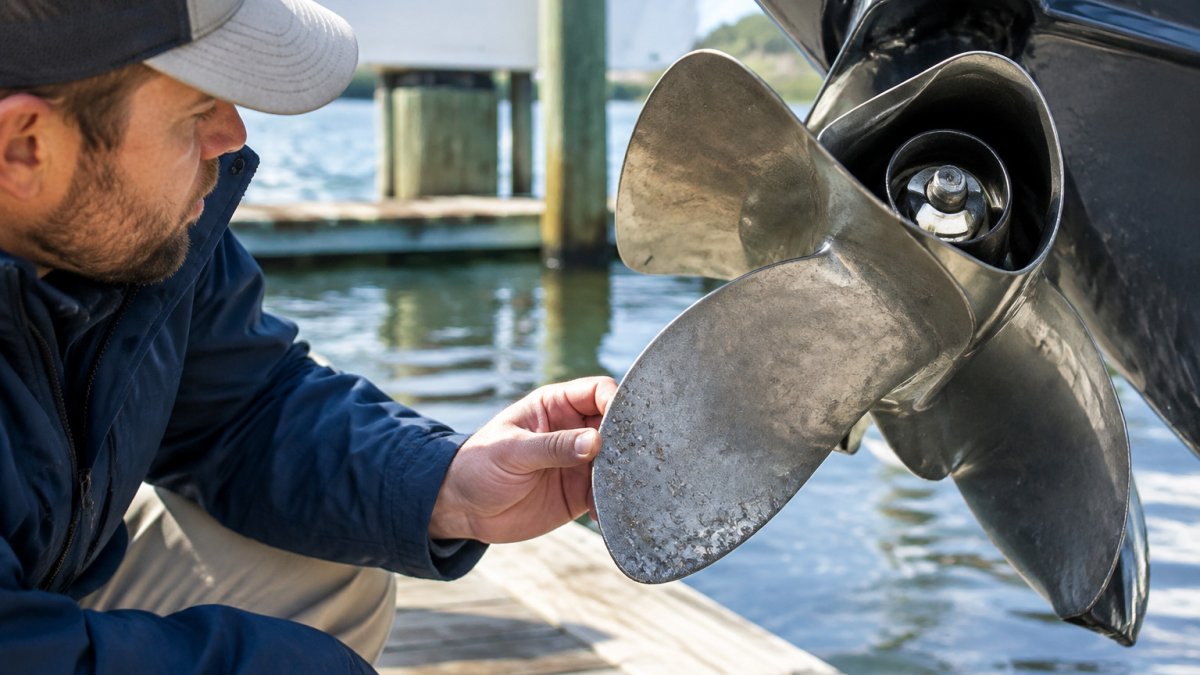
The damage is caused by tiny vapor bubbles that form on the low-pressure side of the blade and collapse violently as they move into higher pressure water. Each collapse hits the metal like a small hammer blow. Over time, those hits wear the surface away.
Pitting and Erosion Patterns
Pitting usually looks like clusters of small, dark pits on the back face of the blade, near the tip or along the leading edge. Erosion often starts as a dull, frosted area that spreads outward. On aluminum props, the surface can look chewed up in a patchy way. On stainless steel, the pits may be harder to see, so run a fingernail across the area to check for small craters.
Watch for these signs during a quick visual check:
- Small pits clustered in one area of the blade
- A dull or frosted patch on the back face
- Rough or ragged leading edges
- Damage that is worse on one blade than the others
If you see damage on only one blade, the issue may be a bent blade or an uneven prop rather than cavitation alone.
Vibration, Noise and Speed Loss as Warning Signs
Pitting on the blade is only half the story. Cavitation also changes how the boat feels and sounds.
A common mistake is ignoring a faint vibration because it only shows up at one RPM range. Many owners assume the problem is in the hull or the engine mounts. Often, the prop is the real cause.
Look for these signs on the water:
- A buzzing or rattling feel through the deck or steering wheel
- A loud, grinding, or hissing noise from the stern
- Lower top speed than usual, even with the same load
- Engine RPM climbing faster than the boat speed increases
- Slow or sluggish hole shot when you get on plane
Any one of these can have other causes, so test them across a range of speeds. If the symptoms follow the engine RPM, the propeller deserves a close look.
Cavitation vs Ventilation: How to Tell Them Apart
Cavitation and ventilation both cause a loss of thrust, and both can make an engine rev too high. The difference is where the air and vapor come from.
Cavitation forms vapor bubbles from water pressure drops on the blade. Ventilation happens when air is pulled down from the surface, usually through the gearcase or along the hull, and reaches the blade. Ventilation often shows up as a sudden surge in RPM followed by a loss of grip, and it tends to be worse in turns or rough water.
Watch out: Assuming every thrust loss is cavitation can lead you to replace a prop that only needs a better engine trim or a correct gearcase depth. Check trim and cavitation plate height before ordering new parts. Once trim and cavitation plate height are correct, matching engine load to the boat’s setup can also improve boat fuel efficiency.
Quick ways to separate the two:
-
Ventilation usually reduces grip sharply in turns or waves
-
Cavitation tends to show steady noise and pitting on the blade
Solas Prop 4-Blade Aluminum 14.75 x 15 A S Rubex 4 #9514-148-15 →
-
Cavitation damage stays on the prop even after the symptom changes
What Causes Cavitation on a Boat Propeller
Cavitation starts when water pressure drops below the vapor point at a spot on the blade. Speed and load are the main triggers. The faster the blade spins, and the harder it bites, the more likely this is to happen.
Several common factors push props toward cavitation:
- Running the prop with too little blade area for the load
- Prop pitch that is too high for the engine and hull
- Damage to the leading edge that disrupts smooth water flow
- Running with the drive trimmed too far out or too far in
- Operating in shallow water with the gearcase near the surface
Cavitation is often a sign that the prop is not matched to the boat, so the fix may involve a different pitch or blade count rather than just a repair.
Step-by-Step Check to Diagnose Cavitation
Work through these steps in order. Most owners can complete the check in under an hour.
- Inspect the blades on land. Look at the back face and leading edges under bright light. Note any pits, dull patches, or chips.
- Feel the surface. Run a fingernail across each blade. Compare them to each other for uneven wear.
- Check for bends or dings. Rest the prop on a flat surface and look for wobble or gaps.
- Run the boat at idle, then slowly increase RPM. Note when vibration or noise starts.
- Compare speed and RPM. Record the speed at several RPM settings. A prop with cavitation often shows high RPM and low speed.
- Test in a turn. A sudden loss of grip points toward ventilation rather than cavitation.
- Adjust trim and retest. If the symptoms change with trim, ventilation may be involved.
Keep notes on each step. A written record helps if you later need to compare results or talk with a marine technician.
How to Prevent Propeller Cavitation and What to Replace
Prevention comes down to matching the prop to the boat and keeping the blades in good shape. Many owners find that a small change in pitch or a regular inspection schedule prevents most problems.
Practical steps to reduce cavitation:
- Keep the blade edges smooth and free of nicks
- Check the prop after hitting debris or grounding
- Set the drive trim to the correct position for your load
- Avoid running the engine at high RPM with the boat unloaded in shallow water
Repair or replace? Light pitting and small edge nicks can often be smoothed and treated. Deep pits, bent blades, cracks, or large missing sections usually call for replacement. Replacement also makes sense when the prop is no longer matched to the engine, since a better-matched prop can prevent future damage.
Choosing Your Replacement Prop Before the Next Trip
If your prop needs replacing, pick the new one before your next outing so you are not stuck at the dock. Match the blade count, diameter, and pitch to your engine's recommended range, and confirm the hub type fits your drive.
Options available from First Choice Marine include the Solas Prop 4-Blade Aluminum 14.75 x 15 A S Rubex 4 #9514-148-15 ($140.46, qualifies for free shipping), the Solas 3-Blade SS Propeller E Series Rubex S3 #9561-151-22 ($529.84, qualifies for free shipping), and the Solas Rubex Hydro 14-1/2 X 15 RH #9581-145-15 ($484.41, qualifies for free shipping; requires a Solas RBX hub kit sold separately).

Before you order, check your engine manufacturer's prop specifications and confirm the rotation direction you need. If you are unsure,
Before you order, compare the three replacement props named in this section by blade count, diameter and what each is noted for.
| Prop | Key spec | Note |
|---|---|---|
| Solas Prop 4-Blade Aluminum 14.75 x 15 A S Rubex 4 #9514-148-15 | 4-blade aluminum, 14.75 x 15 | Qualifies for free shipping |
| Solas 3-Blade SS Propeller E Series Rubex S3 #9561-151-22 | 3-blade stainless steel | Qualifies for free shipping |
| Solas Rubex Hydro 14-1/2 X 15 RH #9581-145-15 | 14-1/2 x 15 hydro | Requires Solas RBX hub kit, sold separately |
Frequently Asked Questions
What does cavitation damage look like on a boat propeller?
Cavitation damage usually appears as small pits, craters or a rough, sandblasted texture on the back (suction side) of the blades, often near the tip and leading edge. The pitting tends to grow over time and can eventually remove metal, leaving uneven edges. Because the damage is concentrated on one side, a careful visual check with the prop removed and the blade cleaned is the most reliable way to see it. If you find pitting, note its location and size so you can track whether it is getting worse between haul-outs.
How can you tell the difference between cavitation and ventilation?
Cavitation and ventilation both cause slip, noise and vibration, but they leave different evidence. Cavitation comes from low pressure causing vapor bubbles to collapse on the blade, leaving pitting. Ventilation happens when air is drawn down from the surface, often when the prop is too close to the water surface or during hard turns, and it usually leaves no lasting damage on the blade. If the surface is clean but the engine revs jump, suspect ventilation. If the blade shows pitting, suspect cavitation.
Can a damaged propeller cause cavitation?
Yes. A bent blade, a chipped leading edge or a damaged pitch can disturb water flow across the blade and create low-pressure zones where cavitation starts. Even a small nick can trigger it at higher RPM. Straightening or replacing a damaged prop, and making sure the blades are balanced and evenly pitched, often reduces cavitation. The Solas Prop 4-Blade Aluminum 14.75 x 15 A S Rubex 4 #9514-148-15 is one option available when replacing a prop.
How do you prevent cavitation on a boat propeller?
Prevention starts with matching the prop to your engine and hull, keeping the blades free of nicks, and avoiding sudden throttle changes that load the blades unevenly. Checking that the prop is the correct pitch for your typical load and running at a steady, reasonable RPM reduces the chance of cavitation. Keep the prop clean and inspect it after running in shallow or debris-heavy water. If cavitation persists after these checks, a 3-blade stainless steel option such as the Solas Rubex S3 #9561-151-22 is available from First Choice Marine.

