


Quick Summary
Marine navigation lights show other vessels your heading, size and status, and are generally required between sunset and sunrise and in restricted visibility. Red sits on the port side, green on starboard, and white lights mark the stern and top of the vessel. Required lights depend on vessel length, propulsion and whether the boat is under way or at anchor.
- Measure length overall first, since vessel length drives the lighting requirements.
- Sailboats motoring must show the lights of a power-driven vessel of the same length.
- Match each light's rated visibility range to the requirement for your vessel length.
- Mount sidelights at the bow and the stern light on the centerline, clear of obstructions.
- Verify light arcs from the water at night, since structures can block them.
Table of Contents
- What Marine Navigation Lights Do and When They Are Required
- Boat Navigation Lights Rules by Vessel Size and Type
- Types of Marine Navigation Lights and Their Visibility Ranges
- LED Boat Navigation Lights Compared With Incandescent Options
- Boat Navigation Light Placement for Compliance and Visibility
- Wiring, Power Draw and Troubleshooting Boat Navigation Light Problems
- Choosing Your Next Navigation Light Upgrade
- Frequently Asked Questions
Marine Navigation Lights: Types, Rules and Placement
Last Updated: November 19, 2026
What Marine Navigation Lights Do and When They Are Required
Marine navigation lights tell other vessels which way you are heading, how big you are and whether you are under way or at anchor. Under U.S. Coast Guard rules, they are generally required between sunset and sunrise and whenever visibility is restricted.
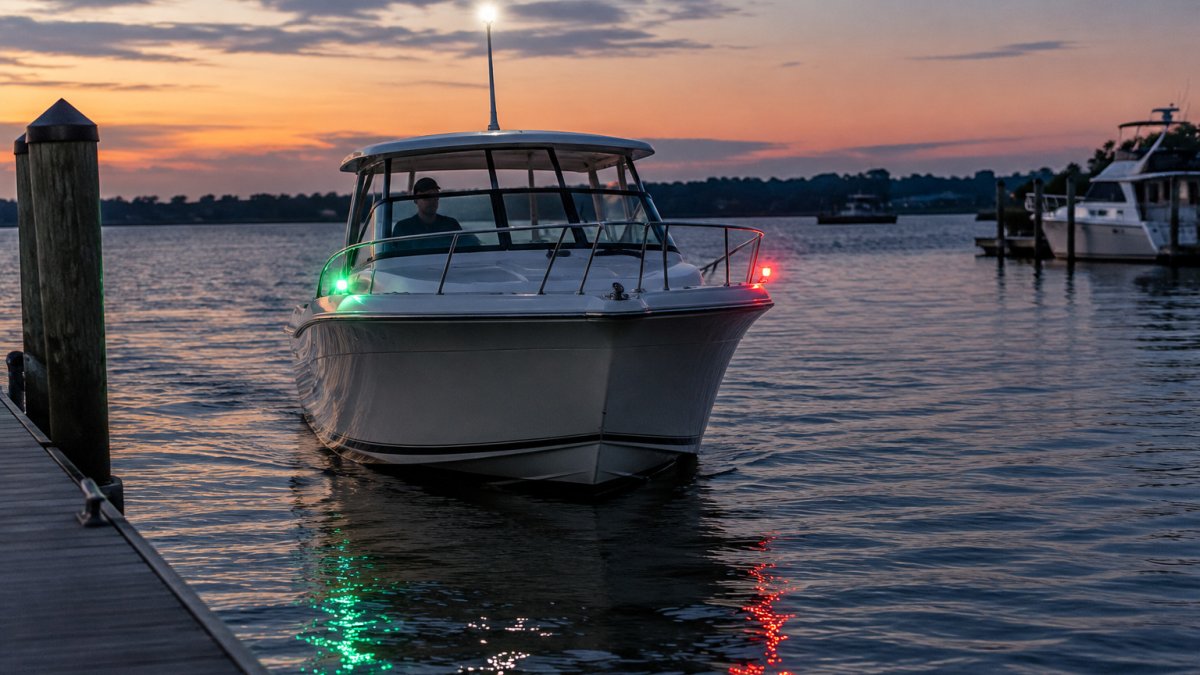
The principle is simple. Red sits on the port (left) side, green on the starboard (right) side, and white lights mark the stern and the top of the vessel.
Most boats fall under the same core requirements, but the exact lights depend on vessel length, whether the boat is powered or sailing, and whether it is moving or anchored. The sections below walk through those variables one at a time.
Boat Navigation Lights Rules by Vessel Size and Type
The rules are easier to apply when you treat them as a decision path rather than a list.
Step 2: Identify propulsion. Power-driven, sailing, and manually propelled vessels carry different requirements.
Step 3: Determine operating status. Under way, at anchor, and aground each call for a different combination.
Step 4: Match the rated visibility range. The required range scales with length.
A practical decision guide looks like this:
| Vessel profile | Under way | At anchor |
|---|---|---|
| Powerboat under 39.4 ft | Sidelights, stern light, masthead light if the hull is wide enough to need one | All-round white light |
| Powerboat 39.4 to 65.6 ft | Sidelights, stern light, masthead light | All-round white light |
| Powerboat over 65.6 ft | Sidelights, stern light, forward masthead light, second masthead light higher and aft | All-round white light, plus deck illumination in some cases |
| Sailboat under sail, under 65.6 ft | Sidelights and stern light, or a tricolor masthead light | All-round white light |
| Sailboat under power | Lights of a power-driven vessel of the same length | All-round white light |
| Manually propelled or rowed | Handheld white light or lantern shown in time to prevent collision | All-round white light where practical |
Two more variables change the answer. Vessels operating in inland waters follow the Inland Navigation Rules, which differ from the international rules in a few details, so confirm which set applies to your waterway. And vessels of unusual construction, such as submarines or air-cushion vehicles, carry their own provisions that a general guide cannot cover.
Before ordering, write down your length, propulsion, and typical operating status, then match that profile to the table. That one step prevents most wrong-category purchases.
Types of Marine Navigation Lights and Their Visibility Ranges
Each light type has a defined visibility range, measured in nautical miles, and a defined arc of coverage. Match the rated range printed on each light to the requirement for your vessel, not to what looks bright on the shelf.
Bow, Port and Starboard Lights
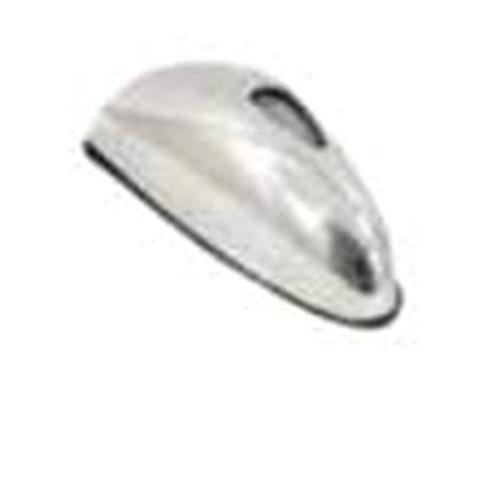
Sidelights are the red and green lights mounted at the bow. The port light is red and covers the arc from dead ahead to the port side, and the starboard light is green and covers the same arc to starboard. Together they tell other skippers which side you are on.
Vertical-mount sidelight pairs are a practical choice for smaller bow spaces. The T-H Marine LED Sidelights Vertical Mount Pair (#LED-LPNAV-2-DP, $91.64) provides both colors in one kit with a 316 stainless steel construction and a vertical-mount design that keeps the footprint small.
Stern, Masthead and All-Round Anchor Lights
The stern light is a white light that shows toward the rear of the vessel. Masthead lights sit higher on the centerline and show forward. An all-round light shows white over a full 360 degrees and is the standard anchor light for most vessels that are not under way.
For all-round coverage, the Attwood Fold-Down All-Round 20-inch Vertical Mount (#5551-PA20-7, $73.62) is a 20-inch all-round light with a folding base. For larger vessels, the Attwood Fold-Down Anchor/Mast Light Stainless 12-inch (#7812-S-7, $133.59) provides 360-degree illumination. Its folding stainless base makes it practical for boats that need to lower the mast or stow the light for trailering.
| Light Type | Color | Coverage Arc | Typical Rated Range | Common Use |
|---|---|---|---|---|
| Sidelights | Red (port), Green (starboard) | 112.5 degrees each | 2 nautical miles | Under way, forward |
| Stern light | White | 135 degrees, rear | 2 nautical miles | Under way, rear |
| Masthead light | White | 225 degrees, forward | 2 to 3 nautical miles | Powered vessels, larger boats |
| All-round light | White | 360 degrees | 2 to 3 nautical miles | Anchored, or as a combined light |
LED Boat Navigation Lights Compared With Incandescent Options
LED navigation lights are widely used today, and the differences from incandescent models show up in power draw, service life and maintenance.
LED advantages
- Draw a fraction of the current of incandescent bulbs, which matters on batteries that run through a night at anchor
- Rated for 50,000 hours or more in some models, which reduces the need for replacement
- Shock-resistant and cool to the touch, with no bulbs to replace after vibration
LED drawbacks
- Higher upfront cost per fixture than basic incandescent replacements
- Sealed LED assemblies usually mean replacing the whole unit when the electronics fail, instead of swapping a bulb
- Some older fixtures were not designed for LED retrofits, so check compatibility before buying
Incandescent advantages
- Lower purchase price, useful for budget repairs on older boats
- Simple to replace with a bulb from any marine store
Incandescent drawbacks
- Higher current draw, which adds up quickly on a boat with a limited battery bank
- Bulbs fail with vibration and need regular checks
- Shorter service life, so the cost of frequent replacement often erases the initial savings
Many owners consider an LED upgrade worthwhile because of lower battery drain. Incandescent remains a reasonable choice for an occasional-use boat on a tight budget, provided the fixtures are still in good condition and rated for the vessel.
Boat Navigation Light Placement for Compliance and Visibility
Placement is where a compliant fixture becomes a non-compliant installation.
Masthead light. Mount it on the fore-and-aft centerline, forward of amidships, at a height that clears the cabin top and any radar dome.
All-round light. Mount it on the centerline at the highest practical point, clear of antennas, radar, and fishing towers.
Verify the arcs from the water. The only meaningful test is from the perspective of an approaching vessel.
Confirm that a folding all-round light clears the highest obstruction in its raised position before you drill.
Recheck after any change. Adding a radar, a tower, a spotlight, or a new antenna can block a light that was previously clear.
Wiring, Power Draw and Troubleshooting Boat Navigation Light Problems
Navigation lights should run on a dedicated circuit with a fuse or breaker sized for the total load. Confirm the fuse rating against the light manufacturer's specification, and use marine-grade tinned wire with proper heat-shrink connectors. Corroded connections cause more navigation light failures than defective fixtures.
When a light fails, work through the circuit in order. Check the fuse first, then the switch, then the connections at the fixture, then the wiring between them.
Battery draw is the other planning factor. An LED light running all night uses far less energy than incandescent, but a boat with several lights on at anchor still needs a battery bank sized for the overnight load.
Choosing Your Next Navigation Light Upgrade
Start with your vessel length and propulsion, then confirm which lights the rules require for your setup. Choose LED fixtures with a rated range that meets or exceeds the requirement, and check the mounting space before you order.
If you are upgrading an older boat, replace sidelights and stern lights first, since those are the most commonly failed or non-compliant fixtures. Then address the anchor light, and finish with any wiring repairs the old circuit revealed.
Browse the full range of navigation lights at First Choice Marine, and check the sidelight pairs, all-round lights and masthead options against the rules for your boat. For a broader look at what an electrical overhaul costs, read our guide to marine electrical system upgrade costs.
Frequently Asked Questions
What are the best navigation lights for boats?
The best option depends on vessel size and how you use the boat. For small boats, a pair of vertical-mount LED sidelights, such as the T-H Marine LED Sidelights Vertical Mount Pair at $91.64, covers port and starboard visibility in a compact package. Larger boats need masthead and stern lights as well. LED fixtures are a common choice for their lower current draw. Check that any light you buy is USCG-compliant for your vessel length before installing it.
What are the rules for navigation lights on boats?
Under United States Coast Guard rules, boats operating between sunset and sunrise should display the lights required for their size and type. Confirm the current rules for your vessel. Power-driven vessels generally show a red port sidelight, a green starboard sidelight and a white stern light, with a masthead light on larger craft. Anchored vessels typically display an all-round white anchor light. Visibility requirements vary by vessel length, so confirm the rules that apply to your boat before you head out.
What nav lights do I need for a boat?
Most boats need red and green sidelights, a white stern light and an all-round anchor or masthead light, depending on length and whether the boat is underway or at anchor. Small open boats may be able to use a combined light, while larger vessels need separate fixtures. The Attwood LightArmor Bi-Color Pole Light 14 inch Straight, priced at $57.42, is a bi-color option. Review the rules for your vessel size before buying.
Where should navigation lights be placed on a boat?
Sidelights belong near the bow, positioned so the red light shows on the port side and the green on the starboard side. Masthead and all-round lights sit high and centered so they are visible from all directions, with the stern light mounted at the rear. Keep fixtures clear of obstructions such as rod holders, electronics mounts and canopy frames, since blocked arcs can make the boat hard to identify at night. Proper placement matters as much as the light itself.
What do red and green boat navigation lights mean?
Red and green sidelights show other mariners which way a power-driven vessel is heading. The red light is on the port (left) side and the green light is on the starboard (right) side when facing forward. If you see a red light, the vessel is moving toward your port side, and if you see green, it is moving toward your starboard side. Seeing both lights means the other boat is heading toward you, so you should take early action to avoid a collision.
When are boat navigation lights required?
Navigation lights are generally required from sunset to sunrise and whenever visibility is restricted by fog, rain or other conditions. Boats underway and boats at anchor have different light requirements, so the required lights depend on what the vessel is doing. Check the current United States Coast Guard navigation rules for your vessel type to confirm exactly when your lights must be on.
How do you check whether boat navigation lights are working?
Turn on each light at the helm and confirm that the red, green and white fixtures illuminate with the correct color and arc. Check each circuit with a multimeter for voltage at the fixture, and inspect connectors for corrosion, loose terminals and chafed wire. Test lights before dusk so any problems can be fixed while you are still in the harbor. Replacing a failed LED fixture is usually simpler than tracing a fault through an older incandescent circuit.
Are LED boat navigation lights worth the higher price?
LED navigation lights typically cost more up front than incandescent lights. Some fixtures in our catalog are rated for 50,000 hours or more. Compare the purchase price with your own battery and replacement needs to decide whether an LED upgrade fits your boat.

