


Boat repairs can go wrong fast when the wrong product gets used. A loose hatch, a leaking fitting, a cracked fiberglass panel, or deck trim that is starting to lift can all look like simple fixes, and they often are. Still, the best marine adhesive for one repair might be completely wrong for another. Some products create a bond that is nearly permanent, while others are made to stay flexible. That difference often matters once parts begin moving with waves, vibration, heat, and everyday use. Some adhesives work better above the waterline, while others are made for constant water exposure, like fittings low on the hull or areas around wet deck hardware.
That is why choosing a marine adhesive should not be guesswork. The product needs to fit the material, the location, and the kind of stress the repair will likely face. This guide covers the main adhesive types, how to choose for different repairs, which mistakes to avoid, and how to get a longer-lasting result, which usually comes down to good matching and prep. It also looks at cure time, UV exposure, and serviceability, along with simple prep steps like cleaning the surface, drying the area, and checking fit before applying anything. Those steps often matter just as much as the adhesive itself, and skipping them can easily ruin an otherwise solid repair. For a deeper overview of product categories, see this Marine Adhesive Guide for Boat Owners.
Why marine adhesive choice matters more than many boat owners think
Marine repairs are not like household repairs. Boats have to deal with salt, sun, vibration, flex, impact, and constant moisture, which is a rough mix for any material. That helps explain why the marine adhesive market reached USD 494.57 million in 2024, according to IMARC Group. Fortune Business Insights puts the market at USD 574.26 million in 2025, showing steady growth and, in many cases, rising demand for more specialized products. The category keeps growing because boat owners and repair pros need different solutions for different kinds of jobs.
| Marine adhesive metric | Value | Year |
|---|---|---|
| Global market size | USD 494.57 million | 2024 |
| Global market size | USD 574.26 million | 2025 |
| Projected market size | USD 600.53 million | 2026 |
| Deck systems application share | 38.7% | 2024 |
| Two-component systems share | 62.6% | 2025 |
Those figures point to something pretty practical: there is no single best marine adhesive for every repair. Technical guidance from brands like WEST SYSTEM, 3M, and Sika backs that up. Structural repairs usually need stronger systems, and those are often epoxy-based. By contrast, sealing a joint or bedding hardware often works better with a more flexible product, and that is usually where people get tripped up. Removable parts also should not be bonded with a highly permanent adhesive unless there is real certainty they will never need service later.
For boat owners, this shows up in everyday situations. The wrong adhesive might trap water in seams or fittings, crack as the boat moves, or damage a surface when removed. It can also turn a later repair into a much bigger, more expensive job. That is the real issue here: choosing the right product often makes future maintenance simpler, safer, and less frustrating.
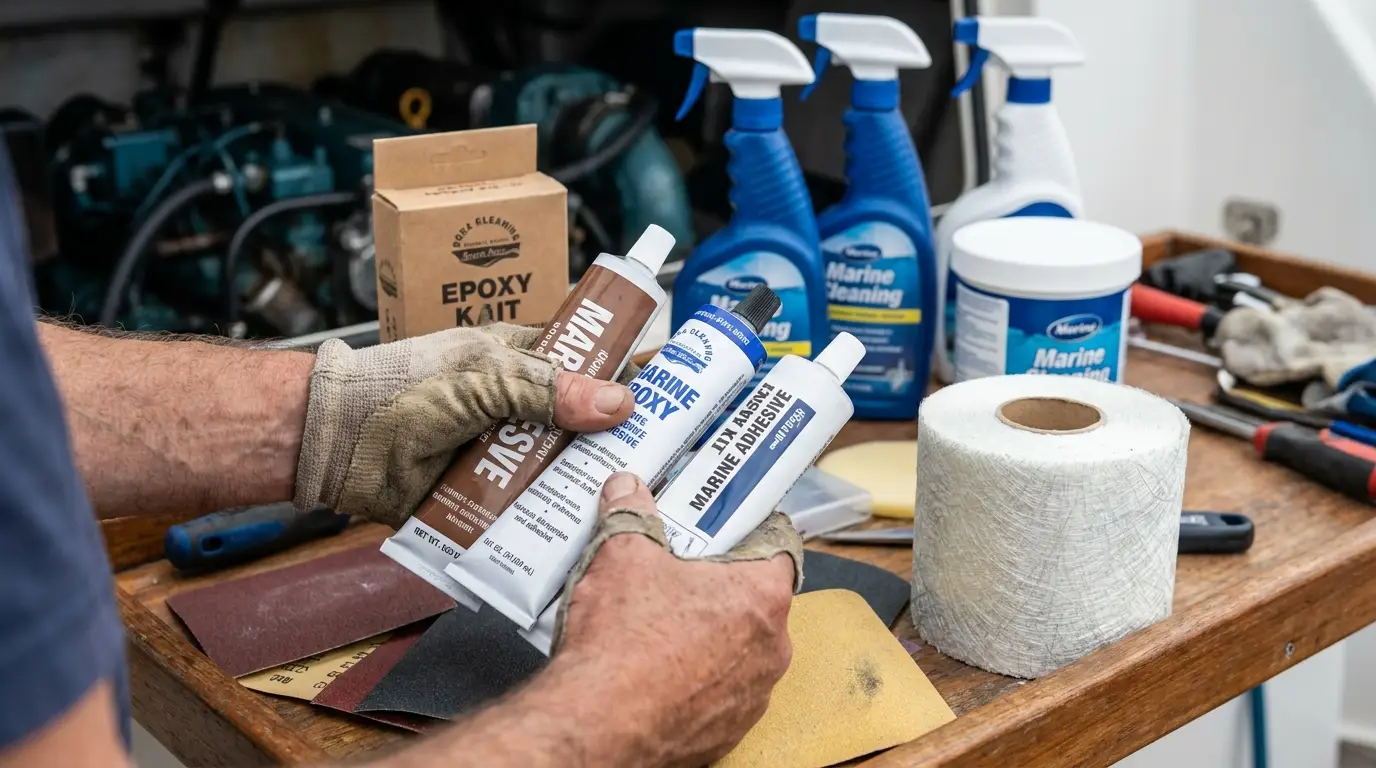
Match the adhesive to the repair, not just the label
Usually, the easiest way to pick a marine adhesive is to start with the job itself, since that keeps things simple. Just ask one thing first: are you bonding, sealing, bedding, rebuilding, or dealing with some other repair you probably already know?
Structural repairs
When you need to bring strength back to cracked fiberglass, rebuild damaged wood, fill and reinforce a weak spot, or even work on some metals, epoxy is often the better choice. It’s strong stuff, honestly, and usually a good fit for structural repairs. If the surface is prepared the right way, it gives you high strength, solid gap filling, and strong adhesion on common boat materials like fiberglass and wood, and sometimes metal. It’s often used for fiberglass, wood, and some metals. We covered where it works best in Marine Epoxy for Boat Repairs: When to Use It, Where It Fails, and How to Get Long-Lasting Results.
Flexible bonding and sealing
For deck fittings, rub rails, hull-deck joints, and hardware that moves a little, polyurethane adhesive sealants are often used. They bond and seal while staying flexible, which usually works well in these spots. That matters on boats because they often flex underway, especially in waves.
Bedding hardware
Cleats, rails, lights, and through-bolted parts usually need sealing more than very strong bonding in most cases. A serviceable bedding compound or a gentler sealant often makes removal later much easier, which is usually a nice advantage.
Fast repairs
Emergency fixes often use easy-mix kits or fast-cure products. They help when time is short, especially for a quick patch. In many cases, though, they usually aren’t the strongest long-term fix, but they can buy you some time until a proper repair can be done.
The main thing is to avoid choosing by brand reputation alone. It’s better to decide based on the type of repair, the material involved, and whether the part may need to come apart later, which sometimes happens.
The five factors that should guide every buying decision
Once the repair type is clear, you can usually narrow the options using five practical factors. Pretty simple, really. And that often makes choosing easier.
1. Above or below the waterline
A product used below the waterline needs to handle constant moisture, and that’s usually the main thing to check. Some adhesives and sealants work really well topside, but they are not made for permanent underwater use. That first check is probably the main step.
2. Material compatibility
Fiberglass, aluminum, painted metal, wood, plastic, and gelcoat do not all behave the same way, and that is usually normal. Some adhesives bond really well to one surface but not as well to another. Epoxy is often strong on many repair materials, while some sealants are more selective.
3. Flexibility versus rigidity
A rigid repair can work very well when rebuilding a broken panel, since that part is usually quite straightforward. But for a joint that moves, it’s probably not the best choice. Flexible products are often a better fit where vibration and hull movement are normal, especially on boats.
4. Cure time
Slow-cure products often give you more working time, which really helps, and they can build better strength. Fast-cure products are useful when time is tight. But if alignment or prep gets rushed, which often happens, the repair can still fail.
5. Permanent or removable bond
This is often one of the most overlooked things. Some marine adhesive products create bonds that are very hard to remove, which can work well for a permanent installation. But that same strength can become a real headache if the fitting needs service next season, and that happens pretty often.
If a part may need maintenance, it’s usually safer not to make it a permanent bond unless the manufacturer clearly recommends it. In most situations, that tends to be the safer choice.
Common repair mistakes that lead to leaks, weak bonds, or hard future repairs
A lot of marine adhesive failures are not really product failures at all. Most of the time, they come from prep or planning mistakes instead. That is actually reassuring, because these are the kinds of problems you can often avoid before the tube is even open.
Poor surface prep is one of the biggest reasons a bond fails. Dirt, wax, salt film, oxidation, and leftover sealant can all stop even a good product from sticking the way it should. One helpful approach is to clean the area well, remove anything loose, and do some light sanding if the surface needs more grip. Skip that step, and the bond will usually be weaker right from the start.
Using too much adhesive is another common mistake. More is not usually better here. A thick, messy layer can slow curing, push squeeze-out around the joint, and make cleanup a bigger job than expected. In most cases, following the product directions gives a better result, even if the steps seem a little fussy.
What about cure time? A joint can look dry on the surface and still be weak underneath. Put stress on it too soon, and the repair may fail. That happens pretty often, especially when someone is trying to finish the job quickly.
Another mistake is using a strong permanent adhesive where a removable bedding compound would have been the better option. This comes up often around deck hardware and access parts, and it can make future repairs much harder than necessary.
The environment matters too. Heat, humidity, cold, and direct sun can all affect cure speed, and topside joints often need better UV resistance.
There is a reason products are becoming more specialized. Technavio reports the marine sealants market is expected to increase by USD 101.8 million from 2025 to 2030, with a 6.5% CAGR. More products are now made for specific jobs, and boat owners should use that to their advantage instead of treating every tube the same, which is often where these mistakes start.
Smart marine adhesive choices for different boat areas
Different parts of a boat need very different things from an adhesive. According to IMARC Group, deck systems account for around 38.7% of marine adhesive use, which gives a good sense of how important topside repairs are, especially on exposed decks.
Deck hardware usually needs a mix of watertight sealing, reliable bond strength, and enough flexibility so the part can still be serviced later if needed. Hull or transom repair has a different set of needs, with structure and water resistance coming first. Cabin trim and interior panels often need something else. In those spots, extreme underwater durability may matter less than easy application and a clean finish that does not leave the interior looking untidy.
For aluminum or mixed-material repairs, compatibility needs careful attention before starting. Some boat owners assume a strong product will stick to anything, but that usually is not how it works in real conditions. The best marine adhesive is often the one made for that exact material combination, whether that means aluminum to fiberglass or trim to a composite surface.
UV exposure is another factor people often miss. A product hidden under a hatch does not face the same stress as one around a windshield, along a top cap, or on an exposed deck seam. If the repair sits in full sun, UV resistance should be on the checklist right away, before the tube is even opened.
For bigger maintenance jobs, adhesives are usually just one part of a broader system. Moisture control, corrosion prevention, and proper hardware installation all matter too. In most cases, that is what helps a repair last longer and avoid problems later. This is where resources like Advanced Techniques for Marine Corrosion Prevention: Protecting Your Investment can help connect the dots.
How to shop with confidence and plan a repair that lasts
Before buying, it helps to describe the repair in plain language. For example: “rebonding a loose hatch frame above the waterline on fiberglass, needs some flexibility, may need removal later.” A note like that will often lead to a better choice than simply going with a favorite brand, which people probably do pretty often. It’s a simple step, but it keeps the focus on the actual job instead of the label.
Having the basics ready before opening the tube or kit usually helps the whole repair go more smoothly: gloves, cleaner, scraper, sandpaper, masking tape, clamps if needed, and enough dry time set aside. Adhesives do not respond well to rushed work. In many cases, when everything is not close at hand, the job turns into a scramble halfway through, and the repair often suffers because of it.
It also helps to buy from a marine-focused source that carries repair products along with related maintenance supplies. That makes it easier to order cleaners, surface prep items, fiberglass materials, and sealing products together. First Choice Marine is one example of an online marine parts and maintenance source where boat owners can compare products for different repair jobs without jumping between unrelated stores, which probably saves time. Boat owners who also want advice on cleaners and prep materials can review this Comprehensive Guide to Marine Cleaning Products before starting a repair.
If there’s uncertainty, one useful approach is to start by ruling products out. Remove anything not rated for the location, material, or service needs, then look at cure time and bond type. That quick filter can cut a confusing shelf of options down to a short list of realistic choices.
Frequently Asked Questions
What is the best marine adhesive for fiberglass repair?
It depends on the repair. For structural fiberglass repair, epoxy is often a strong choice because it bonds well and can fill gaps. For sealing or bedding fiberglass hardware, a flexible marine sealant may be better than a rigid adhesive.
Can I use regular household adhesive on my boat?
Usually, no. Household products often are not made for constant moisture, UV exposure, vibration, and salt. A true marine adhesive is designed for the conditions boats face every trip.
Is epoxy better than polyurethane for boat repairs?
Neither is better for every job. Epoxy is often better for structural repair and rebuilding damaged material. Polyurethane is often better when you need a durable bond that can still handle movement and seal out water.
How do I know if an adhesive is too permanent for my repair?
Think about future service. If the part may need removal, such as hardware, trim, or inspection access, a highly permanent adhesive can create problems later. Product labels and technical sheets usually make it clear when a bond is intended to be permanent.
Where can I compare marine adhesive options with other repair supplies?
A marine-specific retailer is often the easiest place to compare adhesives, sealants, cleaners, and repair materials together. First Choice Marine is a practical example because boat owners can look at maintenance products in the same place they shop for parts and onboard gear.
Does marine adhesive choice matter for small jobs like lights, trim, or accessories?
Yes, because small jobs still face water, sun, and vibration. Even a minor repair can leak, loosen, or stain surrounding materials if the wrong product is used. The same selection rules still apply, even when the job looks simple.
Make your next repair easier, stronger, and less stressful
Choosing the right marine adhesive starts with a few helpful questions. What needs fixing? What material are you working with? Will it stay underwater? Does the joint need to flex over time? And could it need to come apart later? Once you know those answers, it gets much easier to narrow down which product fits the job and which ones could cause problems.
There is no single best marine adhesive for every repair. For structural work, epoxy is often a good choice. For bedding jobs or joints that need to move, flexible adhesive sealants usually work better. Small details often make the biggest difference. UV resistance, cure time, and material compatibility can be what separates a clean, durable repair from a frustrating do-over.
A little extra prep usually pays off. Surface prep matters, and reading the label can help you avoid problems before they start. Choosing a product for the real conditions, not just the fastest fix, can save hours of rework and help prevent expensive damage later. If you’re putting together a repair kit or replacing maintenance supplies, an online marine parts store like online marine parts retailer can also help keep basics close by, including adhesive, sealant, and prep supplies before the next problem shows up at the dock.
