


A working oil pressure gauge can help protect a boat engine from very expensive damage. It’s one of those small dash items many owners glance at without really knowing what it’s saying, and that can lead to trouble. When oil pressure drops, bearings, cam parts, and other moving components can lose the protective film they need. Once that happens, serious problems can develop fast.
For boaters, this matters whether the boat is a small fishing rig, a family cruiser, a commercial workboat, or anything in between. The gauge does more than take up space on the dash. Usually mounted on the instrument panel at the helm, it works as an early warning tool. It’s simple, but it matters because it can help catch low pressure, sender problems, wiring faults, and poor gauge matching before a small issue turns into a ruined engine, or at least a repair bill no one wants.
This guide explains what an oil pressure gauge does, what normal readings might look like, and why sender compatibility matters. It also examines how brands like Faria, Teleflex, and VDO fit into the picture. It covers common troubleshooting steps, analog and digital options, and practical buying tips for DIY marine maintenance. If the goal is to better understand the instrument panel and make safer choices on the water, this guide will likely be useful.
What an Oil Pressure Gauge Actually Tells You
An oil pressure gauge shows whether pressurized oil is moving through the engine the way it should, especially to the bearings and other internal parts, which is really what it’s there to do. That pressure is what gets oil to the places that need it. If it drops too low, metal parts can wear fast or even fail. That’s obviously bad news.
One key point is that oil pressure is not the same thing as oil level. An engine can still have oil in it and still lose pressure for dangerous reasons. That can happen because of a worn pump, hot thin oil, a clogged pickup, internal wear, or a bad sender, along with a few other possible causes. So checking oil level by itself will not always show the real problem.
Marine engine manuals make it pretty clear why this gauge matters so much. Indmar gives 8 psi at idle as a minimum reference and 29 to 60 psi at 2,000 RPM for one current engine family. Scania also gives a minimum of 0.7 bar, or about 10.2 psi, at 800 rpm, plus 3 to 6 bar, or 43.5 to 87 psi, at operating speed.
| Operating point | Pressure | Source |
|---|---|---|
| Idle minimum | 8 psi | Indmar 2025 |
| 2,000 RPM | 29-60 psi | Indmar 2025 |
| 800 rpm minimum | 10.2 psi | Scania |
| Operating speed | 43.5-87 psi | Scania |
| Rated speed | 50-87 psi | Caterpillar 3208 |
Those figures are not universal, and the engine manual for that specific engine is always the one to follow. Still, they usually show something important here: low pressure above idle should not be ignored, even if the engine seems fine at first.
If the temperature rises past 210° F (99° C) or your oil pressure drops below 10 psi (69 kPa), severe engine damage may result.
That is why many boaters see the oil pressure gauge as one of the most important instruments on the dash.
How the Gauge, Sender, and Wiring Work Together
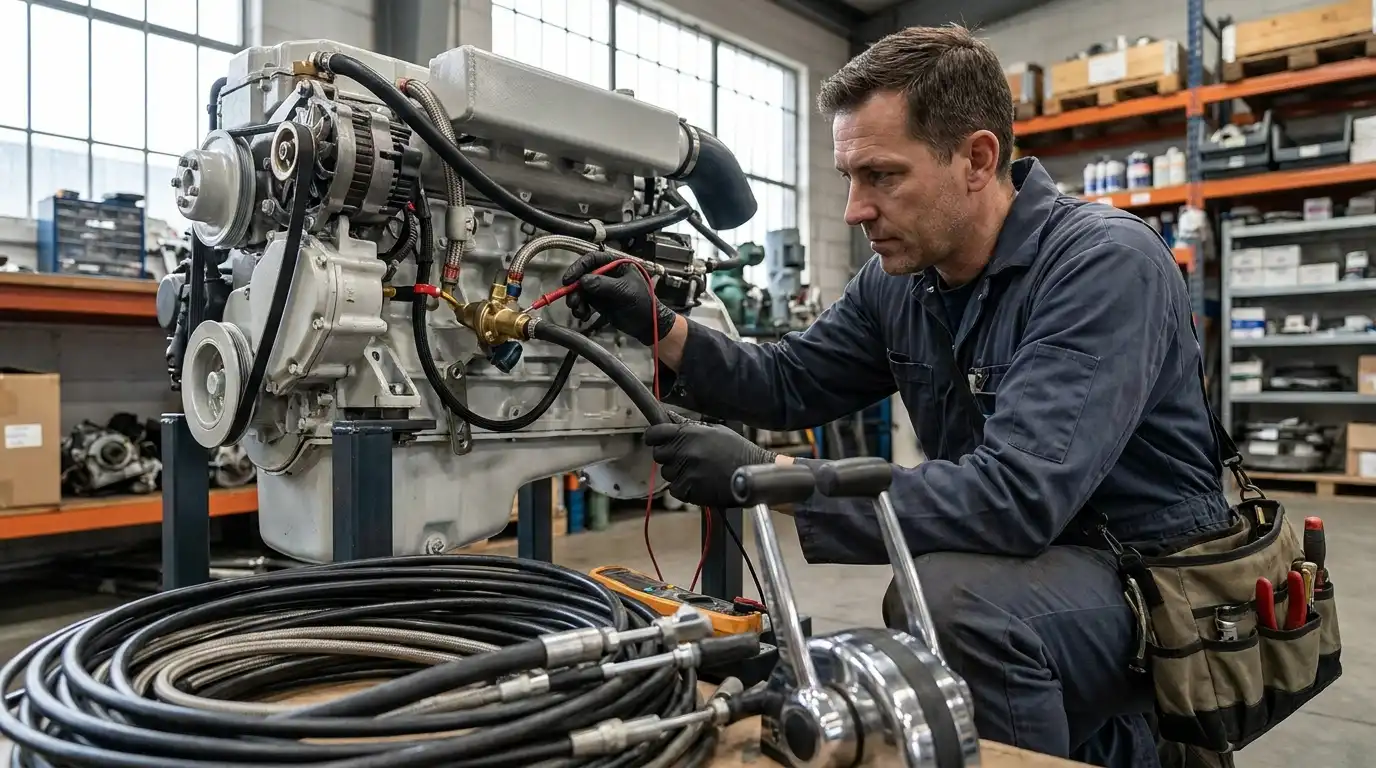
Most traditional marine oil pressure gauge systems use both a sender and a gauge. The sender threads into the engine oil passage, and when pressure changes, it changes electrical resistance. The gauge then reads that change and moves the needle.
Faria explains it in a pretty simple way: the pressure gauge uses low current through the meter, then to ground through a variable-resistance sending unit. That means the sender matters just as much as the gauge face, since the two usually work as a pair. In most cases, if one is off, the reading will probably be off too.
Here’s the basic flow:
1. Oil pressure builds in the engine
When the engine starts, the oil pump pushes oil through the internal passages pretty fast. In most cases, pressure starts to build up.
2. The sender reacts to that pressure
The sender turns that pressure into a resistance signal, pretty much directly. It seems quite simple.
3. The gauge displays the reading
The dash gauge turns that signal into a needle position, pretty simply. In most cases, though, it appears as a digital value.
4. The alarm system may also react
Some boats also use a pressure switch for a warning light or buzzer, and that part can be surprisingly easy to miss.
This is where many DIY repairs start to go wrong. A boat owner might replace a bad gauge with one from another brand and leave the old sender in place. In other cases, they install a generic sender that does not match the gauge calibration. The result can be false low readings, false high readings, or sometimes a needle that barely moves at all.
Cross-brand mismatch is a real issue with Faria, Teleflex, and VDO setups. Even when the threads fit, the calibration may still be off. So physical fit is only one part of the job, not the whole story, and that is usually the first thing people check.
For more on the lubricant behind the readings shown here, our guide on Understanding Marine Oil: Types and Best Practices covers it in detail.
Faria, Teleflex, and VDO: What Boat Owners Should Know
If someone is shopping for a marine oil pressure gauge, they’ll probably keep seeing Faria, Teleflex, VDO, and a few other brands. They’re well-known names in boating for a good reason. Still, they usually don’t work as plug-and-play options with each other, so that’s one thing to check first.
Faria
Faria is still a well-known name in marine instrumentation. Its current marine lineup includes oil pressure gauges in 80 PSI and 100 PSI, plus metric versions, which is useful. That usually makes it easier to match the gauge scale to the engine type. Faria also offers newer digital products tied to J1939, NMEA 2000, and SmartCraft, often for engine data as monitoring moves past simple analog dials.
Teleflex
Teleflex gauges are already on plenty of boats, especially older recreational setups. As they get older, owners often replace them one by one, which is usually pretty normal. The tricky part is compatibility. Older Teleflex systems may use sender curves that do not match newer replacement gauges from other brands.
VDO
VDO is known for marine and automotive-style gauges. Many boat owners like the clean look and the wide availability, which helps, but matching a VDO sender still needs a careful check.
A practical example shows why. A boater sees a worn Teleflex oil pressure gauge and replaces it with a VDO unit because the size fits the dash. The engine is fine, but the reading is wrong because the old sender is still there. That usually wastes time and can cause a lot of unnecessary stress, especially when it looks like something is wrong.
So what helps most when changing brands? Check the gauge range, sender type, resistance curve, and pressure scale before buying. In most cases, that is what keeps the reading accurate. Shops like First Choice Marine are useful because boat owners can compare marine parts in one place instead of relying on a generic listing.
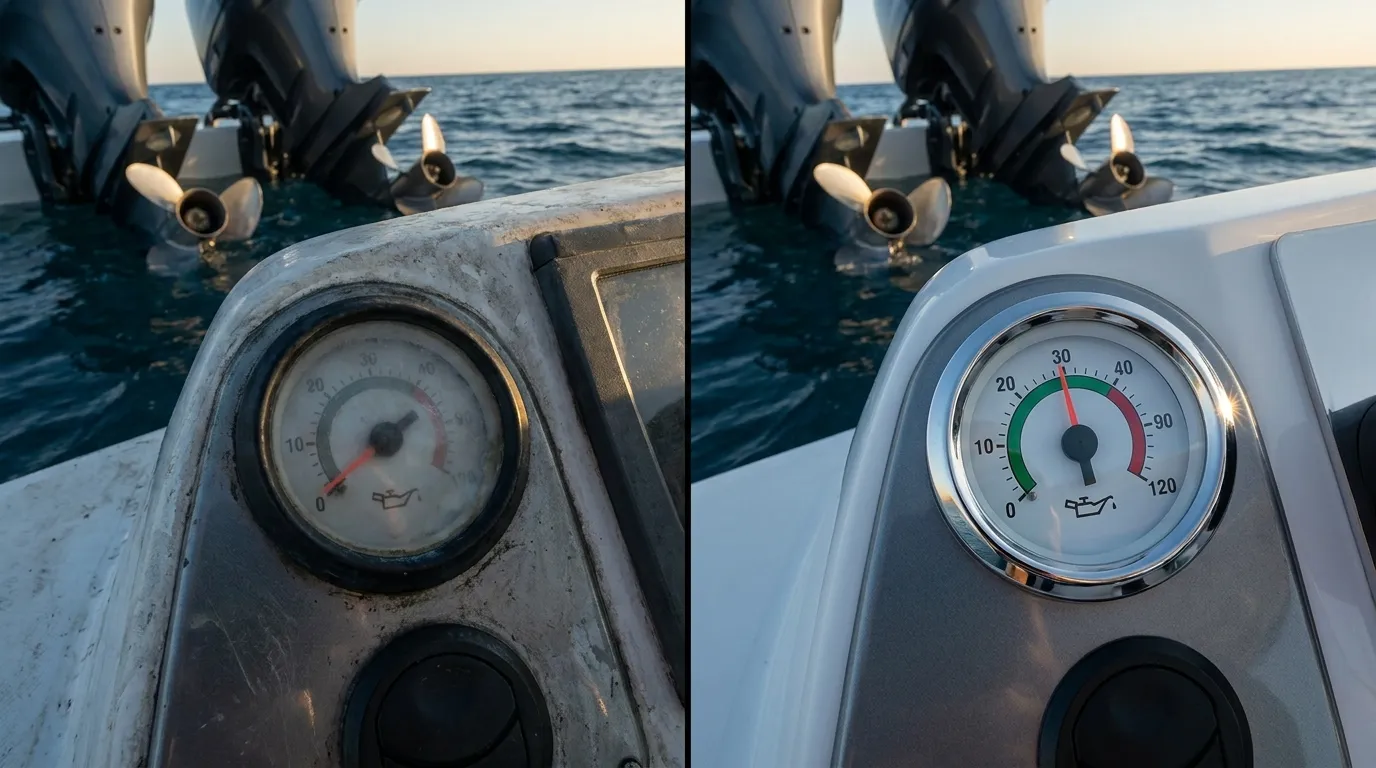
Reading the Oil Pressure Gauge Correctly on the Water
A lot of owners ask, “What is a normal oil pressure reading?” The honest answer is pretty simple: it depends on the engine, RPM, oil temperature, and oil viscosity, which can vary some. It usually isn’t just one fixed number.
A cold engine will often show higher pressure. Once the engine is fully warm, pressure at idle can read much lower and still be within spec, which is usually normal.
What often matters most is how the reading changes as you run it.
Healthy signs
- Pressure rises soon after startup.
- The reading stays steady once it’s warm.
- Pressure goes up as RPM increases.
- Gauge behavior is usually repeatable, which is a good sign on one trip after another.
Warning signs
- No pressure rise right after startup
- The needle suddenly drops while the engine is running
- Hot idle pressure gets much lower than normal
- The gauge may swing wildly or stick at full scale
Marine Power documentation says pressure should come up quickly after startup, and if it does not rise above the minimum spec within 5 seconds, the engine should be shut down. For everyday use, that is a practical rule and usually easy to remember.
Oil pressure below 0.7 bar at speeds above 800 rpm will cause engine damage. The engine must be stopped immediately.
The guidance is simple. If the reading is truly low above idle, shut the engine down and check it out. Don’t leave it running just to “see if it clears up,” because that usually does not happen.
If a service interval is also coming up, we covered Choosing the Right Oil for Your Boat Engine here. That often helps connect gauge behavior with oil choice and maintenance timing, so what you are seeing makes more sense.
Common Oil Pressure Gauge Problems and How to Check Them
A bad reading doesn’t always mean the engine is failing, and that’s usually a relief. In most cases, oil pressure gauge problems actually start in the instrument system itself, not the engine.
Common causes of false readings
- Bad sender
- Corroded terminal
- Weak ground connection
- Damaged gauge wire
- Wrong sender for the gauge
- Gauge failure
Simple troubleshooting order
Start with the oil level and its condition before touching any wiring; seriously, that’s usually the best first move.
After that, inspect the sender and the wire connections. You’ll often find loose push-on terminals, corrosion, cracked insulation, or some other small issue that seems minor but can create a much bigger-looking problem.
It also helps to compare the gauge behavior with engine temperature and RPM. If the reading still doesn’t make sense, a useful next step is testing it with a mechanical gauge. That’s often one of the clearest ways to tell whether the problem is real lubrication trouble or just an electrical fault.
A common mistake is replacing parts blindly. Another is assuming a sender from Faria will read correctly on a Teleflex or VDO gauge just because the threads match; that does not always happen.
For anyone building a smarter maintenance routine, First Choice Marine can be a good place to start for marine parts and engine care planning, especially when comparing related items instead of chasing the same problem in circles.
Analog Oil Pressure Gauges vs Digital Monitoring Systems
Analog oil pressure gauges are still popular because they’re simple, easy to read at a glance, and usually cheaper to replace, which helps. That’s a big reason Faria still offers plenty of analog options in its current lineup, and that often works well for many boats.
At the same time, digital monitoring is growing fast. Modern systems can show oil pressure on multifunction displays with coolant temperature, voltage, alarms, and fault messages in one place. Some newer Faria systems also support network standards like NMEA 2000 and J1939, which often fits newer boats or repower projects well if getting more data is the goal.
So which one is better? Usually, it depends on the age of the boat, the system already installed, and how much information the owner wants to see.
Analog may be best if:
- You want a simple DIY replacement, since it’s usually fairly straightforward
- Your boat already has a classic dash setup
- You need a quick at-a-glance reading, so you can check it quickly
- And you want a lower replacement cost, likely to save money
Digital may be best if:
- You want engine data on one screen, which is often faster to check at a glance
- Your boat uses networked electronics, so integration is usually simpler
- Fault alerts and more detailed system data matter to you, which can be very useful
- You’re replacing several gauges at the same time
For routine maintenance, there’s also a Marine Oil Change Kit Guide: Clean, Easy Engine Servicing that covers oil service tools for better engine care. Good to know if you handle regular upkeep.
Frequently Asked Questions
What is a normal oil pressure gauge reading for a boat engine?
It depends on the engine and operating condition. Some engines may show around 8 to 10 psi at idle and 30 psi or more at higher RPM, while others run higher. Always compare your reading to the engine maker’s manual, not a generic number.
Is low oil pressure at idle always a problem?
Not always. A warm engine can show lower pressure at idle than it does when cold. But if pressure is lower than your engine’s minimum spec or drops unusually low above idle, treat it as a real warning.
Can I mix a Faria gauge with a Teleflex or VDO sender?
Sometimes, but you should never assume it will work correctly. Gauge systems depend on sender calibration, so mismatched parts can give false readings. When in doubt, match the sender and gauge brand or confirm compatibility before you install anything.
How do I know if my oil pressure gauge is bad or if the engine really has low pressure?
Start with the basics: oil level, oil condition, and visible wiring problems. If the reading still seems wrong, test the engine with a mechanical gauge. That gives you a more direct pressure reading and helps confirm whether the problem is in the engine or in the dash system.
Where can I compare marine oil pressure gauge options for my boat?
A marine-focused parts source like First Choice Marine can help because it puts engine care parts and related maintenance items in one place. That makes it easier to compare replacement gauges, supporting parts, and other service items without relying on guesswork.
Should I upgrade from an analog oil pressure gauge to a digital display?
If your current setup works and you want simple, analog is still a strong choice. If you are updating electronics, repowering, or want networked engine data, digital may be worth it. First Choice Marine is a practical place to review broader marine maintenance and accessory options when planning that kind of upgrade.
The Bottom Line for Safer Engine Monitoring
An oil pressure gauge is one of the most important warning tools on a boat. It tells you if the engine’s lubrication system is working as it should. That may sound simple, but the risk is real. Low pressure can lead to serious damage in minutes, not months, and that is often what catches people by surprise.
A simple routine is usually the best way to deal with it. Learn what normal looks like for that engine. You should also notice how fast pressure rises after startup, then compare hot idle readings with cruise readings over time. If something changes suddenly, do not ignore it. Check the oil level, inspect the sender and wiring, and confirm the reading with a mechanical gauge if needed. In most cases, that basic process helps find trouble early, before it becomes an expensive repair.
When shopping for parts, compatibility needs close attention. Faria and Teleflex are common in marine dashboards, and VDO is as well, but the sender must match the gauge. It seems like a small detail, yet it often prevents false readings and unnecessary repair work, especially when someone is in a hurry.
For a boat to stay dependable, the oil pressure gauge should be treated as a regular part of engine care. That means checking it often, noticing unusual readings, and following up when the numbers change. It helps catch problems early and gives you more confidence each time the boat heads out.
