


The right screw or bolt can help a boat repair last for years. The wrong one might stain the deck, loosen from vibration, or slowly damage nearby metal until a fitting fails. That’s why choosing marine fasteners is not some small detail. It’s a basic part of safe boating and smart maintenance, and it’s often easier to miss than it should be.
Many boat owners focus most on the part they can actually see, such as a cleat, hinge, bracket, light, electronics mount, or rail fitting. But the fastener, along with the surrounding boat repair materials, matters just as much. Everything has to keep parts secure through pounding waves, salt spray, engine vibration, heat, and constant wet-dry cycles. On a boat, even a simple replacement screw usually needs more thought than most people expect.
In this guide, readers will learn how to choose the right marine fasteners based on material, location on the boat, load, and water type. It covers stainless grades, galvanic corrosion, aluminum boat concerns, and isolation methods, along with a few common mistakes. It also explains how washers, bedding compounds, and backing materials work together with the fastener as one system. That part is especially helpful. The result is a clearer way to make better repair choices that stay tight and resist corrosion over time, especially in saltwater and other harsh conditions.
Why marine fasteners matter more than many boat owners think
Marine fasteners have to deal with one of the harshest environments around. Saltwater, humidity, UV exposure, movement, and trapped moisture can wear them down fast, often much faster than boat owners expect. A bolt that works perfectly fine on a trailer or backyard patio may not last long once it is used on a boat. That helps explain why this market keeps growing. Mordor Intelligence estimates the global marine fasteners market will reach USD 1.44 billion in 2025 and climb to USD 1.78 billion by 2030, with a 5.36% CAGR. The same research says stainless steel made up 46.27% of the market in 2024.
| Metric | Value | Year/Period |
|---|---|---|
| Global marine fasteners market | USD 1.44 billion | 2025 |
| Projected market size | USD 1.78 billion | 2030 |
| Forecast growth rate | 5.36% | 2025-2030 |
| Stainless steel market share | 46.27% | 2024 |
Those figures matter because they show how important durable fastening systems are for both recreational and commercial boating. Stainless steel is widely used for a good reason, but that does not mean every stainless fastener is right for every boat. That detail is easy to miss. According to technical guidance from the Nickel Institute, some grades, including 303, 303Se, 416, and similar options, can corrode quickly in marine service and should be avoided.
So the word ‘stainless’ by itself usually does not tell you enough. The base material still matters, the environment matters, and so does the specific job the fastener needs to do. In most cases, the better approach is to match the fastener to where it will be installed and how much salt or moisture it is likely to face. And for anyone planning a larger repair, the basics are covered in Boat Repair Basics: What Every Owner Should Know.
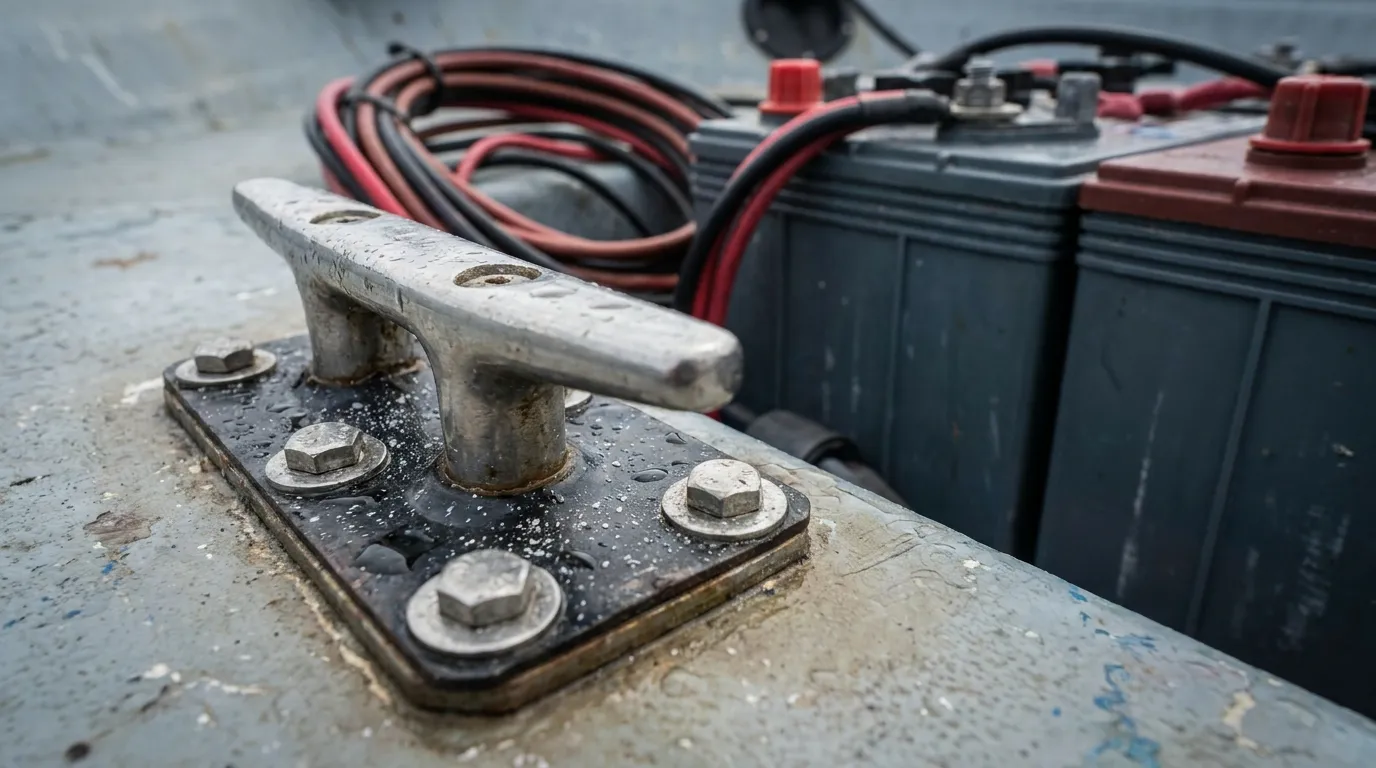
Start with the material under marine fasteners
The first question is pretty simple: what are you actually fastening into? Fiberglass, aluminum, stainless, wood, and composite surfaces all behave a little differently, which is just normal on boats. The best marine fasteners for a fiberglass console panel probably will not be the right choice for an aluminum T-top base or a wooden hatch frame, so you cannot always treat them the same way.
When possible, matching materials is usually the safer move. Stainless hardware often works best with stainless mounting surfaces too, like a stainless bracket or plate. Boats do mix metals all the time, though, and that is often where problems begin because it is easy to miss at first. Install stainless fasteners directly into aluminum without isolation, and you can create a galvanic cell.
The fastener should be cathodic to (more noble than) the base plate material. It should never be the anode (less noble) material.
For DIY jobs, use these steps:
1. Identify the base material
Is it fiberglass, aluminum, teak, stainless, painted steel, or something else? Really, try not to guess if you can avoid it.
2. Check the environment
Freshwater is usually easier on hardware than saltwater, which helps. That’s good news. A covered pontoon boat also often gets less stress than an offshore center console, especially on the ocean.
3. Think about the load on marine fasteners
A cup holder screw is not the same as an engine bracket bolt. Load and vibration matter a lot, and shock does too, especially on the engine.
4. Add the right support materials
Backing plates, fender washers, locknuts, and bedding compounds are all part of the fastening system, not just extras.
For wood-core repairs around decks and transoms, the fastener choice should usually match the repair method too. That matters a lot in this kind of job. If moisture damage is involved, which often happens, see Marine Wood Rot Repair: Restore Transoms and Decks Easily.
Understanding stainless grades and when 316 marine fasteners are worth it
A lot of boat owners hear that 316 stainless fixes everything. It’s a very solid choice, especially in saltwater, but the main thing is usually comparing grades instead of just grabbing the cheapest box labeled “marine,” which happens all the time. In most cases, 316 stainless offers better corrosion resistance than 304, especially in spots where salt spray tends to collect around screw heads, threads, and washers.
Recent corrosion data helps explain why material quality matters here. A 2025 study on a 17-4PH stainless fastener measured a corrosion rate of 0.0021 mm/a, far below the study’s referenced failure threshold of 0.1 mm/a. That does not mean every stainless fastener will act the same way. It does suggest, though, that the right alloy in the right conditions can often hold up very well over time.
| Technical Measure | Value | Context |
|---|---|---|
| Measured corrosion rate | 0.0021 mm/a | 17-4PH stainless fastener study |
| Approximate annual loss | ~2 μm/year | Same study |
| Referenced failure threshold | 0.1 mm/a | Same study |
In real boating use, 316 is often worth the extra cost for rail fittings, deck hardware, seat bases, hinges, latches, electronics mounts, exposed exterior screws, and similar parts, especially anything sitting out in spray and weather. That is usually where the upgrade makes the biggest difference. In lower-risk interior spots, 304 may still be used, although it is not a very good match for constant salt exposure.
A few common mistakes to avoid:
Buying by appearance alone
A shiny finish often doesn’t mean it’s really marine-grade, just saying.
Reusing old locknuts
Nyloc nuts and lock washers often work less well over time, which is normal. They grip less well.
Ignoring thread type
Machine screws and lag screws usually do different jobs. Self-tapping screws often do too. Different uses.
Overtightening marine fasteners
This can crush fiberglass or strip aluminum, which is usually bad news. It can also squeeze out too much bedding material, and that often happens more easily than people expect.
When hardware is bedded into fiberglass, the fasteners often overlap with resin-based repairs. Because of that, many owners will also find Marine Epoxy for Boat Repairs: When to Use It, Where It Fails, and How to Get Long-Lasting Results helpful in most cases.
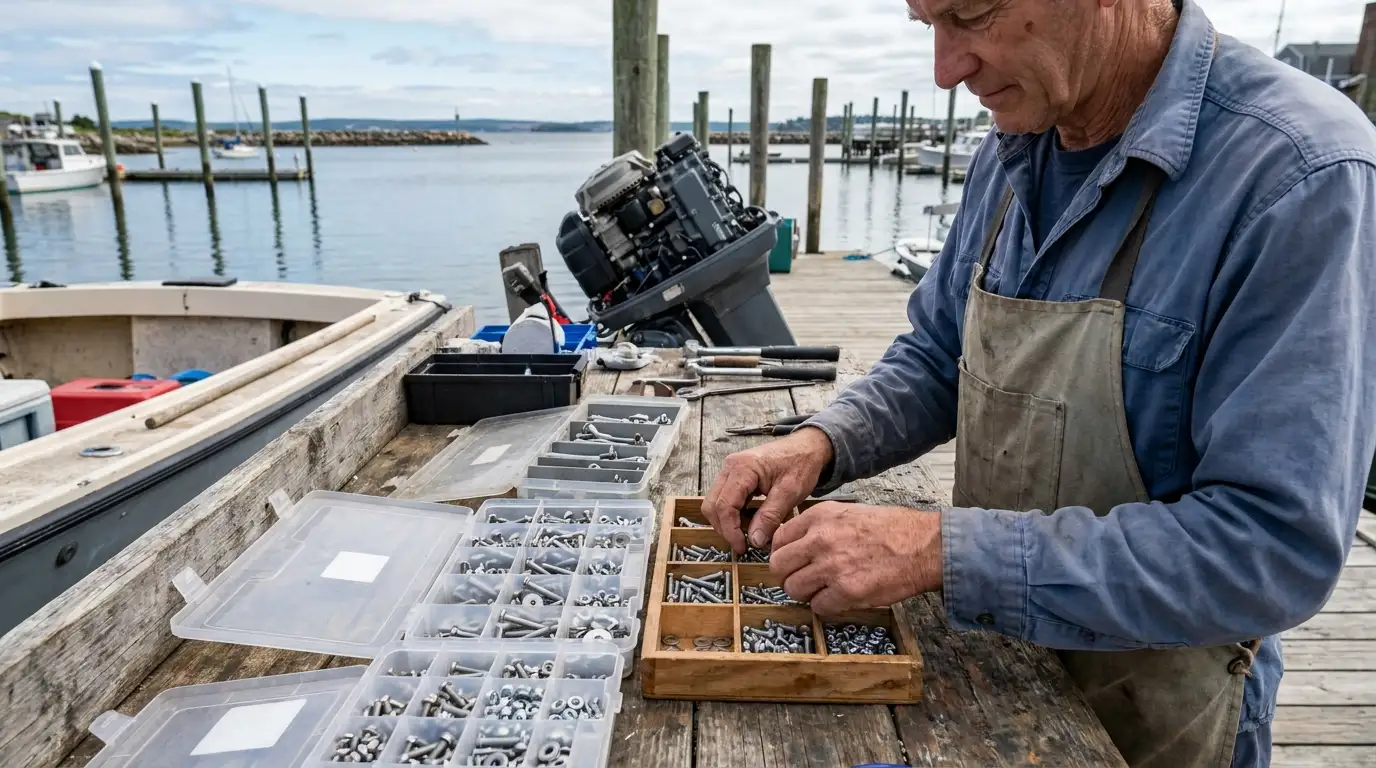
The biggest hidden risk: galvanic corrosion on mixed-metal boats
One of the most important things to know about marine fasteners is that corrosion is often a system problem, not just a fastener problem on its own. You see this all the time on aluminum boats, aluminum T-tops, and on brackets, ladders, and electronics mounts, where stainless hardware is commonly used and can seem harmless at first.
Galvanic corrosion requires three elements: two dissimilar metals, electrical contact between them, and an electrolyte, a conductive liquid that allows ion flow.
Saltwater is an excellent electrolyte, and technical guidance summarizing research puts a typical stainless-to-aluminum separation in seawater at about 0.6 to 0.9 volts. That is usually enough to cause corrosion. Another study found that corrosion rates for coupled 7025 aluminum alloy with 304 stainless steel fasteners increased 4.92× in tap water, 3.16× in NaCl, and 4.26× in H2SO4.
That sounds technical, but the practical takeaway is simple: when different metals touch directly, damage can happen fast, often faster than people expect.
So to lower the risk:
Use isolation materials
Non-conductive washers, bushings, sleeves, and pads often help prevent metal-to-metal contact, which usually helps.
Seal the joint well
Marine sealants or coatings can help reduce water entry, which often helps. They also isolate contact points. Simple protection.
Inspect hidden areas
Corrosion often starts under hardware bases, I think. It can start around wet threads too.
Think beyond the fastener
Sometimes the best fix is not the fastener itself. It can help more than you might expect to switch the washer, use a different backing plate, or rethink the mounting method too.
That matters most on commercial boats and hard-used fishing boats, where vibration and washdown keep hardware under constant stress almost all the time.
Build a fastening system for marine fasteners, not just a hardware list
Marine fasteners usually work best when the parts around them are chosen well too. It helps to look at the whole stack: the fastener, washer, bedding, backing plate, locknut, and the material being clamped, not just the screw itself. That is often what leads to a repair that stays dry and keeps holding over time. In this kind of job, the full setup usually matters more than any single part on its own.
Take a cleat mounted on a thin fiberglass deck. That setup usually calls for a through-bolt, fender washers or a backing plate under the deck, and proper bedding. A self-tapping screw may feel solid at first, and often it does. Later, though, it can loosen, wear out the hole, and give water a path into the core. What starts as a small problem can often turn into a much bigger repair.
That same approach works for electronics, lighting, accessory upgrades, and other add-ons. As boats carry more equipment, clean fastening often becomes more important, and corrosion control does too. Market reporting also points to longer-life coatings, along with smart fasteners that use condition monitoring in higher-end marine and industrial settings. Most DIY owners do not need sensor-equipped hardware, but the trend still shows where the industry is going: fewer failures and more planned maintenance as parts start to show wear.
If you are shopping for parts and maintenance supplies, First Choice Marine is a useful resource for boat owners comparing marine hardware, engine care items, and other onboard essentials.
A simple buying checklist for DIY boat owners
When it’s time to buy, keeping it simple usually makes things easier. Start with the job, not the catalog. Ask what the hardware needs to hold, what it will touch, and how wet it usually stays. It’s pretty simple, really. Then pick marine fasteners with your boat repair materials so everything works together as one package and helps avoid mismatches.
Use this quick checklist:
Pick the right fastener type
Choose a bolt, machine screw, lag screw, or self-tapper based on access and load; that’s usually all you need. It’s a simple choice.
Choose the right material
For many exposed saltwater jobs, 316 stainless usually works well. But near aluminum, be extra careful because it can react.
Match the head and drive style
Use a style you can tighten well, I think. And do it without causing damage, if possible.
Add washers and backing where needed
Spread the load where it helps. And usually, protect the surface too.
Bed hardware correctly
Use a good marine sealant anywhere water might get in; it helps, and leaks are less likely.
Plan for future service
Can it be removed later without damaging the surface or the fitting?
For many owners, a trusted marine parts retailer like this online marine parts store can make the search simpler, since it lets them compare related maintenance products in one place, which often helps rather than treating each repair as a completely separate issue.
Frequently Asked Questions
What are the best marine fasteners for saltwater boats?
In many cases, 316 stainless steel is a strong choice for exposed saltwater use because it resists corrosion better than 304. Still, the best option also depends on what material the fastener touches, how much load it carries, and whether isolation is needed.
Can I use regular stainless screws on my boat?
Sometimes, but it is risky to assume any stainless screw is safe for marine use. Some stainless grades perform poorly in saltwater, so check the alloy and avoid treating ‘stainless’ as a complete answer.
Why do stainless fasteners corrode on aluminum boats?
They often create galvanic corrosion when stainless and aluminum are in electrical contact with saltwater present. Using non-conductive washers, bushings, sealants, and coatings can help slow this process.
Should I use sealant with marine fasteners?
Yes, when the fastener passes through a surface where water can enter, sealant is often a smart part of the system. It helps reduce leaks, limits moisture around the hole, and can also help separate dissimilar materials.
Where can I find marine fasteners and related boat repair materials?
Many boat owners look for a retailer that carries hardware along with maintenance supplies so they can solve the whole repair at once. First Choice Marine is one example, especially if you also need engine care items, accessories, or other boating parts during the same project.
How do I know if I need backing plates or just washers?
If the hardware sees real load, pull, shock, or foot traffic, a backing plate is often better than a washer alone. For light-duty items, large washers may be enough, but fiberglass and thin panels usually benefit from better load spread.
Make your next repair last longer
Choosing marine fasteners is really about finding a setup that works for your boat. The right choice depends on more than strength alone. Corrosion resistance, stainless grade, metal compatibility, vibration, water type, and the materials around the fastener all matter. That’s why experienced boat owners often treat screws, bolts, washers, backing plates, and sealants as one complete system instead of looking at each part on its own.
If only a few points stick, these are the ones that usually matter most: don’t rely on the word “stainless” by itself, be extra careful around aluminum, use isolation where different metals meet, and match the fastener to the load. Small decisions often lead to bigger problems than expected. They can help prevent leaks, rust streaks, loose hardware, and costly damage later, which is often when repairs turn frustrating.
Before starting the next project, inspect the hardware already onboard. You will often notice staining, pitting, looseness, cracked bedding, white corrosion around metal contact points, or other clear signs of wear. Then replace weak links with better-matched marine fasteners and boat repair materials. A little care now usually helps a lot later, saving trouble and often helping avoid larger repair issues.
