


Table of Contents
- Marine Hardware for DIY Boaters: What You Need to Know
- Quick Comparison: Essential Marine Hardware Categories
- 1. Bonding and Sealing Solutions with Marine-Grade Stainless Steel Hardware
- 2. Electrical System Components and Battery Connections
- 3. Mounting Hardware for Navigation and Electronics
- Marine Sealant for Hardware Installation: Choosing the Right Product
- How to Prevent Galvanic Corrosion on Boats: A DIY Guide
- Common Mistakes to Avoid When Installing Marine Hardware
- Frequently Asked Questions
Last Updated: September 21, 2026
Marine Hardware for DIY Boaters: What You Need to Know
According to Dream Yacht Sales' 2026 Recreational Boating Industry Statistics, aftermarket marine accessories accounted for $12.4 billion in spending last year. That's a massive market, and most of it flows to boat owners like you who choose to maintain and upgrade their vessels themselves rather than pay inflated marina labor rates. At First Choice Marine, we've helped thousands of customers find marine hardware for DIY boaters, the right components and mounting solutions to keep their boats running safely and reliably.
The problem isn't finding marine hardware. It's finding the RIGHT hardware without overspending or installing something that corrodes after six months. This guide covers essential upgrades DIY boaters should consider, from bonding solutions to electrical system components, plus common mistakes that cost boat owners time and money.
Quick Comparison: Essential Marine Hardware Categories
| Category | Best Use | Key Consideration | Price Range |
|---|---|---|---|
| Bonding & Sealing | Structural repairs, hardware mounting | Marine-grade formula required | $13-$37 |
| Electrical Components | Battery connections, bilge systems | Corrosion resistance critical | $27-$126 |
| Mounting Hardware | Navigation, electronics installation | Compatibility with your devices | $22-$580 |
| Fasteners & Fittings | Deck hardware, rigging | Stainless steel prevents galvanic corrosion | $15-$75 |
| Safety & Rigging | Structural integrity, emergency systems | Marine-grade standards non-negotiable | $50-$200 |
1. Bonding and Sealing Solutions with Marine-Grade Stainless Steel Hardware
The foundation of any DIY boat repair starts with the right adhesive and sealant. Most boaters reach for whatever epoxy they find at a hardware store, then wonder why their repair fails within a season.
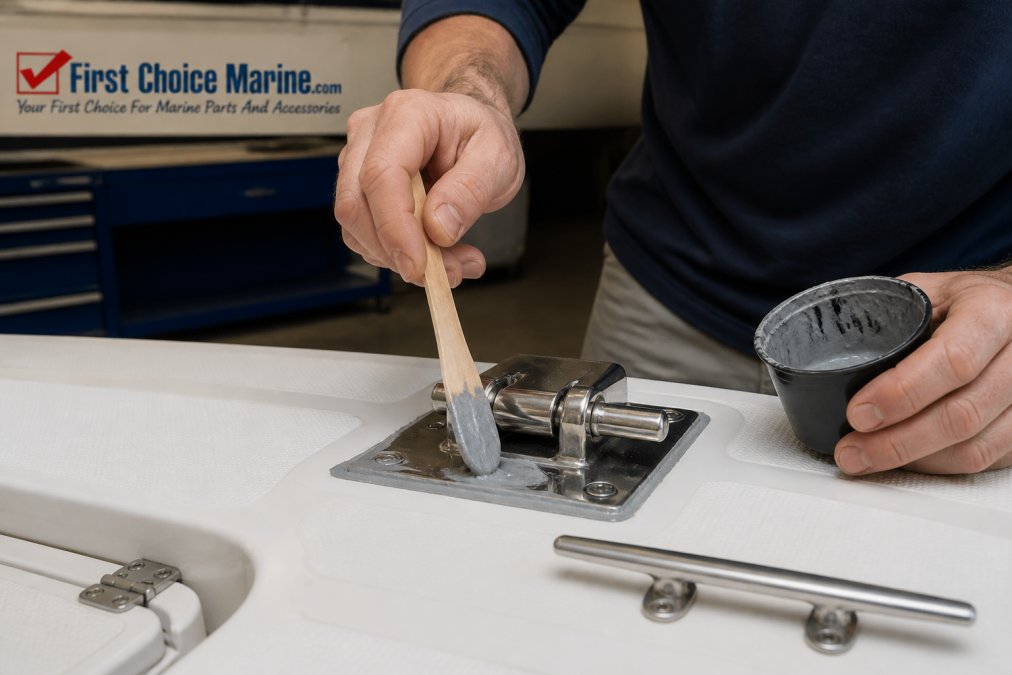
Marine-grade adhesives bond tenaciously to wood, metals, fiberglass, and concrete while creating permanent, waterproof structural bonds that withstand demanding saltwater environments. The WEST SYSTEM 610 epoxy adhesive ($37.05) eliminates the guesswork: it's a self-metering coaxial cartridge that dispenses resin and hardener in the correct ratio automatically. Load it into any standard caulking gun, attach the static mixing wand, and you're ready to apply gap-filling structural epoxy with precision. The formula stays workable for 42 minutes, giving you time for complicated assemblies without rushing, then cures fast enough to move forward efficiently.
For sealing hardware mounts, Star Brite Silicone Sealant ($13.39) is true 100% marine-grade silicone that provides a durable, waterproof seal without cracking, shrinking, or yellowing. It bonds to fiberglass, wood, glass, metal, and some plastics, both above and below the waterline. Dries tack-free in under an hour, fully cured in 24 hours.
2. Electrical System Components and Battery Connections
Your boat's electrical system is where most DIY failures happen. Corroded battery terminals, loose connections, and improper wire gauging cause everything from dead batteries to engine fires.

The T-H Marine Battery Cable Extender ($27.50) solves a common problem: when you need to wire accessories and lights but can't access the battery posts conveniently. This kit includes both positive and negative terminals that accommodate up to 2-gauge wire. It uses stainless steel hardware with a 5/16-18 stud and a protective case that latches and unlatches for reuse. The case can be sealed with water sealant or grease, preventing corrosion before it starts.

For bilge pump automation, the Rule-A-Matic Float Switch ($52.95) has been the standard for decades. The latest design includes a removable base for easy cleaning and servicing, a mercury-free snap switch tested to over one million cycles, and marine-grade blocked wire. It's designed for pumps drawing up to 14 amps and comes with a 2-year warranty.
3. Mounting Hardware for Navigation and Electronics
Navigation and fishfinding electronics represent a significant investment. Mounting them wrong, using the wrong fasteners, incorrect angles, or incompatible brackets, degrades performance and wastes money.
The RAM Surface-Mount for Humminbird Helix 9, 10, 12 ($126.49) uses powder-coated marine-grade aluminum with patented rubber ball and socket technology. This design dampens shock and vibration while allowing nearly infinite adjustability, so you set your device at the perfect viewing angle. The double socket arm includes a round 3.68-inch base and a 2-by-5-inch rectangular plate, giving you flexibility in where you install it. Weight capacity is up to 15 pounds, covering most mid-sized fishfinders and GPS units.
For transducer mounting, the Rig Rite Transducer Board ($22.23) is made from gray Starboard marine-grade polymer sheets that won't warp, corrode, or degrade from sunlight. It measures 3.5 by 12 inches and provides a perfect mounting surface for installing, removing, or adjusting transducers to maximize fish locator performance. Mounts with two provided screws.
For mounting modern connectivity solutions, the NavPod StarPod Mini System ($580.35) is built for boats running Starlink Mini. It's a waterproof housing with an internal swivel tube that allows dish rotation to optimize satellite view. The 10-degree housing angle facilitates rainwater runoff, preventing signal degradation from water accumulation. The StarTower base is 8-millimeter-thick aluminum with a powder-coated white finish. All hardware is 316 stainless steel.
Marine Sealant for Hardware Installation: Choosing the Right Product
Selecting the wrong sealant is one of the costliest mistakes DIY boaters make. Not all sealants are created equal in marine environments, and using a product designed for bathrooms instead of boats leads to leaks, corrosion, and structural damage.
WEST SYSTEM Adhesive Tube with Static →
Marine sealants fall into different categories. Silicone remains flexible, handles temperature swings, and bonds to nearly any surface. Polyurethane is stronger for structural applications but requires more careful application. Polysulfide is often chosen for below-waterline work.
For deck hardware mounting, the most common DIY application, marine-grade silicone is your best choice. It provides waterproof, airtight bonds while remaining flexible enough to handle hull movement without cracking. Star Brite Silicone Sealant ($13.39) fits this need perfectly. It's not affected by sunlight, weathering, most chemicals, or solvents. Use it for mounting cleats, stanchions, rails, and other deck fittings.

For structural repairs and gap-filling where hardware bonds to the hull, epoxy is non-negotiable. The WEST SYSTEM 610 ($37.05) is specifically engineered for this. Its shear-thinning formula becomes thinner as you work it, making it easy to tool into smooth, non-sagging fillets or spread for wetting out fiberglass reinforcement. This property gives you excellent control during application while ensuring the adhesive stays in place after tooling.
How to Prevent Galvanic Corrosion on Boats: A DIY Guide
Galvanic corrosion is the silent killer of boat hardware. Two different metals in contact with saltwater create a tiny electrical current that eats away at the softer metal. Within months, fasteners corrode, fittings weaken, and structural integrity suffers.
Here's how it works: when dissimilar metals touch in a conductive environment (saltwater), electrons flow from the more active metal to the less active one. The active metal (the anode) sacrifices itself to protect the other. Aluminum corrodes to protect steel. Zinc corrodes to protect copper. Left unchecked, this process can weaken your entire hull.
Prevention starts with material selection. Use stainless steel fasteners and hardware wherever possible, 316-grade stainless is often considered the marine standard because it resists saltwater. The T-H Marine Battery Cable Extender uses stainless steel hardware. The Lewmar Quick Release Mounting Bracket features powder-coated aluminum, which adds a protective layer against corrosion.
When you must mix metals, use a barrier. Isolate dissimilar metals with plastic washers, gaskets, or sealant. This breaks the electrical connection and prevents galvanic current from flowing. Apply marine sealant around all fastener penetrations, water is the electrolyte that enables galvanic corrosion. Keep it out, and you stop the process.
For existing hardware showing early corrosion, don't ignore it. Clean corroded areas with a stainless steel brush and apply a corrosion-inhibiting coating. Many boaters use zinc-based primers or marine-grade grease to slow the process. The key is catching it early, corrosion accelerates once it starts, and a small problem becomes a structural failure fast.
Common Mistakes to Avoid When Installing Marine Hardware
Installing marine hardware correctly matters as much as choosing the right product. Here are the five mistakes that cost DIY boaters the most time and money.
Frequently Asked Questions
What grade of stainless steel is best for marine hardware?
316 stainless steel is superior for saltwater environments because it contains molybdenum, which resists chloride corrosion better than 304 stainless steel. For freshwater boats, 304 stainless steel works well and costs less. Always verify hardware is labeled 316 for saltwater vessels to ensure longevity and structural integrity of your marine hardware for DIY boaters.
How do I prevent corrosion on boat hardware?
Use marine-grade stainless steel fasteners, apply waterproof marine sealant around all fittings, and use sacrificial zinc anodes to prevent galvanic corrosion. Keep hardware clean and dry, apply a thin coat of marine grease annually, and inspect connections regularly. Proper maintenance extends the life of your deck hardware and fittings significantly.
What is galvanic corrosion and how do I stop it on my boat?
Galvanic corrosion occurs when dissimilar metals contact saltwater, creating an electrical current that corrodes the weaker metal. Prevent this by using the same metal type (preferably 316 stainless steel), isolating different metals with non-conductive washers, or installing sacrificial zinc anodes. These anodes corrode instead of your hardware, protecting your boat's structural integrity.
Can I use non-marine hardware to save money?
No. Non-marine hardware can fail quickly in saltwater and freshwater environments due to corrosion. Marine-grade stainless steel and hardware cost more upfront but can last longer, preventing costly replacements and safety failures.
