


Upgrading your boat lighting makes night trips safer, helps with docking, and lets you keep using the deck after sunset. It can also make the boat look better, which is a nice bonus. The problem many owners only notice later is the extra strain on the marine electrical system. Every new light adds to the load. Add deck lights, courtesy lights, underwater lights, and updated navigation lights without checking the numbers, and you could end up with dim lighting, blown fuses, weak batteries, or wiring that gets too hot.
Smart boat lighting upgrades in 2026 are about more than brightness and style. They also need to cover safety, compliance, and power management, not just looks. This guide explains how to choose the right boat lighting for each area of the boat and how to calculate electrical load in simple terms. It also shows how to avoid common wiring mistakes. You’ll find current lighting rules, why LED systems have become the main choice, and what to check before buying. For a broader look at onboard power, see Marine Electrical Systems 2026: Adopting Next-Gen Power Innovations for Small Boats.
Why modern boat lighting upgrades start with power planning
A lot of owners choose lights by color, beam pattern, or housing style first. Those details do matter. But power draw should get attention before any of that. Most lighting upgrades also do not happen all at once. It may start with a pair of courtesy lights, then underwater lights are added next month, and later an anchor light gets replaced with a brighter one. After a few small changes, the total load can end up much higher than expected.
A simple formula keeps the math clear: Amperes = Power in watts divided by voltage. On a 12-volt boat, a 24-watt light draws about 2 amps. Install four of those lights, and that circuit will pull about 8 amps. It also helps to leave a 10% to 20% reserve margin above total lamp current instead of running right at the limit. That extra buffer makes sense once more fixtures start getting added over time.
| Lighting example | Watts total | Approx. amps at 12V |
|---|---|---|
| 2 LED courtesy lights | 6W | 0.5A |
| 4 LED deck lights | 24W | 2A |
| 2 underwater lights | 72W | 6A |
| Basic nav light set | 12W | 1A |
LED lighting keeps growing for a reason. Strategic Market Research says LED navigation lights use 80% to 90% less energy than halogen and can last up to 50,000 hours. That gives owners a real advantage with battery life and cuts down on maintenance. The wider market is moving the same way. Fact.MR estimates the boat lights market at USD 618 million in 2024, with strong growth ahead. Better lighting has become a normal part of boat ownership.
These lights allow vessels to be seen by other boats, indicating their position, direction, and status (e.g., underway, at anchor), which overall helps prevent collisions and assures safe navigation.
Choosing the right boat lighting for each part of the boat
Boat lighting does different things, so it helps to choose based on function first. That makes it less likely you’ll waste power or end up with fixtures that don’t really fit what’s needed. For additional insight on lighting selection, check 2026 Trends in Boat Lighting: Embracing Advanced LED Systems for Enhanced Visibility.
Deck lights
Deck lights make night work easier and a lot less annoying, whether it’s rigging, cleaning, or docking. On fishing boats, a wider beam over key work areas usually helps more than a tight spot. Look for sealed LED deck lights, corrosion-resistant housings, and a beam pattern that fits the job. Too much brightness can create glare, which shows up fast and can also mess with night vision.
Courtesy lights
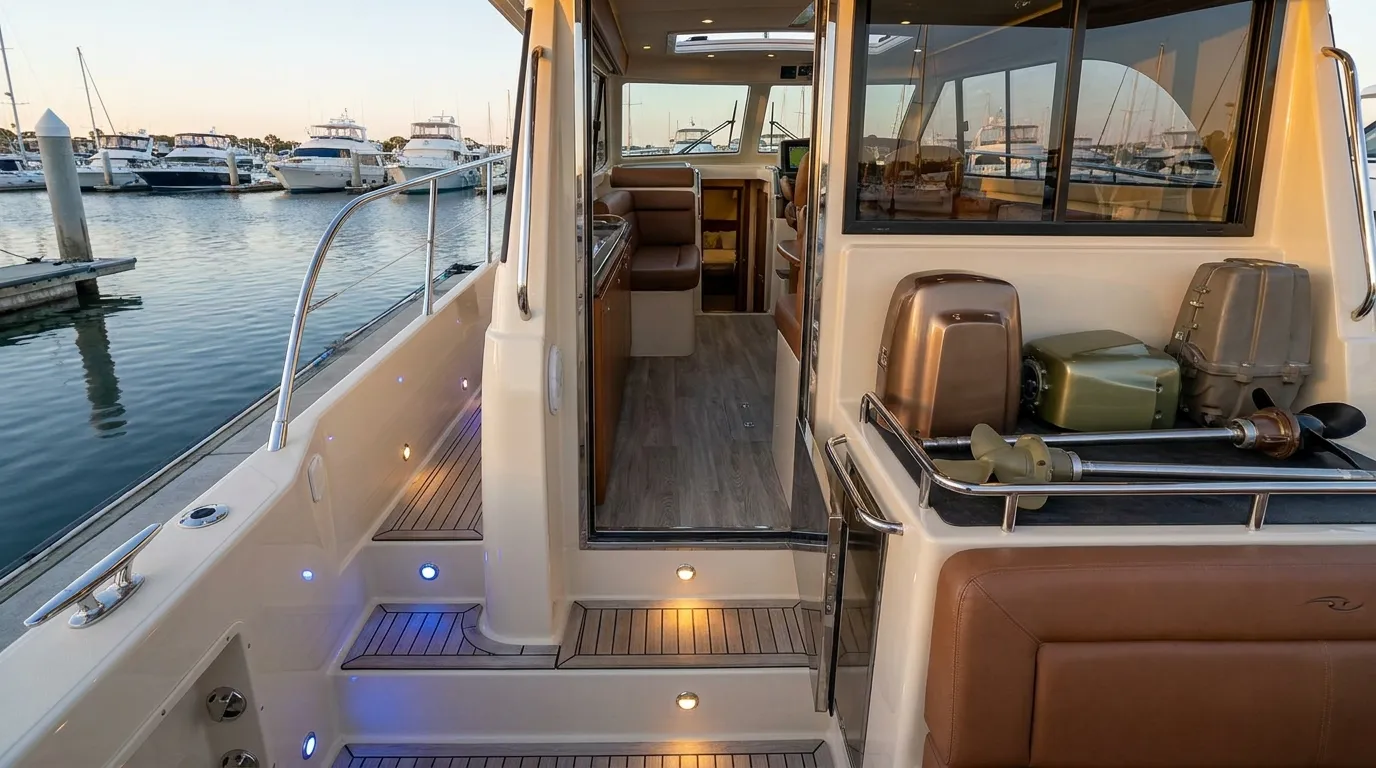
Courtesy lights are low-level lights for walkways, steps, under gunwales, and cabin entries, where people move around most. They’re made for safe movement rather than lighting the whole area. Very low-draw LEDs work very well here, since these lights may need to stay on for long periods.
Underwater lights
During a retrofit, underwater lights can quietly become big power hogs (they sneak up on you). They look great, and on some fishing setups they can attract bait, but high-output models can add a lot of load quickly. Before adding several fixtures across the transom, check the total wattage.
Navigation lights
Navigation lights are safety gear, not accent lights. For powered boats under 12 meters, the usual setup is a 360-degree all-around white light visible for 2 miles, plus red and green sidelights covering 112.5 degrees and visible for 1 mile. Pretty simple.
For boats from 12 to 20 meters, the setup changes to a 225-degree masthead light and a 135-degree stern light. Different layout, same basic purpose, and both lights need to be visible for 2 miles. For more details on care and inspection, see Marine Electrical System Maintenance: Complete Boater Guide.
How to keep from overloading your marine electrical system
Before you wire anything, put your boat lighting plan on paper (it really doesn’t need much). It doesn’t have to be complicated. For most small and mid-size boats, a simple checklist is enough (pretty simple, honestly).
Step 1: List every light you want to add
Write down each fixture, its wattage, and where it will go. Put navigation lights on their own line, they matter for compliance.
Step 2: Convert watts to amps
Use the formula amps = watts ÷ volts. In a 12V system, 12 watts equals 1 amp, which makes the math simple. In a 24V system, that same light draws half the current, so don’t miss that.
Step 3: Group lights by circuit
Don’t add up the whole boat all at once. Group the lights by switch or breaker instead. One circuit may run deck lights, another may handle courtesy lights, and underwater lights may be on their own circuit, which matters here.
Step 4: Add reserve margin
Keep 10% to 20% headroom above the expected load. If a circuit draws 4 amps, plan for about 4.4 to 4.8 amps of capacity. That extra room gives a helpful buffer.
Step 5: Check battery and charging ability
The circuit may be safe, but the battery bank can still have a hard time if the lights stay on for hours while you’re anchored (that adds up fast). You’ll see it even more on fishing boats, where electronics, livewells, trolling motors, and pumps may all be running at once (and yeah, you’ll notice it).
Step 6: Match fuse, breaker, and wire size
A bright light on wire that’s too small is not much of an upgrade, even if it seems fine at first. The safer move is to follow the light maker’s specs and good marine wiring practice.
People often think LEDs need less planning because they draw less power, and that is a common mistake. They do use less than halogen, but several high-output LED fixtures on the same setup can still overload a small circuit, so it still needs the right size.
Navigation lights need compliance, not guesswork
Some boat owners will spend hours picking an underwater light color, then give almost no attention to navigation light standards. That’s the wrong priority. Navigation lights directly affect safety and whether the boat is legal to operate.
A big update for 2025 to 2026 is that the Coast Guard now accepts ABYC C-5 as equal to UL 1104 under Policy Letter 01-25. NMMA also says vessels over 65 feet or 19.8 meters need navigation lights that meet UL 1104 or another approved standard.
The Coast Guard's acceptance gives manufacturers and boat builders a modern way to meet compliance, especially for vessels over 65 feet (19.8 meters) in length.
For most recreational owners, the main point is pretty straightforward: buy navigation lights that clearly show compliance with current marine standards. Avoid mixing random automotive lights into a nav light setup. Also skip painting lenses, and watch where deck hardware goes so it does not block the required arc of visibility. That mistake is easier to make than most people think.
Even a very good LED fixture can become unsafe if it is mounted badly. A bright spotlight aimed over the bow light may reduce visibility, and a trolling motor head, rod holder, or canvas frame can block the side lights. Those issues are easy to miss at the dock and much harder to spot once the boat is already underway in bad weather.
Smart upgrade trends for 2026 boat lighting
The clearest trend in boat lighting upgrades is pretty simple: LED is now the standard choice. One market report says, “LED navigation lights have transitioned from being a premium upgrade to the default choice for new vessels and aircraft.” Another report puts LED technology at about 46% of the total marine lighting market share.
For everyday boaters, that shift is easy to understand. LED systems use less energy, need fewer bulb changes, and hold up better to vibration than older bulbs. It’s a practical upgrade for boats that actually get used. In 2026, many owners are also picking modular upgrades instead of replacing everything at once. Navigation lights usually come first, with courtesy lights added after that. From there, lots of people move on to work or deck lights, and some finish with underwater lighting if the power budget allows it.
Electrical planning is getting more attention as well. Boats carry more accessories than they used to, so owners are paying closer attention to total onboard load. Fish finders, pumps, chargers, trolling motors, and lighting all pull from the same power supply. For a broader troubleshooting view, we covered that in Marine Electrical Systems Troubleshooting Guide.
Installation tips that help boat lighting last longer
A lighting upgrade only pays off if the install is done properly. Salt, spray, vibration, and heat can ruin a cheap wiring job quickly. Marine-grade wire, sealed connectors, proper heat shrink, and corrosion-resistant fixtures all make a real difference. Secure the wiring too, so it does not rub on sharp edges or shake loose over time.
If possible, keep decorative lighting separate from critical circuits. An underwater light failure should not affect navigation lights. Clear switch labels make things easier, and every light should be tested at night, not just in daylight. Night checks make glare, reflections, and blocked angles much easier to catch.
Buying from trusted marine-focused suppliers such as First Choice Marine can also help as you compare parts for onboard systems. The result is not just a brighter boat, but one that is safer and more reliable too.
Frequently Asked Questions
How do I know if my new boat lighting will overload a circuit?
Add up the wattage of all lights on that circuit and divide by system voltage to get amps. Then leave 10% to 20% extra capacity. If the total is close to the fuse, breaker, or wire limit, the circuit needs to be redesigned.
Are LED boat lighting upgrades always better than halogen?
For most boats, yes. LEDs usually use far less power, last much longer, and handle vibration better. The key is choosing marine-rated fixtures with proper sealing and compliance where required.
Do underwater lights use more power than courtesy lights?
Usually, yes by a wide margin. Courtesy lights are often very low draw, while high-output underwater lights can add several amps each. That is why underwater lighting should always be included in your load plan.
Can I install navigation lights anywhere they fit?
No. Navigation lights must meet visibility angle and distance requirements, and their light output cannot be blocked by boat hardware or glare from other lights. Placement matters as much as the fixture itself.
Should navigation lights and accent lights be on the same switch?
That is not a good idea. Navigation lights are required safety equipment, while accent lights are optional. Keeping them on separate switches and circuits makes operation safer and troubleshooting easier.
Put your boat lighting plan to work
The best boat lighting upgrades in 2026 need to handle two things at the same time: better visibility and safety, without putting extra strain on the marine electrical system. Start with the lights that matter most: navigation lights for compliance, courtesy lights to make moving around safer, deck lights for real work, and underwater lighting as a luxury load that needs careful measuring instead of being the first priority for sizing. That keeps power focused where it counts.
Before buying anything, list every fixture, add up the watts, convert that number to amps, and check each circuit with some reserve margin. It’s a small step that helps a lot. Then confirm battery capacity, charging support, fuse size, breaker size, and wire condition (yes, all of it). Doing that early can help you avoid dead batteries, flickering lights, or having to rewire halfway through the season.
Good boat lighting isn’t about packing in the most fixtures. It comes down to choosing the right ones and wiring them with a plan. The boat will be safer, easier to use at night, and better ready for the seasons ahead. It’s simple enough, and still worth getting right.
