


A small part can cause a big engine problem, especially with marine thermostats. When one stops working the way it should, the engine may run too hot, too cold, or never stay in the right operating range. Bad news. That can lead to poor fuel burn, extra wear, weak performance, and in serious cases, engine damage that can ruin a day on the water.
A lot of boat owners overlook this part because it sits quietly inside the cooling system. Even so, marine thermostats have an important role in engine care, safety, and reliability. They help the engine warm up at the right pace, then keep it in the proper temperature range while you cruise, fish, or work. Small part. Big job.
This guide explains what marine thermostats do, why they matter, how to spot trouble early, and how to maintain them with confidence. It also covers basic testing and replacement intervals for outboards and marine diesels, along with simple upkeep habits that can help you avoid overheating and costly repairs. If you like handling marine maintenance, marine thermostats are one system worth understanding clearly.
What Marine Thermostats Actually Do
Marine thermostats control engine temperature by opening and closing as the engine warms up. When the engine is cold, the thermostat stays shut. That holds back cooling flow so the engine can warm up faster. Once it hits its target temperature, the thermostat opens and lets more coolant or water move through the system.
If an engine runs too cold, it can burn fuel poorly and begin building up deposits. If it runs too hot, the problems get worse: wear, warped parts, and even full overheating alarms. Many marine thermostats start opening at around 180°F or 82°C, although the exact spec depends on the engine maker and model.
Market data shows why temperature-control parts are getting more attention. The thermostat market is estimated at USD 6.8 billion in 2025 and USD 7.6 billion in 2026. The marine temperature sensor market is projected at USD 251 million in 2025, with growing focus on temperature monitoring and preventive maintenance across marine systems helping support that growth.
| Data Point | Value | Why It Matters |
|---|---|---|
| Global thermostat market | USD 6.8B in 2025 | Shows strong demand for temperature control parts |
| Global thermostat market | USD 7.6B in 2026 | Growing focus on efficient thermal management |
| Marine temperature sensor market | USD 251M in 2025 | Marine systems rely more on temperature monitoring |
In real boating terms, the thermostat helps the engine reach a healthy warm-up point before hard use. Service guidance for marine diesels says engines should generally reach about 120°F or 49°C before operators really push them hard. A healthy thermostat supports performance and helps protect engine life.
Why Marine Thermostats Fail and What It Looks Like on the Water
Marine conditions are rough, which is why thermostat failures are so common. Saltwater, scale, corrosion, debris, and plain old age can make a thermostat stick open or stick closed. Even on freshwater boats, mineral buildup can slowly turn into a problem over time. In saltwater use, the risk is higher, and it can show up faster.
When a thermostat sticks open, an engine can run too cool. You might notice slow warmup, weak heater performance on enclosed vessels, rough idle during cold starts, or lower fuel efficiency. The engine never really settles into its ideal temperature range, so combustion may be less complete.
If a thermostat sticks closed, things are more serious. Restricted cooling flow lets temperature rise fast, and common warning signs include a climbing temp gauge, overheat alarms, steam, reduced power, or an engine that feels hot much earlier than normal, sometimes very quickly.
Some symptoms can look a lot like other cooling issues, so proper diagnosis matters. A clogged intake, a bad impeller, blocked passages, or even a sensor problem can also cause overheating. Marine thermostats are still one of the first checkpoints in many service guides. They fail enough to deserve attention.
Watch for patterns instead of relying too much on a single reading. If your engine has started warming up much slower than normal, or it begins overheating after years of stable operation, the thermostat deserves a close inspection. Cooling system care also connects with other onboard systems. If you’re building a stronger full-boat maintenance routine, Demystifying Marine Electrical Systems: Maintenance and Troubleshooting is another helpful place to start. Alarms, gauges, and sensors all depend on solid electrical health.
How to Inspect, Test, and Replace a Marine Thermostat
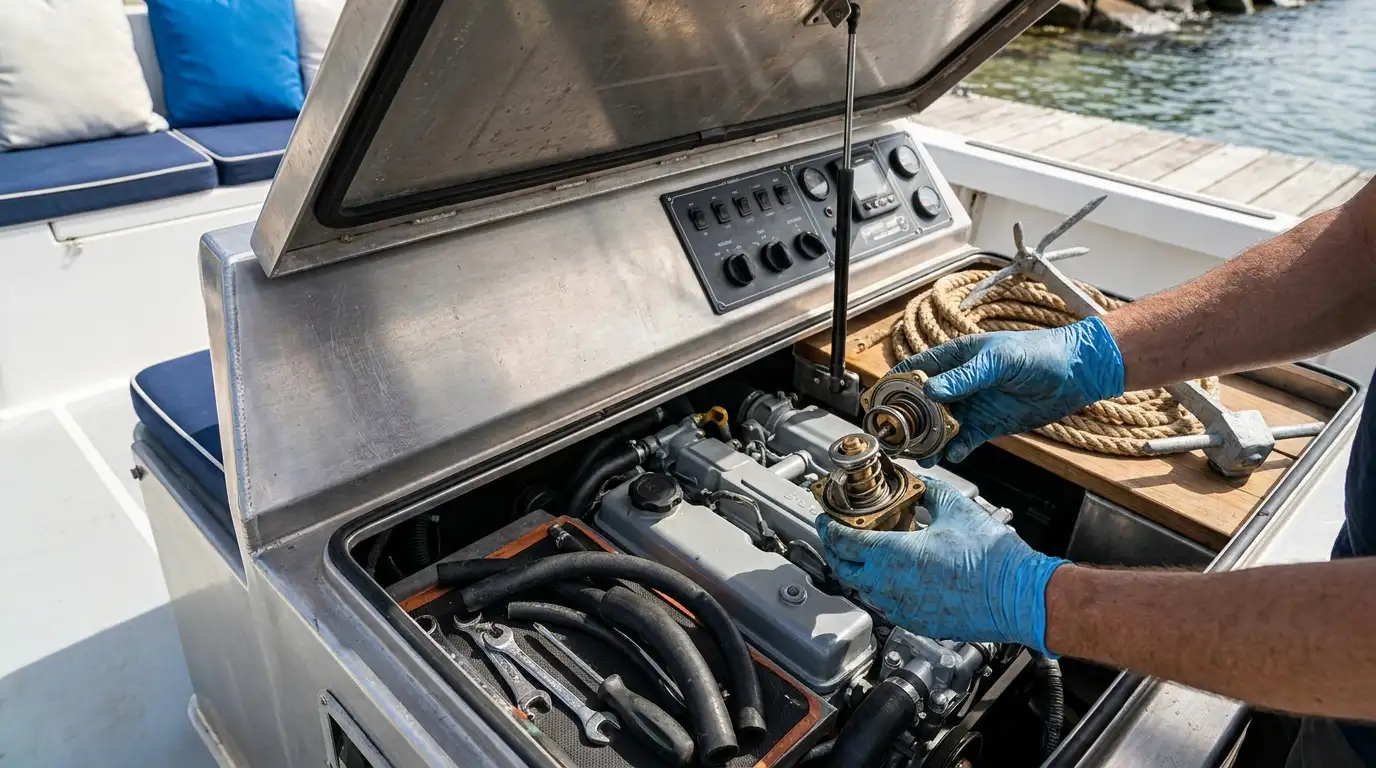
For many DIY boat owners, thermostat service is manageable if they work carefully and follow the engine manual. First, let the engine cool all the way down before starting. Don’t rush. Shut off power, close any needed water feeds, and get the right gasket, thermostat, and tools ready before opening the housing.
Remove the housing and inspect the old thermostat and the area around it. Look for white scale, rust, salt crust, pitting, damaged gasket surfaces, and small bits of debris. These are warning signs. If the housing has heavy corrosion, changing only the thermostat may not fix the problem.
Many people do a simple bench test with hot water. Service guidance says to test thermostat function in water between 70, 85°C or 158, 185°F and check whether the valve opens properly and reaches the correct lift for that engine. If it doesn’t open, opens too late, or doesn’t move far enough, replace it.
| Task | Recommended Range | Typical Use |
|---|---|---|
| Bench test water temperature | 70-85°C | Checks opening action |
| Bench test water temperature | 158-185°F | Same test in Fahrenheit |
| Typical opening point | Around 180°F | Varies by engine spec |
To install the new unit, clean the housing surfaces gently, place the thermostat in the correct position, and fit a fresh gasket or seal. Use the specified temperature rating. Marine thermostats need to match the engine specification because the wrong one can cause poor warmup or repeated overheating, even when the part is brand new.
After reassembly, run the engine and watch how the temperature changes. You want to see a steady rise into the normal range, not sharp swings. If you also maintain drive and engine performance parts, Best Practices for Maintaining Marine Propulsion Systems gives useful context on how cooling system health supports the full propulsion setup.
Replacement Timing and Preventive Maintenance Schedules
Engine care has moved toward replacing the thermostat on a schedule instead of waiting for it to fail. Recent service guidance for outboards recommends changing thermostats every 100 hours of operation or once a year, whichever comes first. In many marine diesel setups, service providers suggest replacement every 2 to 3 years. For larger diesel systems, technicians also recommend thermostat inspection every 2,000 to 2,500 running hours or during major overhauls.
That approach makes sense. A thermostat generally costs very little compared with the damage an overheating engine can cause. Planned replacement is usually cheaper than dealing with an emergency repair at the dock or offshore, much cheaper.
Preventive care should also include flushing the cooling system when needed, checking hoses and clamps, inspecting the thermostat housing, and using the right coolant mix in closed systems. Corrosion control matters too, especially on saltwater boats. To help reduce long-term damage around metal parts and cooling passages, read Advanced Techniques for Marine Corrosion Prevention: Protecting Your Investment.
Common Mistakes Boat Owners Make
A few simple mistakes come up again and again. One big one is assuming every overheating issue starts with the water pump. Impellers do fail, but marine thermostats cause plenty of problems too, and they should always be part of the diagnosis.
Another common mistake is reusing old gaskets or overlooking corrosion inside the housing. A new thermostat will not seal properly against damaged surfaces, and installing a part with the wrong temperature rating just because it “fits” can throw the whole system off. It seems minor, but it can have a big effect.
Some boaters remove the thermostat and leave it out during normal use. In an emergency, service advice sometimes notes that taking it out may help a boat limp to the next port if the thermostat sticks closed, but that only works as a short-term fix. The real repair still needs to happen. Running without the correct thermostat can also lead to slow warmup and less efficient operation.
Seasonal changes get forgotten too. During spring recommissioning, after long idle periods, or when salt buildup appears after heavy summer use, cooling issues can start to show. Those are good times to inspect marine thermostats before a small problem turns into something bigger.
Choosing the Right Parts and Building a Smarter Maintenance Routine
Your boat’s thermostat needs to match your engine’s exact spec. That means the correct opening temperature, the right fit, and materials that suit the engine and cooling system design. Not every setup is the same. Outboards, stern drives, and marine diesels all use different arrangements.
It also helps to look beyond a single part. A thermostat works with your impeller, sensors, hoses, coolant, and warning system, so good engine care means keeping the full setup in solid shape. It’s simple, but important. Many DIY boat owners follow a basic seasonal checklist: inspect in spring, keep an eye on things through summer, flush after use when needed, and replace wear parts on schedule. Boat owners updating onboard visibility and safety equipment may also find 2025 Marine Lighting Trends: How LED Technology is Transforming Boating Safety useful alongside regular engine maintenance planning.
When sourcing maintenance parts and boat care items online, First Choice Marine is one example of a resource where boat owners can compare engine care products, maintenance supplies, and related boating gear in one place. Shop by engine spec instead of guessing.
Frequently Asked Questions
How do I know if my marine thermostat is bad?
Common signs include overheating, slow warmup, the engine running too cool, erratic temperature readings, poor fuel efficiency, or alarms. These signs can also point to other cooling system issues, so it is best to inspect the thermostat along with the impeller, passages, and sensors.
How often should marine thermostats be replaced?
For many outboards, service guidance suggests every 100 hours or once a year. For marine diesels, many service providers recommend every 2 to 3 years, with testing or inspection during major overhauls. Always compare that guidance with your engine manual.
Can I test a marine thermostat at home?
Yes, many boat owners do a basic hot-water bench test. The thermostat is placed in heated water and checked to see if it opens at the correct temperature range and moves properly. You still need your engine’s exact spec to know whether the opening point is correct.
Is it safe to run a boat engine without a thermostat?
Only as a short emergency measure to get to a place where proper repairs can be made. Running without a thermostat for normal use can prevent the engine from warming up correctly, which may hurt performance and increase wear over time.
Where can I find the right thermostat and other engine care parts?
The safest approach is to match parts to your engine make and model. Many boat owners use marine parts retailers such as First Choice Marine to compare maintenance parts and related supplies, but the most important step is confirming fit and temperature rating before ordering.
What other maintenance should I do with thermostat service?
Inspect the housing, replace the gasket, check hoses and clamps, and look for corrosion or salt buildup. It is also a good time to review coolant condition in closed systems and inspect nearby electrical connections for gauges or alarms. If your boat depends heavily on battery-powered systems and monitoring, good charging and battery health matter too, and A Beginner’s Guide to Marine Batteries: Selection and Maintenance can help with that side of maintenance.
Keep Your Engine Running in the Right Temperature Zone
Marine thermostats are small, but they do a lot every time your engine starts. They help the engine warm up the right way, keep the operating temperature steady, and protect against damage from running too hot or too cold. It’s a small part, but one that’s worth taking care of.
Know a few basics and you’ll stay ahead of a lot of boat owners. Watch for warning signs. Check for corrosion and buildup, test when needed, and replace thermostats on a schedule instead of waiting for something to go wrong. For outboards, that can mean yearly service. With diesels, that may mean a planned replacement cycle based on time, along with checks during bigger maintenance intervals.
Preventive care can save fuel, protect performance, and reduce the chance of an overheating surprise when you’re far from the dock. If your boat’s cooling system hasn’t been checked in a while, now is a good time to add marine thermostats to the maintenance list.
